How Does a Transfer Case Select Low Range?
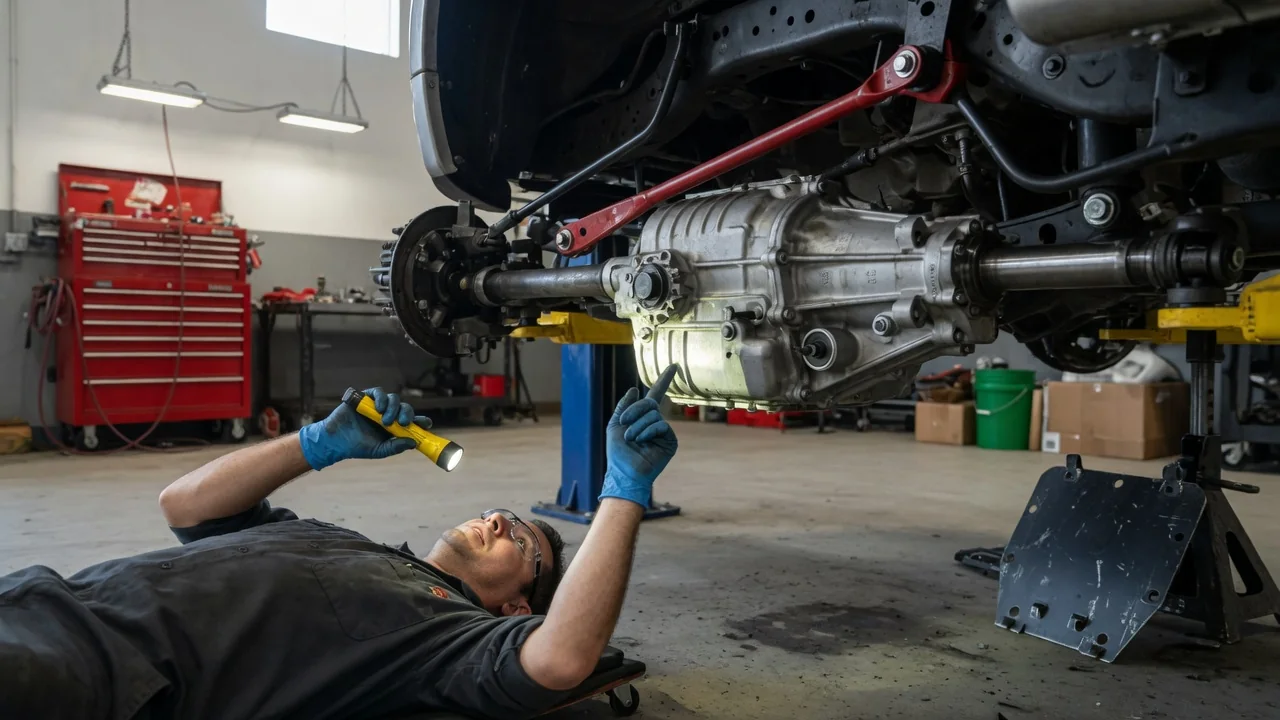
A transfer case with a low range gives a four-wheel-drive vehicle a second, much shorter set of gear ratios for slow, demanding work. Selecting low range is not just flipping a switch on the dash: inside the case, a sliding collar or similar coupling reroutes power through a reduction gearset before it reaches the front and rear driveshafts. Understanding how transfer case low range gears work, how they engage, and where their limits lie helps owners use the feature correctly and avoid driveline damage.
Gear reduction: how low range multiplies torque
Low range works by placing a gear reduction between the transmission output and the transfer case output shafts. In high range, power usually passes through the case at a one-to-one ratio, so the driveshafts turn at the same speed as the transmission output. In low range, the input turns faster than the output, which trades speed for torque. The reduction multiplies every gear in the transmission, so first gear in low range is far slower and stronger than first gear in high range. The exact ratio depends on the transfer case design and is listed in the vehicle's service information rather than being a universal figure.
Two general layouts are common. Many transfer cases use a planetary gearset: the input shaft drives a sun gear, the ring gear around it is held stationary by the case, and the planet carrier becomes the output. Because the carrier rotates more slowly than the sun gear, output speed drops and torque rises. Other designs use an offset countershaft, where the input gear drives a larger gear on a parallel shaft, which in turn drives the output through another gear pair. In either arrangement, the reduction gears are often constantly meshed; selecting low range does not so much bring them into mesh as choose whether the output is driven through them or bypasses them.
Engagement: what physically happens when you shift into low
The selection itself is usually made by a range sleeve, also called a range collar or shift collar. This is a toothed ring that slides along splines on a shaft and can lock to one of two sets of mating teeth. In the high position, the sleeve couples the input directly to the output, or locks the planetary gearset so it rotates as a single unit. In the low position, it breaks that direct path and connects the output to the reduction side, such as the planet carrier. Between the two positions sits neutral, where the sleeve engages neither path and the driveshafts are disconnected from the transmission. A shift fork riding in a groove on the sleeve moves it back and forth.
How the fork is moved varies by vehicle. With a floor-mounted lever, a linkage or shift rail moves the fork directly, and the driver feels the collar slide into place. With electronic selection, a switch or knob signals a control module, which runs an electric motor or actuator. The motor typically rotates a shift cam or drum that converts its rotation into fork movement. The module may refuse or delay the change until certain conditions are met, such as the vehicle being stopped or nearly stopped, the brake applied, and an automatic transmission in neutral. A flashing indicator commonly signals that the shift is in progress or waiting for those conditions.
These conditions exist because a range shift is generally not synchronized the way many transmission gears are. The collar teeth must line up with the mating teeth while both sides turn at matching speeds and are not loaded by engine torque. Putting the transmission in neutral removes driving torque, and stopping or creeping removes the speed difference. If the teeth butt against each other instead of meshing, the shift may hang until the vehicle rolls slightly or the driveline rotates enough to align them. Forcing the change at speed can grind or damage the collar and gear teeth.
Usage boundary: when low range belongs and when it does not
Low range is meant for slow, controlled driving where high torque at the wheels matters more than speed. Typical situations include climbing or descending steep, loose grades, crawling over rocks or ledges, working through deep sand, mud or snow at walking pace, and moving a heavy trailer or boat up a slippery ramp. On descents, the reduction strengthens engine braking, helping the vehicle hold a slow, steady speed with less reliance on the service brakes. In all of these cases, the goal is fine throttle control and steady traction rather than momentum.
Low range is not for normal road driving. Because of the reduction, engine speed climbs quickly as road speed builds, and the owner's manual typically sets a recommended maximum speed in low that varies by vehicle. In many part-time systems, low range is available only with the front and rear driveshafts locked together, so using it on dry pavement causes driveline binding in turns, known as windup, because the front and rear axles cannot turn at different speeds. Some full-time systems with a center differential handle this differently, which is why the specific vehicle's instructions decide where low range is acceptable.
Practical implications and limits
The torque multiplication that makes low range useful also raises the load on everything downstream of the transfer case. Driveshafts, universal joints, front axle CV joints, axle shafts and differential gears all see higher torque than they would in high range. The most damaging moment is often when a spinning wheel suddenly regains grip, or when the front wheels are turned sharply under heavy load, which strains the CV joints at a steep angle. Smooth throttle, avoiding wheel spin, and straightening the wheels before applying significant power reduce the risk of breaking a joint or shaft.
Owners should also confirm that the shift has actually completed. An indicator that keeps flashing, a lever that will not seat fully, grinding during engagement, or a case that slips out of low under load can point to misaligned teeth, a worn collar or fork, a linkage or actuator problem, or fluid condition that warrants inspection. Neutral deserves particular care: with the transfer case in neutral, the wheels are disconnected from the transmission, so the vehicle can roll even when an automatic transmission is in Park unless the parking brake is set. That position is intended for specific purposes, such as flat towing on vehicles designed for it.
The general mechanism described here does not settle vehicle-specific details. Shift procedures, permitted speeds in low, whether low range works with an open center differential, and transfer case fluid intervals differ between designs, so the owner's manual and factory service information remain the authority for any particular vehicle.