How Does a Thermostat Open as an Engine Warms?
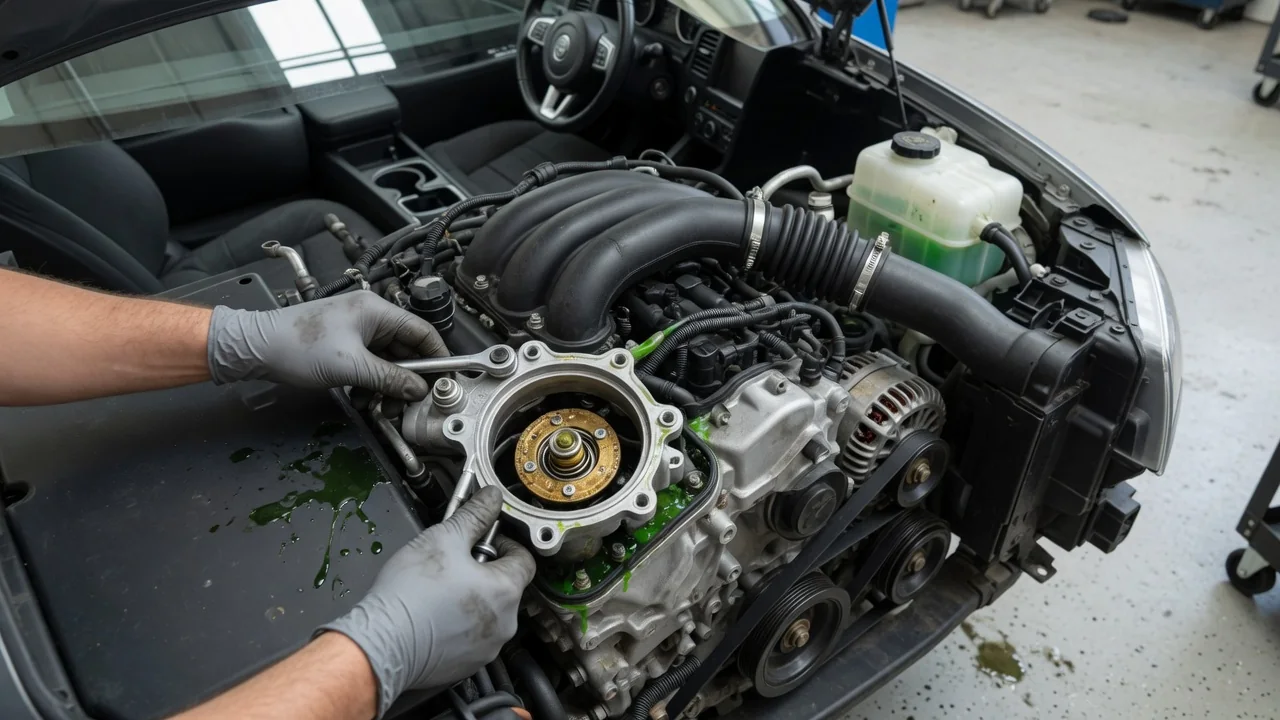
A car thermostat is a small valve with a big job. It keeps coolant away from the radiator until the engine is warm enough, then opens gradually to hold temperature in a steady band. Knowing how a thermostat opens as an engine warms explains why warm-up time, heater output and the temperature gauge behave the way they do. It also helps you recognize when the part is no longer working correctly.
Wax Element: What Actually Moves the Valve
Most conventional automotive thermostats need no electricity or engine computer to work. Their motion comes from a wax pellet sealed inside a small metal cup, usually copper or brass because those metals conduct heat well. The wax is a blend formulated to melt over a narrow temperature range that matches the thermostat's rated opening point. Below that range, the wax is solid and compact. As the surrounding coolant heats the cup, the wax begins to melt and expands noticeably in volume. Because the cup is sealed, that expansion has nowhere to go except against a flexible rubber diaphragm or boot that surrounds a small steel pin.
The pin is anchored against the thermostat frame. When the expanding wax squeezes the boot, the force pushes the cup and the attached valve away from its seat rather than moving the pin. A coil spring opposes this motion and holds the valve closed while the wax is solid, so opening is a contest between wax expansion and spring force. The wax melts progressively rather than all at once, which means the valve does not snap open. It lifts slightly at the start of the range and further as temperature rises, until it reaches full travel. When the coolant cools, the wax contracts and the spring pushes the valve back toward its seat.
Some newer engines use an electronically assisted version. A small heating element inside the wax pellet lets the engine control module open the valve earlier than coolant temperature alone would. The wax-and-spring principle stays the same, but the opening point can shift with operating conditions.
Coolant Flow Before and After the Thermostat Opens
With a cold engine, the water pump still circulates coolant whenever the engine runs. The closed thermostat simply blocks the route to the radiator. Coolant moves through the block and cylinder head and returns to the pump through a bypass passage, and in many designs it also passes through the heater core. Keeping the radiator out of the loop means the engine sheds less heat, so the combustion chambers, oil and cylinder walls reach working temperature sooner. Many thermostats also have a small bleed hole or jiggle valve that lets trapped air escape and allows a trickle of flow even when closed.
Once the wax begins to expand, the valve opens a path to the radiator. Hot coolant leaves the engine, gives up heat as air passes through the radiator core, and returns cooler to the pump. Some thermostats carry a second, smaller valve that closes the bypass as the main valve opens, sending more coolant through the radiator instead of around it. Location matters as well. Many engines place the thermostat at the coolant outlet. Others put it on the inlet side, where it senses the mix of cooled radiator coolant and engine coolant entering the pump, which can smooth out temperature swings.
In normal driving, the thermostat rarely sits fully open or fully closed. It settles at a partial opening that balances the heat the engine produces against the heat the radiator can reject. On a long climb or while towing, more heat reaches the wax and the valve opens further. Coasting on a cold day, it partly closes again. This continuous adjustment is what lets a healthy cooling system hold a fairly steady temperature under changing loads.
Failure Signs of a Thermostat That Will Not Open or Close
Thermostats commonly fail in one of two directions. A valve that is stuck open, or one that never fully seats, lets coolant reach the radiator too early. The engine then warms slowly or never reaches its normal operating temperature, especially in cold weather or at highway speed, when airflow through the radiator is strong. Typical clues include a temperature gauge that reads lower than usual, weak or lukewarm heater output, and possibly reduced fuel economy because the engine management system keeps adding warm-up fuel for longer. Many vehicles with onboard diagnostics can also store a fault code when coolant temperature stays below the expected regulating temperature. The generic OBD-II code P0128 describes this condition.
A valve stuck closed is more serious, because it blocks the main path for heat to leave the engine. Temperature can climb quickly after a cold start, the gauge may move toward the hot zone, and coolant may boil over into the reservoir. Another possible sign is an upper radiator hose that stays relatively cool while the engine is clearly hot, because heated coolant is not reaching it. A thermostat that sticks intermittently or opens sluggishly can make the gauge rise, drop suddenly and then repeat the cycle, as the valve finally releases a slug of hot coolant.
None of these signs is unique to the thermostat. Low coolant, air pockets, a weak water pump, a failed cooling fan, a clogged radiator, a faulty temperature sensor or a gauge problem can produce similar symptoms. Overheating can also point to internal engine problems. The symptoms suggest where to look but do not confirm the cause on their own.
Practical Implications and Limits
Because car thermostat opening depends on heat reaching the wax, warm-up time varies with outside temperature, idling versus driving, and engine load. A long warm-up on a frigid morning or during short trips is not automatically a fault. Many dashboard gauges are also buffered so the needle holds steady across a range of normal temperatures, which means small changes in thermostat behavior may not show until the problem is significant. Where available, a scan tool reading live coolant temperature gives a clearer picture than the gauge alone.
When a replacement is needed, the opening temperature and design should match the manufacturer's specification for that engine. A different rating can change warm-up, emissions control behavior and heater performance. Removing the thermostat entirely is not a fix, because the engine loses its temperature control, and some systems rely on the thermostat to direct flow correctly. After cooling system work, air usually has to be bled out following the procedure for that vehicle, since trapped air can mimic a thermostat that will not open.
Safety and scope also matter. A cooling system at operating temperature is under pressure, so the radiator or reservoir cap should not be opened while hot. Reaching near fans and belts also carries risk. This explanation covers the general wax-element mechanism shared by most engines. Exact opening temperatures, thermostat location, bypass arrangement, electronic control strategy and service steps differ between vehicles, and the service manual for the specific model is the reliable reference for those details.