How Does a Radiator Release Heat? Coolant Path, Airflow, and Fan Support Explained
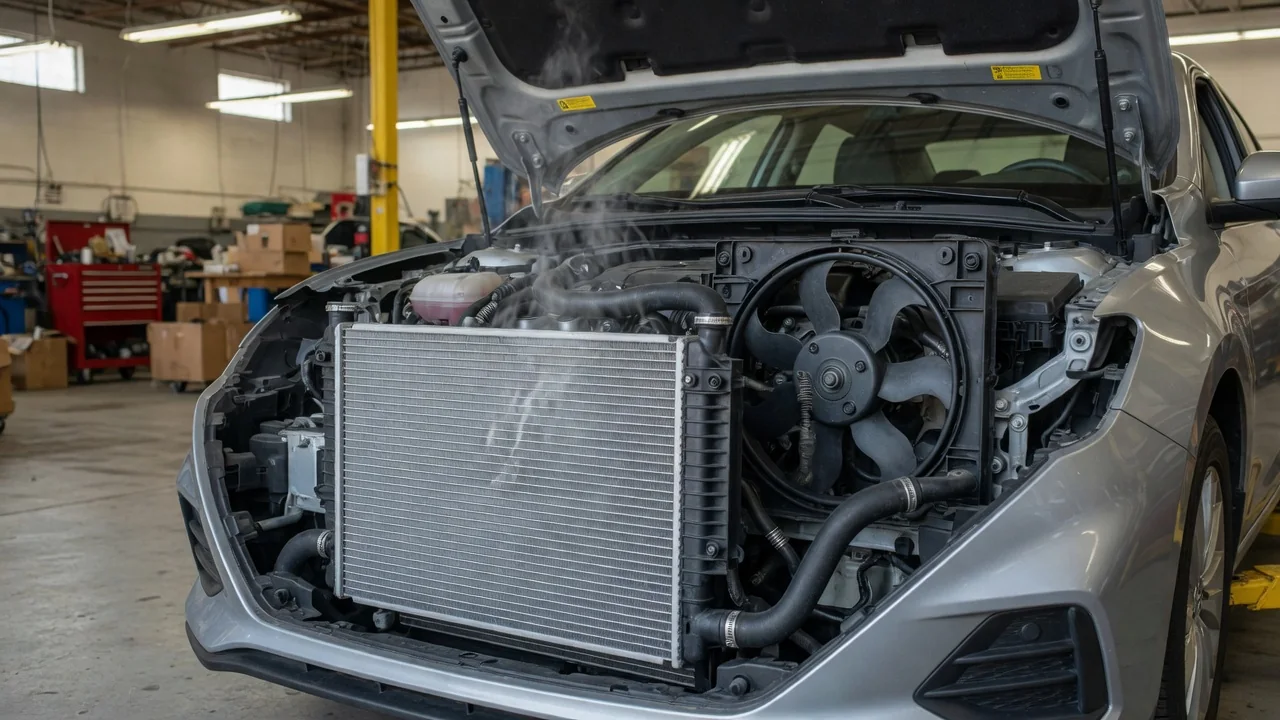
A car radiator releases heat by passing hot coolant through thin tubes surrounded by metal fins, then letting air carry that heat away. Despite the name, very little of the work is done by radiation. Most car radiator heat transfer happens by conduction into the metal and convection into the passing air. The coolant path, the airflow through the core, and the cooling fan that fills the gaps explain why a radiator copes well on the highway and why problems often appear first in traffic.
Coolant path
The heat starts in the engine. Combustion heats the cylinder walls and cylinder head, and coolant, usually a mix of water and antifreeze, flows through passages around them and absorbs that heat. A water pump keeps the coolant moving. On most engines a belt drives the pump, while some designs use an electric pump. When the engine is cold, the thermostat stays closed and the coolant circulates inside the engine without going to the radiator, so the engine warms up faster. Once the coolant reaches the thermostat's opening temperature, the valve opens and hot coolant flows through the upper hose to the radiator.
Inside the radiator, coolant enters an inlet tank and spreads into many small, flat tubes that make up the core. In a downflow design the coolant travels from a top tank to a bottom tank. In a crossflow design it moves sideways between tanks at each end. As the coolant moves through the tubes, heat passes through the tube walls into the thin fins attached to them. Modern radiators commonly use aluminum, and older designs often used copper and brass. Both conduct heat well. Because the tubes are narrow, a lot of metal surface touches a small amount of coolant, so heat leaves quickly. The cooled coolant collects in the outlet tank and returns to the pump through the lower hose to repeat the loop.
The system is sealed and pressurized by a cap on the radiator or on a separate expansion tank. Higher pressure raises the boiling point of the coolant, so it can run hotter than plain water at atmospheric pressure without boiling. This matters for heat release. A larger temperature difference between the coolant and the outside air makes heat move faster, so a pressurized system can shed more heat through the same core. A reservoir absorbs the volume change as coolant expands and contracts. The actual cap pressure and thermostat opening temperature vary by vehicle and are listed in the service information for that model.
Airflow
Heat moved into the fins only helps if something carries it away, and that job belongs to air. As air passes between the fins it picks up heat by convection and leaves the core warmer than it arrived. The fins are very thin and closely spaced, and they are often louvered. This multiplies the surface area exposed to the air and breaks up the airflow so more of it actually touches the metal. How much heat the radiator releases depends mainly on three things: how much air moves through the core, how much hotter the fins are than the incoming air, and how clean the surfaces are on both sides.
When the car is moving, forward speed pushes air through the grille and into the core, which is often called ram air. The front of the vehicle is shaped to guide that air. Grille openings, air dams, ducts and seals around the radiator help keep air from slipping around the core instead of going through it. On many vehicles other heat exchangers sit in the same airstream, most often the air conditioning condenser mounted ahead of the radiator. When the AC is running, the air reaching the radiator has already been warmed by the condenser, which leaves the radiator less cooling margin. Some vehicles also use active grille shutters that close to reduce drag when less cooling is needed and open when the system calls for more air.
Air also needs somewhere to go after it leaves the core. It exits into the engine compartment and escapes underneath the vehicle, so anything that restricts this exit path reduces flow through the radiator. Outside air temperature matters too. On a hot day the gap between fin temperature and air temperature shrinks, and each volume of air carries away less heat. The system then needs more airflow or a hotter coolant to keep up.
Fan support
At idle or crawling speed there is little or no ram air, so the radiator needs help. A cooling fan provides it by pulling air through the core, or pushing it through in some layouts. A shroud usually surrounds the fan so that it draws air across the whole face of the radiator instead of just churning air around its own blades. Without an effective shroud, much of the fan's effort can be wasted and the outer areas of the core may get little flow.
There are two general fan types. Engine-driven mechanical fans are common where the engine sits lengthwise, as in many trucks and rear-wheel-drive vehicles. These usually use a viscous clutch that slips when the air coming off the radiator is cool and engages more firmly as that air gets hotter, so the fan only works hard when needed. Electric fans are common on front-wheel-drive vehicles with transverse engines. The engine control system or a temperature switch turns them on based on coolant temperature, and often also when the air conditioning is running. Some vehicles use two fans or fans with more than one speed to match cooling output to demand.
At steady highway speed the fan often contributes little, and an electric fan may stay off entirely because ram air already supplies enough flow. The fan supplements the natural airflow rather than replacing it. On some vehicles an electric fan may keep running briefly after the engine is shut off to remove residual heat. Where the design does this, it is normal behavior and not a fault.
Practical implications and limits
Knowing how the parts share the work helps you read symptoms. If the temperature gauge climbs while idling or in stop-and-go traffic but settles once the car is moving, the problem often lies in low-speed airflow, such as a fan that isn't switching on, a worn fan clutch or a damaged shroud. If the engine runs hot mainly under sustained load at speed, the coolant side or the core's capacity is a more likely suspect, for example low coolant, a sticking thermostat, a weak pump or internal restriction. These patterns are general clues, not a diagnosis, and a proper inspection should confirm the cause.
Maintenance affects both halves of the heat transfer process. On the outside, insects, leaves and dirt can pack the gap between the condenser and radiator, and bent fins reduce usable surface area. On the inside, neglected coolant can lose its corrosion protection and leave deposits that narrow the tubes. Using the coolant type specified for the vehicle, at the correct mix, protects the metal and keeps boiling and freezing points where the system expects them. Air trapped in the system after a coolant change can block circulation, which is why many vehicles have a specific bleeding procedure.
Every radiator is sized for the vehicle's expected operating conditions, and heavy loads reduce the remaining margin. Towing, long climbs and very hot weather all push the system closer to its limit. In an emergency, running the cabin heater at full heat and fan speed can shed some extra heat, because the heater core works like a small radiator. Never open a radiator or reservoir cap while the system is hot, since pressurized coolant can spray out and cause burns. Gauge behavior, fan schedules and service intervals differ between vehicles, so the owner's manual remains the reference for any specific car.