How Does a Halogen Car Bulb Work? Filament, Halogen Cycle and Heat
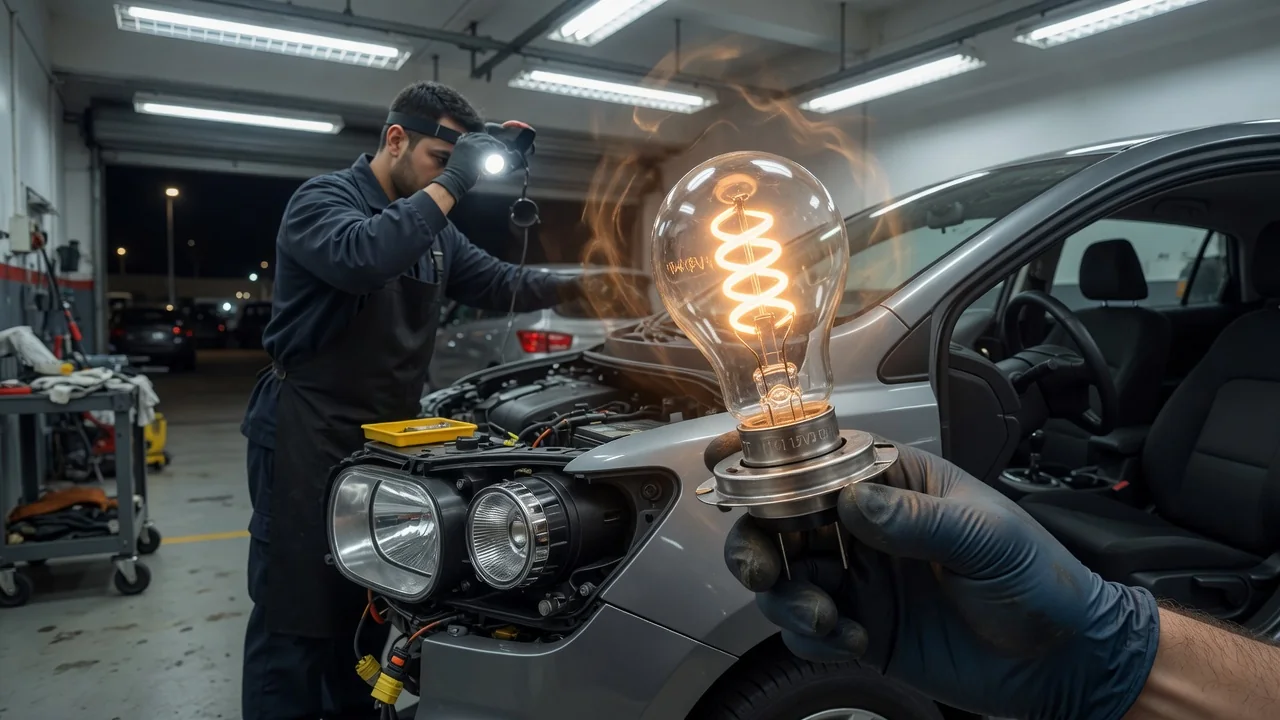
Halogen bulbs remain one of the most common light sources in car headlights, fog lights and other exterior lamps. Their basic principle is simple: electric current heats a thin tungsten wire until it glows. What sets a halogen bulb apart from an ordinary incandescent lamp is the gas sealed around that wire and the chemical cycle it supports. Halogen headlight bulb operation comes down to three things: the filament, the halogen cycle and heat.
Filament: Where the Light Comes From
At the center of every halogen car bulb is a filament made of tungsten. Engineers use tungsten because it has the highest melting point of any metal and keeps its strength at extreme temperatures. When the headlight switch closes the circuit, current from the vehicle's electrical system flows through the filament. Tungsten resists that flow, and the resistance converts electrical energy into heat. Once the wire is hot enough, it glows brightly, a process called incandescence. The hotter the filament runs, the whiter the light becomes and the more of its output falls in the visible part of the spectrum.
The filament is usually wound into a tight coil, and sometimes into a coil of coils, so that a long length of wire fits into a very small space. That compact shape matters for automotive use. Headlight reflectors and projector lenses are designed around a light source of a specific size located at a precise point, so the filament's dimensions and position inside the bulb are tightly controlled. Some bulbs carry two filaments, one for low beam and one for high beam, with a small shield beside the low-beam filament to block light that would otherwise go upward toward oncoming drivers. Tungsten's electrical resistance also rises sharply as it heats, so a cold filament draws a brief surge of current at switch-on before settling to its normal operating level.
Halogen Cycle: How the Bulb Renews Its Filament
Any glowing tungsten filament slowly loses material. At operating temperature, tungsten atoms evaporate from the surface of the wire. In a conventional incandescent bulb, those atoms travel to the glass and condense there, gradually darkening the bulb and thinning the filament until it breaks. A halogen bulb is instead filled with an inert gas under pressure together with a small amount of a halogen, typically a compound of bromine or iodine. The pressurized fill gas slows evaporation, and the halogen changes what happens to the tungsten that does escape.
Near the bulb wall, where the temperature is lower than at the filament but still very high, evaporated tungsten combines with the halogen to form a gaseous tungsten halide compound. Because this compound stays in vapor form rather than sticking to the glass, the wall stays clear. When the compound drifts back to the extremely hot filament, it breaks apart. The tungsten is deposited back onto the filament and the halogen is released to repeat the process. This loop is known as the halogen cycle, sometimes called the halogen regenerative cycle.
The cycle does not make the filament last forever. Tungsten rarely returns to exactly the spot it left, so thin areas and hot spots still develop over time, and the filament eventually fails. What the cycle does is keep the envelope from blackening and allow the filament to run hotter than it could in an ordinary bulb, which yields whiter, brighter light for its size while maintaining a useful service life.
Heat: Why Halogen Bulbs Run So Hot
Heat is both the source of a halogen bulb's light and its main byproduct. Only a small share of the electrical energy a filament consumes becomes visible light; most is radiated as infrared energy and heat. The halogen cycle also depends on heat in a specific way: the bulb wall must stay hot enough for the tungsten halide to remain a gas. If the wall ran cool, tungsten would deposit on it just as it does in a standard incandescent lamp. This is why halogen bulbs use a small, tight envelope placed close to the filament, made of quartz or a heat-resistant hard glass rather than ordinary glass.
The compact envelope reaches temperatures high enough to cause burns and to stress nearby materials, so headlamp assemblies are designed to manage that heat through housing materials, venting and the bulb's mounting base. The hot quartz or hard glass is also sensitive to contamination. Oils and residue from skin can create localized hot spots on the surface, which may weaken or cloud the envelope and contribute to early failure. For that reason, bulb makers generally advise handling a new halogen bulb by its base or with clean gloves, and cleaning the glass with an appropriate solvent if it is touched.
Practical Implications and Limits
Because a halogen bulb's light depends on filament temperature, it is sensitive to the voltage it receives. Higher-than-normal voltage makes the filament hotter and brighter but speeds evaporation and shortens life. Low voltage, caused for example by corroded connectors, poor grounds or worn wiring, makes the light dimmer and yellower and can leave the bulb too cool for the halogen cycle to work as intended. When headlights seem weak, checking connections and the charging system is often as relevant as checking the bulb itself. The same physics explains why bulbs marketed for extra brightness or whiter light commonly trade away some service life: getting more from the filament usually means running it harder.
Most halogen failures are filament breaks. The filament is most vulnerable at switch-on, when the cold-current surge stresses its thinnest points, and while hot, when the metal is softer and more affected by vibration and shock. Gradual dimming over a bulb's life is also normal, since the filament thins even with the halogen cycle at work. Many owners replace headlight bulbs in pairs so that both sides produce similar output and color, though that is a matter of preference rather than a requirement of how the bulb works.
Finally, the general mechanism is the same across halogen bulbs, but how a given vehicle uses them is not. Bulb type, wattage, base design and beam pattern are set by each headlamp's design, and the correct specification is listed in the owner's manual or on the existing bulb. Installing a higher-wattage bulb than the lamp was designed for adds heat that the housing, lens and wiring may not tolerate. Likewise, the reflector or projector is built around the size and position of a filament, so the optical performance of a halogen headlight depends on using the bulb type it was engineered for.