How Does a Fuel Level Sender Work?
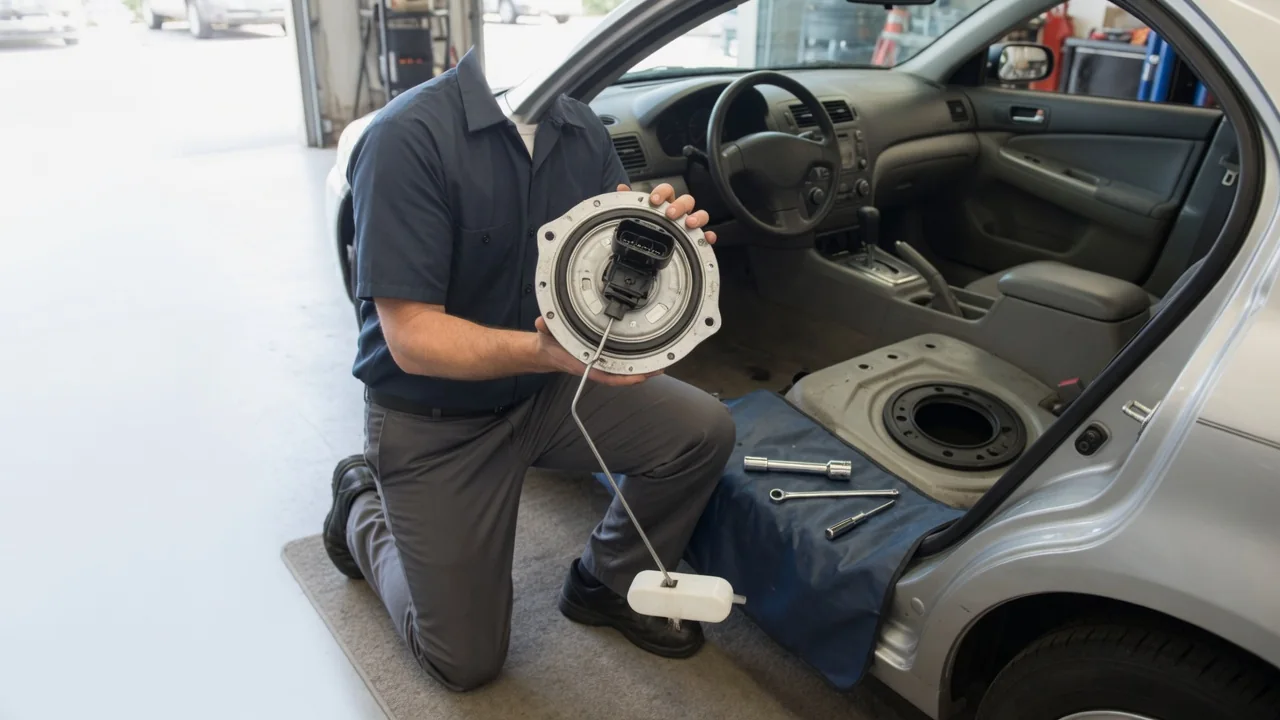
Anyone who has wondered how does a fuel level sender work can start with a simple picture: a float rides on the fuel inside the tank, and its height is turned into an electrical signal the dashboard can display. The details differ between vehicles, but the basic chain from float to sensor to gauge explains most of what drivers see on the instrument panel.
Float and sensor
In the most common design, a buoyant float sits at the end of a pivoting metal arm inside the tank. As fuel is burned, the float drops and the arm swings downward; after a fill-up, it rises again. The arm's pivot carries a small contact, often called a wiper, that slides across a strip of resistive material. Each float position therefore corresponds to a different electrical resistance, which is the actual signal leaving the tank. The sender itself never measures gallons, only the height of the fuel surface.
On many modern vehicles the sender is built into the fuel pump module, so the float arm, pump and strainer share one assembly lowered through an opening in the top of the tank. Older vehicles frequently use a separate sender unit. Some designs replace the sliding contact with a magnetic or contactless sensor to reduce wear, and vehicles with saddle-shaped tanks may use two senders whose readings are combined. Whether resistance climbs or falls as the tank empties also depends on the manufacturer, so the wiring logic is not universal.
Instrument reading
The gauge translates the sender's signal into needle position or a bar display. In older, simpler systems the sender is wired almost directly to the gauge, and the changing resistance alters the current that moves the needle. In most current vehicles the signal goes first to a control module, which converts it to a fuel level value and passes it to the instrument cluster over the vehicle's data network. The same value typically feeds the low fuel warning and the distance-to-empty estimate shown on the trip computer.
Raw float movement would make a needle swing wildly, because fuel sloshes whenever the vehicle brakes, corners or climbs. To prevent that, the reading is deliberately damped, either mechanically within the gauge or through software averaging over time. That is why the display responds slowly after refueling on some vehicles, sometimes taking a noticeable moment to climb to full. It is also why the needle holds steady through a long curve even though the fuel surface inside the tank has tilted well away from level.
Fault clues
Because the classic sender relies on a contact sliding across a resistive track, wear tends to show up at the float positions used most often. A worn or contaminated spot can make the gauge drop suddenly, flicker or read empty at one particular level, then recover once the float moves past it. A gauge stuck at full or empty regardless of fuel added may point toward an open or shorted circuit, a float that has taken on fuel and sunk, or an arm that is binding or bent.
Those symptoms are clues rather than conclusions. Corroded connectors, a poor ground, damaged wiring or a fault in the instrument cluster can produce the same behavior as a failed sender. Some vehicles store a diagnostic trouble code when the fuel level signal looks implausible, but a code identifies a circuit or reading that needs investigation, not a part proven defective. Code meanings also vary by manufacturer, so they should be confirmed against information specific to the vehicle before anything is replaced.
Everyday Use and Observations
Many drivers notice that the needle lingers near full for a long stretch, then seems to fall faster through the lower half. Part of the explanation is geometry: the float reaches the top of its travel before the tank is completely full, so the first portion of fuel burns off with no float movement. Tank shape matters too, since irregular tanks hold different volumes at different heights. Manufacturers also calibrate the display in various ways, and many leave a reserve below the empty mark, though its size is vehicle specific.
Parking on a steep driveway can shift the reading up or down, because the fuel pools toward one end of the tank and moves the float with it. The gauge usually returns to its previous position after some level driving. Distance-to-empty figures change with driving style as well, since they combine the sender's level reading with recent fuel consumption. A range estimate that jumps after a highway run is normally the calculation updating, not a sign that the sender is misbehaving.
Limits and Next Steps
A fuel level sender is an indicator, not a precision instrument. It reports the height of the float within its range of travel, filtered and scaled for display, so small differences between the gauge and the amount actually pumped at a fill-up are expected. Comparing gauge behavior against trip odometer mileage and fuel receipts over several tanks gives a useful picture of whether the readings are consistent. A gauge that is repeatable but slightly pessimistic is behaving very differently from one that wanders unpredictably.
When the reading becomes erratic or plainly wrong, tracking distance since the last fill-up is a sensible way to avoid running out while the cause is found. Diagnosis usually involves checking the sender's signal against the specifications for that vehicle and inspecting wiring and connections along the circuit. Because reaching the sender means opening the fuel tank, with the fire and vapor hazards that involves, the work is best left to a qualified technician who has the correct service information and equipment.