How Does a Fuel Injector Meter Fuel? Valve Opening, Pulse Timing and Spray
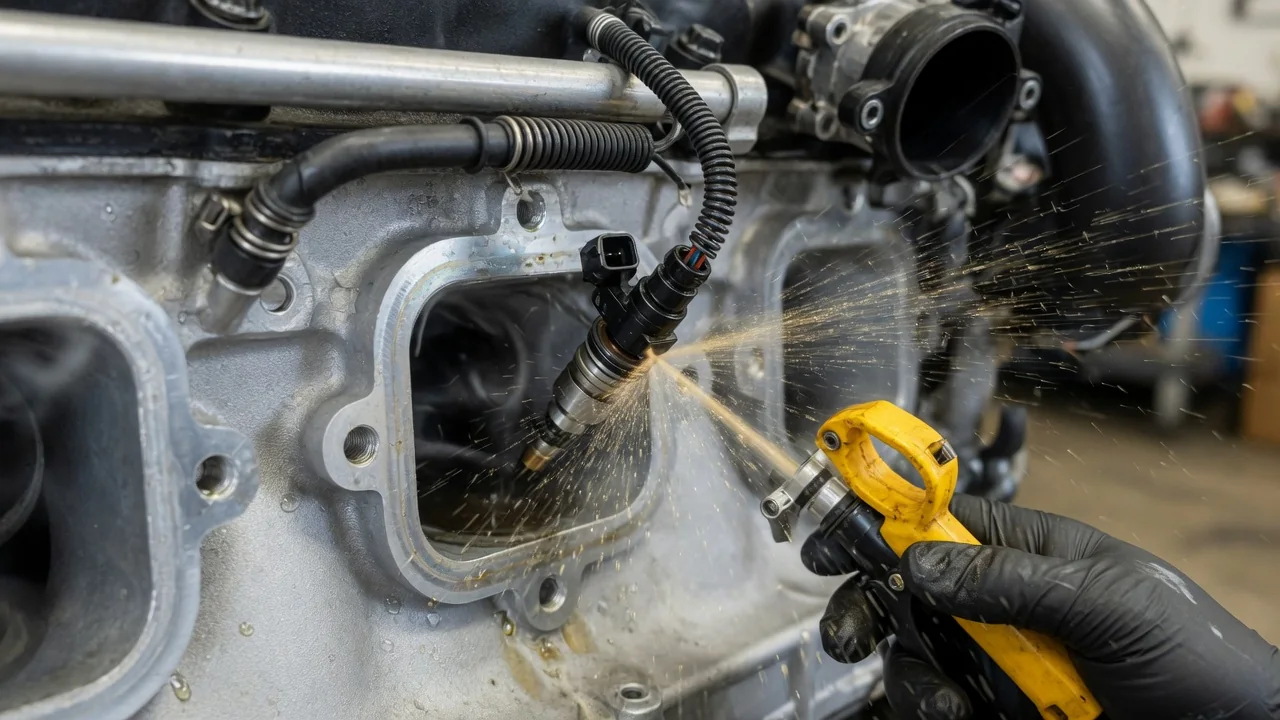
A fuel injector does not measure fuel the way a gauge does. It meters fuel by holding a precisely sized valve open for a calculated length of time while fuel waits behind it at a controlled pressure. The engine control unit decides how much fuel each combustion event needs, and the injector turns that decision into a physical quantity. Understanding how a fuel injector meters fuel comes down to three linked ideas: how the valve opens, how the pulse is timed, and how the spray is formed.
Valve opening
Most gasoline injectors are electrically operated valves. Inside sit a coil, a movable armature carrying a needle, ball or disc, and a return spring. With no current flowing, the spring and fuel pressure hold the valve against its seat. When the engine control unit completes the circuit, current through the coil builds a magnetic field that pulls the armature off the seat, and fuel flows out through one or more small metering holes at the tip. When the current stops, the field collapses and the spring closes the valve. Some direct injection systems use piezoelectric actuators instead of a solenoid, but the principle of an electrically commanded valve is the same.
A conventional injector is essentially an on/off device; it is not designed to open partway to deliver less fuel. While it is open, its flow rate is set mainly by the size of the metering orifices and the pressure difference across the injector, meaning the fuel pressure behind the valve minus the pressure where it sprays. If that difference is predictable, the fuel delivered is roughly proportional to the time the valve stays open. That is why pressure control matters so much. Many port injection systems use a regulator referenced to intake manifold pressure to hold the difference steady, while returnless and direct injection systems typically use a pressure sensor so the control unit can account for actual rail pressure.
Opening and closing are not instantaneous. The magnetic field needs time to build before the needle moves, and the needle needs time to reseat after current is cut. During those transitions the injector delivers fuel at an uneven rate. This lag, often called dead time or injector offset, matters most when the open time is short, and it shapes how the pulse itself is calculated.
Pulse timing
The command that opens the injector is called the pulse, and its duration is the pulse width, usually measured in milliseconds. Fuel injector pulse control starts with an estimate of the air entering each cylinder, taken from a mass airflow sensor or calculated from manifold pressure, engine speed and air temperature. The control unit combines that estimate with a target air-fuel ratio to find the required fuel mass, then converts mass into time using stored injector flow data. Corrections are layered on top: richer mixtures during cold starts and warm-up, extra fuel on sudden acceleration, reduced or cut fuel on deceleration, and closed-loop adjustments from oxygen sensor feedback, reported as short-term and long-term fuel trims.
The control unit also has to correct for the injector's own behavior. Lower supply voltage slows the magnetic build-up, so the opening delay grows when battery or charging voltage drops. Engine calibrations therefore include voltage-dependent offsets added to the calculated pulse width. At very short pulse widths the relationship between time and fuel quantity becomes less linear, because a larger share of the event is spent opening and closing. That is one reason idle and light-load fueling is more sensitive to injector condition than steady cruising.
Timing relative to the engine cycle matters as well as duration. Many port injection engines fire each injector sequentially, timed to that cylinder's intake events, while some older designs fired injectors in groups or all at once. Direct injection engines spray into the combustion chamber, so the control unit can inject during the intake stroke, the compression stroke, or in several smaller injections per cycle. As engine speed rises, the time available per cycle shrinks. The share of that window the injector spends open is its duty cycle; as it approaches fully open, the control unit runs out of room to add fuel precisely.
Spray
Metering decides how much fuel enters the engine, but spray quality decides how much of it burns well. Liquid fuel does not burn efficiently as droplets; it has to evaporate and mix with air first. Injector tips are designed to break the fuel stream into fine droplets and aim them in a specific pattern. Designs range from a single orifice to multi-hole plates that split the flow into several narrow jets. Smaller droplets have more surface area for their volume, so they evaporate faster and support a more even mixture.
Spray targeting depends on the injection layout. In port injection, the injector usually aims at the back of the intake valve or valves, where heat helps vaporize fuel before it enters the cylinder. Some fuel wets the port walls and forms a film that builds and evaporates over time, which is why calibrations include transient compensation for quick throttle changes. In direct injection, fuel enters the cylinder at much higher pressure, and that pressure does much of the atomizing work. The spray must be shaped and timed to mix with the incoming air without excessively wetting the piston crown or cylinder walls.
Because the spray depends on small, precisely formed openings, deposits or damage at the tip change both quantity and pattern. A partially restricted injector may flow less than the control unit expects and produce a streaky, poorly atomized spray, while a valve that does not seal fully can drip fuel after it should have closed.
Practical implications and limits
In practice, correct fueling depends on several conditions holding at once: clean injector tips, fuel pressure in the expected range, a healthy electrical supply and accurate air measurement. When one of them drifts, rough idle, hesitation, misfires, hard starting or higher fuel consumption can follow. Sustained positive or negative fuel trims show the control unit compensating for something, but they rarely identify the cause alone. An unmetered air leak, a weak pump, a faulty sensor and a restricted injector can all push trims the same way, so diagnosis normally means checking pressure, electrical signals and injector balance rather than assuming the injector is at fault.
Replacement and modification raise a related issue. The control unit's fuel calculation relies on stored characteristics for the original injectors, including flow and opening delay. Fitting injectors with different characteristics without matching calibration can leave the engine consistently rich or lean, even if the new parts are high quality. Some systems also use injector-specific correction values that must be entered after replacement. Direct injection systems operate at high pressure, so service work should follow the depressurization and installation steps in the vehicle's repair manual.
Injector type, driver strategy, pressure range, injection timing and acceptable trim limits differ between engines, and test values for a given vehicle come from its service information rather than general rules. The underlying mechanism stays the same: a valve opened for a calculated time against a known pressure, producing a spray the engine can burn.