How Does a Distributor Route Spark? Rotor, Cap, Timing and Wear
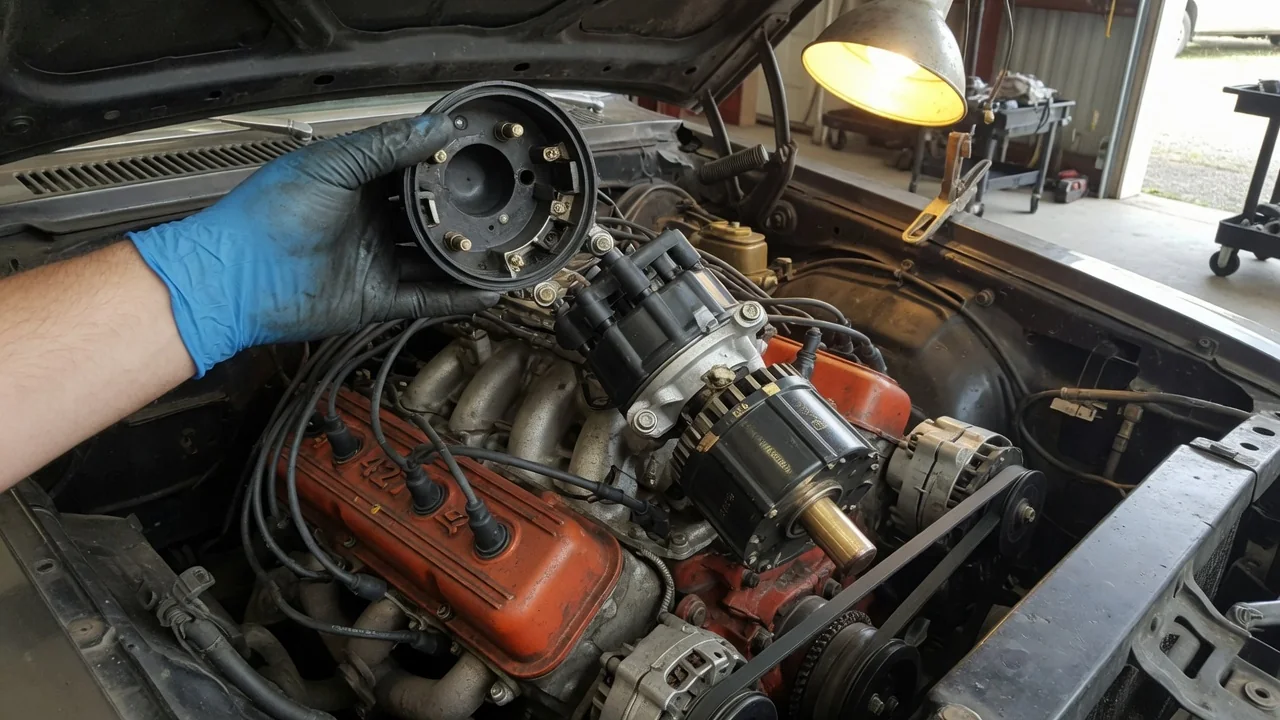
In a classic ignition system, a single ignition coil produces high voltage for every cylinder, and the distributor decides where each pulse goes. Car distributor operation comes down to three linked ideas. The rotor and cap physically route the spark. The timing mechanism decides when the coil fires. Wear gradually erodes the precision of both. This guide explains in general terms how a distributor routes spark. Exact procedures and settings always depend on the specific engine and its service manual.
Rotor and cap: the mechanical switch for high voltage
High voltage leaves the coil through the coil wire and enters the center terminal of the distributor cap. Inside the cap, a spring-loaded carbon button presses against the rotor's center contact, which lets current pass into a spinning part. The rotor is keyed to the top of the distributor shaft. That shaft is typically driven by the camshaft, either directly or through gears. A four-stroke engine fires each cylinder once every two crankshaft revolutions, so the distributor turns at half crankshaft speed and completes one rotation per full engine cycle.
A ring of metal terminals sits around the inside of the cap, one for each cylinder, and each terminal connects to a spark plug wire. As the rotor turns, its outer tip sweeps past these terminals in sequence. The tip does not actually touch them. It passes across a small air gap, and the high voltage jumps that gap on its way to the plug wire. Because nothing touches, the tip and terminals do not wear from friction, although the gap adds some resistance that the coil must overcome.
The order in which the terminals are wired sets the firing order. Plug wires are arranged around the cap according to the engine's firing order, in the direction the rotor turns. The rotor sends each pulse to the correct cylinder simply by pointing at the right terminal at the right moment. The cap must also be a good insulator, so the very high voltage does not leak to neighboring terminals or to the grounded distributor housing.
Timing: deciding when the spark happens
Routing alone does not create a spark. The distributor also houses the trigger that tells the coil when to fire. In older systems the trigger is a set of breaker points, opened by lobes on a cam on the distributor shaft. Later electronic distributors use a magnetic pickup or Hall-effect sensor that signals an ignition module instead. In both designs, interrupting current in the coil's primary winding collapses its magnetic field. That collapse induces the high-voltage pulse, which the rotor then directs to a cylinder.
Base, or initial, timing is set by rotating the distributor housing relative to its shaft. Turning the housing moves the trigger, so the spark occurs earlier or later relative to piston position. Combustion takes time to develop, so engines generally benefit from firing before the piston reaches top dead center. The ideal amount of lead changes with operating conditions. For that reason, many distributors include two advance mechanisms. A centrifugal advance uses weights and springs to advance timing as engine speed rises. A vacuum advance uses a diaphragm that moves the trigger plate in response to manifold vacuum, typically adding advance under light load.
Rotor phasing ties timing back to routing. When the coil fires, the rotor tip must line up closely enough with a cap terminal for the spark to jump the shortest gap. Rotor tips are made wide enough to cover the normal range of advance. If the distributor is installed a tooth off on its drive, or the advance mechanism misbehaves, the tip may point between terminals at the moment of firing. That can produce weak spark or crossfire to the wrong cylinder.
Wear: how routing and timing drift
Each spark removes a little material at the gap, so the rotor tip and cap terminals erode slowly. Over time they develop deposits or burned surfaces, which widen the effective gap and raise the voltage needed to fire. The center carbon button can wear down or lose spring tension, which weakens its contact with the rotor. Caps can also develop hairline cracks or carbon tracks. These are thin conductive paths on the plastic surface that let voltage leak to the wrong terminal or to ground. Moisture and dirt inside the cap make that leakage more likely.
Mechanical wear affects timing accuracy. Worn shaft bushings let the shaft wobble, which can vary the point gap or sensor air gap and make timing inconsistent from one spark to the next. Drive gear wear adds slack between the camshaft and the distributor. In the advance mechanisms, springs can weaken, weights can stick from dirt or lack of lubrication, and a vacuum diaphragm can leak. When that happens, the advance curve no longer follows its intended pattern. Breaker points also wear at the rubbing block and pit at the contacts, which changes dwell and timing.
Practical implications and limits
In everyday driving, distributor problems tend to show up as misfires, rough idle, hesitation, hard starting, or trouble that appears mainly in damp weather. None of these signs is unique to the distributor. Fuel delivery, spark plugs, plug wires, the coil and vacuum leaks can cause similar effects. A visual check of the cap, rotor and shaft play is a reasonable starting point, but it is not a diagnosis on its own. Inspect before replacing parts.
When servicing, owners commonly replace the cap and rotor together. Moving the plug wires one at a time, or labeling them first, preserves the firing order. Any work that disturbs the distributor housing means timing should be checked and set according to the vehicle's manual. Specifications, test conditions and procedures differ between engines, and some require disconnecting the vacuum advance or holding a particular engine speed. A timing light is the usual tool for this check.
This explanation also has limits. Many later engines use distributors whose advance is controlled electronically by a computer rather than by weights and a diaphragm. Many newer engines have no distributor at all and use coil-on-plug or waste-spark systems instead. In those designs, spark is routed electronically rather than through a rotor and cap. The wear patterns described here therefore apply mainly to classic mechanical and early electronic distributor ignition.