How Does a CVT Keep the Engine at a Chosen RPM?
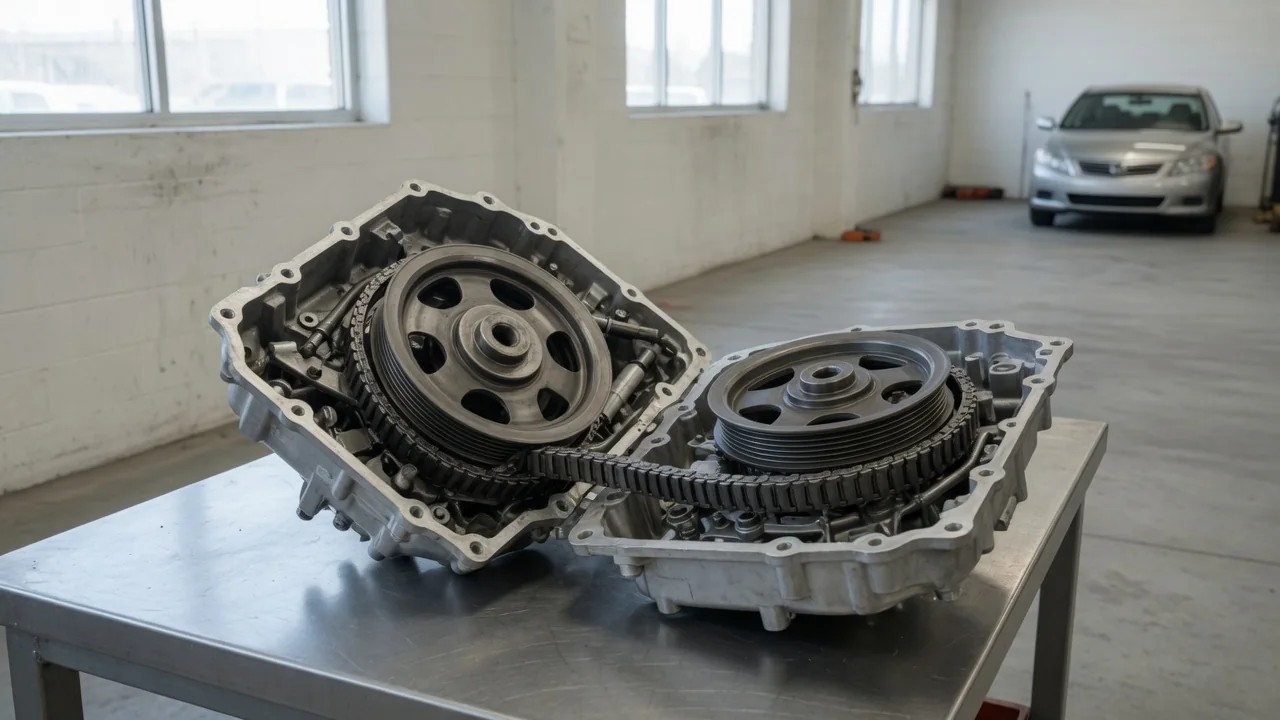
A continuously variable transmission, or CVT, does not have a fixed set of gears. It can change its ratio smoothly across a range, so the control system can hold the engine at a target speed while the car accelerates or cruises. How a CVT keeps the engine at a chosen RPM comes down to three things: how the ratio physically changes, how the computer decides what engine speed the moment calls for, and how that strategy feels from the driver's seat.
Ratio variation
Most passenger-car CVTs use two variable-diameter pulleys connected by a steel belt or chain. Each pulley has two cone-shaped halves, called sheaves, that face each other. When the halves move closer together, the belt is pushed outward and rides on a larger effective diameter. When they move apart, the belt drops deeper into the groove and rides on a smaller diameter. The engine drives the input pulley, usually through a torque converter or a starting clutch, and the output pulley sends power toward the wheels. The belt length is fixed, so when one pulley's effective diameter grows, the other's must shrink. A small input diameter paired with a large output diameter gives a low ratio for pulling away. The opposite arrangement gives a tall, overdrive-like ratio for cruising. Every ratio between those two ends is available, not just a handful of steps.
Hydraulic pressure positions the sheaves. A transmission control module commands solenoid valves, which regulate the pressure acting on pistons behind the movable pulley halves. One part of the control sets the ratio. Another keeps the clamping force on the belt high enough to prevent slipping but low enough to avoid wasting energy and adding wear. This is CVT engine speed control in practice, and it runs as a closed loop. The controller reads engine or input-shaft speed and output-shaft speed from sensors and compares actual engine speed with its target. It then adjusts the pulley positions until the two match. As road speed rises, the controller keeps moving the ratio taller, so engine speed can stay roughly constant while the car accelerates. Some designs use different hardware, such as toroidal rollers, but they apply the same control principle.
Power demand
The target RPM is not fixed. The controller recalculates it continuously from what the driver is asking for. The main inputs are accelerator pedal position, how quickly the pedal is moving, vehicle speed and engine load. Engine temperature and estimated road grade can also play a role. An engine's power output is the product of its torque and its rotational speed, so the controller has two options for delivering a given amount of power. It can let the engine turn slowly while producing more torque, or spin it faster to make more power available. A CVT lets the software choose engine speed largely independently of road speed. A stepped transmission can only approximate this with its fixed gears.
With light pedal pressure, the usual strategy is to keep engine speed low and engine load relatively high, a region where many gasoline engines tend to use fuel more efficiently. As the driver presses harder, the target rises toward the speed range where the engine produces more power. At or near full throttle, the controller typically aims for an engine speed close to the point of maximum power and holds it there, changing the ratio underneath as the car gains speed. Easing off the pedal reverses the process: the target drops and the ratio moves taller, so RPM falls even though the car keeps rolling. Exact target speeds, response rates and thresholds are calibration choices that vary between vehicles.
Driver feel
Holding the engine at one speed while the car accelerates feels different from driving a conventional automatic. The engine sound rises once and then stays steady while road speed keeps climbing. Some drivers call this a rubber-band effect, because the effort they hear seems disconnected from the acceleration they feel. There can also be a brief delay when the pedal is pressed suddenly. The controller first raises engine speed by moving toward a lower ratio, and acceleration builds as the engine reaches its new target. None of this indicates a fault on its own. It follows directly from a strategy that keeps the engine in a chosen operating range.
Not every driver likes that character, so many manufacturers program CVTs to imitate stepped shifts during harder acceleration. The controller lets engine speed climb, then quickly changes the ratio to drop the RPM, mimicking an upshift, even though the hardware could hold a single speed. Many vehicles also offer a manual or sport mode with preset ratio points selected with the lever or paddles. These features change the feel and sound, not the underlying mechanism. Whether a specific car uses them, and how, depends on its calibration.
Practical implications and limits
The ratio range limits how long a CVT can hold an engine speed. At very low road speeds the transmission is already at its lowest ratio, so the pulleys alone cannot keep engine speed up as the car slows. This is one reason a CVT still needs a torque converter or launch clutch for pulling away. At the other end, once the pulleys reach their tallest ratio, engine RPM rises in proportion to road speed, as it would in a top gear. The constant-RPM behavior only happens between those two ends.
Torque capacity is another limit. The belt or chain transmits force through friction, so clamping pressure, fluid condition and temperature all matter. Under sustained heavy load, such as towing or long climbs, the control system may protect the transmission by changing its targets or limiting engine torque. For this reason, owner's manuals often set specific towing limits and fluid service requirements. The ratio control relies on the hydraulic system, so using the specified fluid and service interval helps keep it precise.
Knowing this strategy helps separate normal behavior from symptoms worth checking. A steady RPM during acceleration is usually intentional. So is engine speed rising on a downhill grade to provide engine braking. Warning signs include engine speed that flares without a matching gain in road speed, RPM that hunts up and down at a constant pedal position, or any shudder, whining or warning light. These can point to slipping, control faults or hydraulic problems. In those cases, the vehicle's service information and a scan for stored codes are the right next steps, because the exact control logic is specific to each transmission.