How Does a Clay Bar Remove Bonded Contamination?
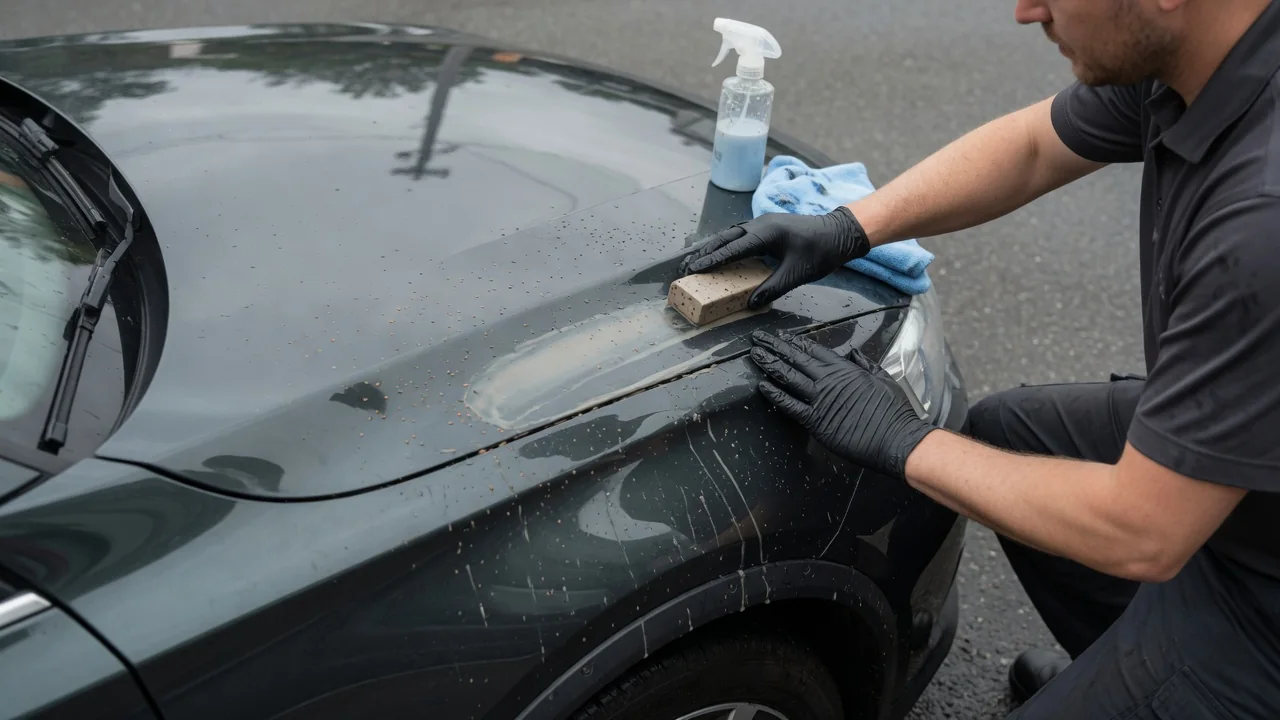
Even after a thorough wash, painted panels can still feel rough. That texture usually comes from bonded contamination, tiny particles attached to the clear coat that ordinary shampoo and a wash mitt cannot remove. A detailing clay bar is made to remove them. Knowing how a clay bar does this, and why the process depends on lubrication and careful technique, shows what clay does well and how it can cause new problems.
Surface pickup: how clay grabs what washing leaves behind
Bonded contamination is a broad label for debris that has stuck to the paint rather than simply resting on it. Common examples include airborne industrial fallout, brake dust and rail dust containing iron particles, paint overspray, tar specks, and hardened residue from tree sap or insects. These materials can adhere through heat, moisture or chemical attraction, or by partly embedding in the top layer of the finish. Part of each particle sits above the surface and part is anchored to it, so the gentle sliding of a wash mitt tends to pass over the particle instead of dislodging it.
Detailing clay is a pliable, slightly tacky compound, typically based on synthetic polymers. Some grades include fine abrasive material to make them more aggressive. When the clay moves across a lubricated panel, its smooth face rides over the flat clear coat but meets resistance wherever a contaminant sticks up. At that point the clay pushes sideways against the raised particle, concentrating force on a spot the particle's bond may not withstand. Once the particle breaks free, the soft, sticky body of the clay takes it in and holds it rather than letting it roll along the paint.
This is why a clay bar works on car paint mechanically, not chemically. It does not dissolve contamination. It pries particles loose and traps them. The same principle explains the common feel test: as the panel gets cleaner, the drag and slight grabbing fade, and the clay glides evenly. Removed debris builds up on the clay face, so users fold and knead the clay to bury the dirty surface and expose a fresh one before continuing.
Lubrication: keeping the clay moving on top of the paint
Clay should not be used on dry paint. A lubricant, usually a dedicated clay lubricant or a slick quick-detailer spray, puts a thin film between the clay and the clear coat. The film lets the clay float over smooth areas while its face still contacts anything that rises above the film. In effect, lubrication keeps the clay off the clean surface, which should be touched as little as possible, while leaving the protruding contamination exposed to it.
Without enough lubricant, the tacky clay can grip the paint itself. It may stick, stutter or tear, leave smeared clay residue, and push already captured particles across the finish under higher pressure. Too little lubricant also makes the feel test unreliable, because general friction hides the difference between clean and contaminated areas. For these reasons, detailers spray generously, work in small sections, and add lubricant whenever the clay starts to drag.
The choice of lubricant also matters. Products formulated for claying are designed to stay slick long enough to finish a section without drying out. Some people use diluted car shampoo instead. Whether a given clay tolerates that depends on its compound, because some formulations can be softened or degraded by soaps or solvents. The safest approach is to follow the instructions supplied with the specific clay product.
Marring: why clay can leave its own marks
Marring is the fine, hazy pattern of very light scratches that clay can leave in the clear coat. It happens because claying drags a solid material, plus whatever it has just picked up, across a finished surface. Particles not yet absorbed into the clay can be pushed along the panel first. More aggressive clay grades, especially those with abrasive additives, remove contamination faster but are also more likely to abrade the surrounding paint. Heavy pressure and too little lubricant raise the risk further.
How visible the marring becomes depends on the finish. Paint hardness varies, and dark colors usually show fine haze more readily than light ones under direct light. For this reason, many detailers follow claying with a light polish to remove any haze the clay introduced. Basic precautions reduce the problem. Use the mildest clay that does the job, keep the surface wet, apply light pressure, and fold the clay often. Throw away any piece dropped on the ground, since it can pick up grit that would scratch the paint.
Practical implications and limits
Clay works best as one stage in a sequence rather than as a standalone fix. Wash and rinse the car first so the clay does not drag loose dirt around. Where iron contamination is heavy, a chemical iron remover applied beforehand can dissolve much of it, leaving less for the clay to pull off and reducing the rubbing needed. Claying also strips much of any existing wax or sealant, so applying fresh protection is normally part of the job.
Clay also has firm limits. It only catches material that stands above the surface, so it cannot fix defects at or below that level, such as scratches, swirl marks, chips or water spots etched into the clear coat. Those need polishing or other paint correction. Clay alternatives, such as mitts, towels or pads faced with a synthetic rubber-like polymer, use a similar pickup principle and can be rinsed instead of kneaded. They still need the same lubrication and light pressure.
Claying is not a routine wash step. Doing it more often than the contamination requires adds rubbing without benefit, and the feel of the paint after washing is a practical guide to when it is needed again. Owners should also check the care guidance for their vehicle's finishes, because surfaces such as matte paint or wrapped panels may not be suited to claying or the polishing that often follows it.