How Does a Classic Heater Control Valve Work?
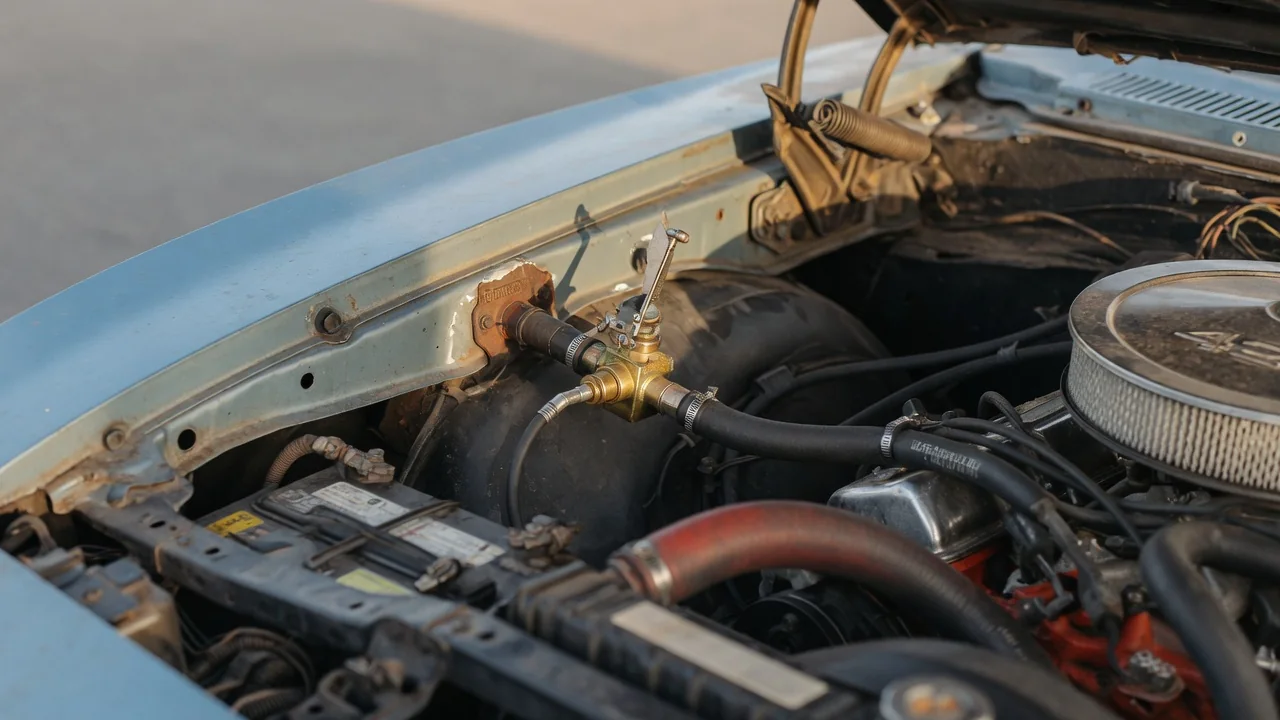
In many older cars, the heater is little more than a small radiator behind the dashboard that receives hot coolant from the engine. The heater control valve decides how much of that coolant reaches it. If you have wondered how a classic heater control valve works, the answer comes down to three things: how it meters coolant flow, how a dashboard cable moves it, and where it tends to leak. Details vary by vehicle, so treat this as a general explanation.
Coolant flow through the valve
The valve sits in the hose circuit that links the engine's cooling system to the heater core. On a typical layout, one hose takes coolant from a hot point on the engine, such as the cylinder head or intake manifold area, and another returns it toward the water pump inlet. The water pump supplies the pressure that pushes coolant around this loop, and the valve acts like a faucet placed in the supply or return line. Open it, and hot coolant circulates through the heater core; close it, and circulation through the core stops or slows to a trickle.
Inside, the valve uses a movable element to restrict the passage. Depending on design, this may be a rotating plug, a sliding gate, a flap, or a spring-loaded poppet that lifts off a seat. Between fully closed and fully open, the element creates a variable restriction. In systems that regulate cabin temperature mainly by coolant flow, that partial opening is how the driver sets the heat: less flow means the heater core runs cooler and the air leaving it is less warm. Other designs use the valve mainly as an on/off shutoff and let a blend door mix heated and unheated air to set the temperature.
Many heater circuits draw coolant from a point that keeps flowing even while the thermostat is closed, which helps the cabin warm up sooner. Some valves also include a bypass passage, so that when the heater is shut off, coolant is routed back toward the engine instead of simply being blocked. Which hose carries the valve, and whether it bypasses, depends on the specific vehicle.
Cable control from the dashboard
On many classic cars the valve is operated by a Bowden cable: a steel inner wire that slides inside a flexible outer sheath. At the dashboard end, the wire is attached to the heater control lever or knob. At the valve end, the sheath is clamped to a bracket on the valve body, and the wire is fastened to a small lever arm that turns or pushes the valve's internal element. Moving the dash control pulls or pushes the wire, which moves the arm, which changes the opening inside the valve.
Because the system is purely mechanical, its accuracy depends on adjustment. The sheath clamp and the wire's attachment point determine where the valve sits at each end of the dash control's travel. If the cable is clamped in the wrong position, the lever may reach its stop before the valve is fully open or fully closed, leaving the heater weak or unable to shut off. Adjustment generally means loosening the clamp, setting both the dash control and the valve arm to the same end position, and retightening, although the exact procedure and which arm position means closed vary by design.
Cable controls also have characteristic faults. A kinked or rusted cable can feel stiff or springy, an inner wire can slip in its fastener or break, and a valve with a corroded shaft can resist movement so strongly that the cable stretches or the dash lever bends instead of the valve turning. Some valves use a return spring, so a disconnected cable leaves them in a default position. Some vehicles use vacuum or other actuation instead of a cable.
Leak points and symptoms
A heater control valve is part of the pressurized cooling system, so it can leak in several places. The usual external points are the hose connections, where clamps loosen or hoses harden and crack; the valve body itself, which may be metal subject to corrosion or plastic that can crack with age and heat cycles; and the seal around the shaft that the cable arm turns. Shaft seals are a frequent source of weeping because the shaft moves every time the heat setting changes.
Signs of an external leak include drips or crusty residue around the valve, a sweet smell under the hood, wisps of steam near the firewall after a drive, and a coolant level that drops over time. Because the valve usually sits in the engine compartment rather than inside the cabin, a leak here typically shows up under the hood. That helps separate it from a heater core leak, which more often appears as damp carpet, a greasy film on the inside of the windshield, or a coolant smell inside the car.
There is also an internal leak, sometimes called leak-by, where the valve no longer seals fully when closed. Coolant keeps passing into the heater core, so the cabin gets unwanted heat in warm weather even with the control set to cold. Worn sealing surfaces, debris, scale, or a cable that does not move the valve all the way can cause this.
Practical implications and limits
Understanding the valve makes symptoms easier to sort, but it also shows what the valve cannot do. It can only pass along the heat the engine provides. Low coolant, air trapped in the heater core, a thermostat stuck open, a partially blocked core, or a weak blower fan will all reduce heat even when the valve is wide open. Before blaming the valve, it makes sense to confirm that the engine reaches normal operating temperature and the coolant level is correct.
A common general check is to warm the engine, set the control to full heat, and carefully compare the two heater hoses. If the supply hose is hot and the return stays noticeably cooler, flow is restricted somewhere, which could be the valve or the core. Watching the valve arm while a helper moves the dash control shows whether the cable actually carries it through its full range. Hot coolant under pressure can cause serious burns, so avoid opening the cap or disconnecting hoses on a hot engine.
When replacing an older car heater valve, fitting the hoses is only part of the match. Flow direction, hose sizes, whether the valve rests open or closed, the direction of arm travel, and whether it includes a bypass all affect how it works with the existing cable and controls. Some owners remove a failed valve and join the hoses, which restores heat but leaves no way to shut it off in hot weather; that is a trade-off rather than a repair. Layouts and adjustment procedures differ between vehicles, so the service manual for the specific car remains the authority.