How Does a Carburetor Meter Fuel? Venturi, Jets and Adjustment Explained
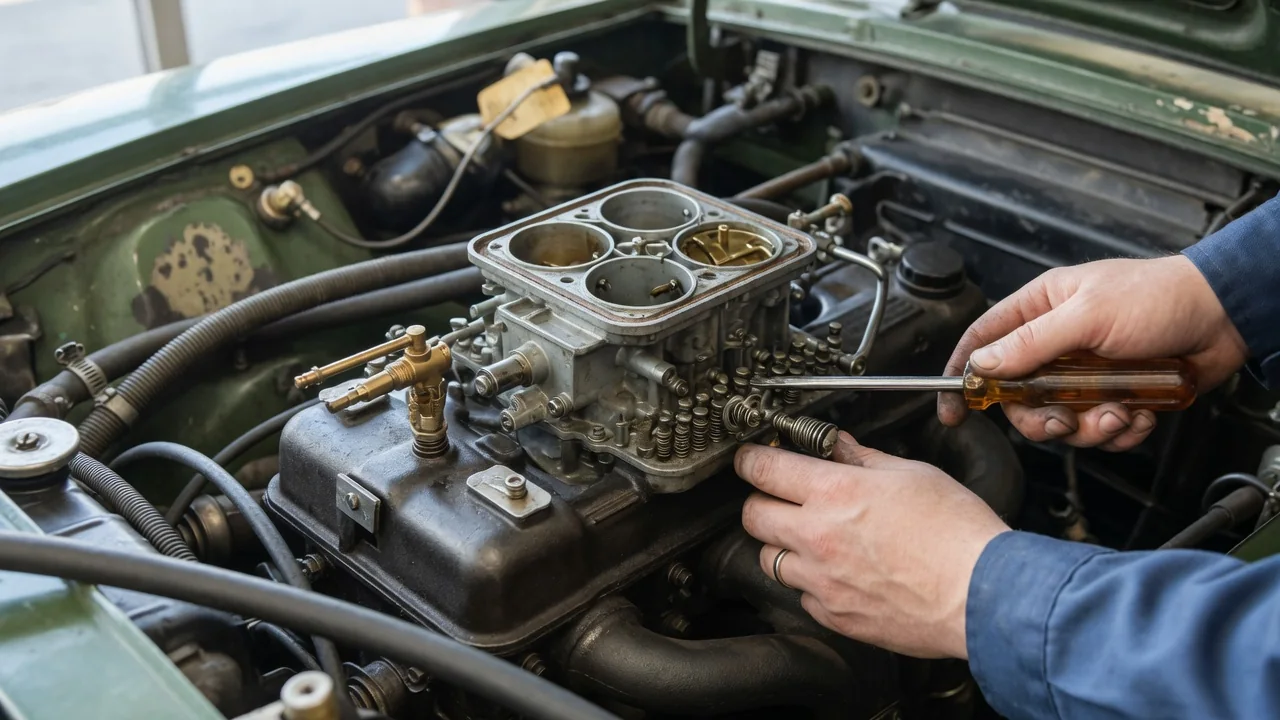
A carburetor has no computer and no sensors, yet it must deliver fuel in close proportion to the air an engine draws in. It does this with physics rather than electronics. Air rushing through a narrowed passage creates a pressure difference, that difference pushes fuel through precisely sized openings, and a handful of adjustable parts fine-tune the result. Understanding how a carburetor meters fuel makes tuning and troubleshooting far less mysterious.
Airflow Venturi
The venturi is a smooth, narrowed section of the carburetor bore. As air passes through it, its velocity increases and its static pressure drops, a relationship described by Bernoulli's principle. The faster the air moves, the stronger the pressure drop. The float bowl, meanwhile, is vented to roughly atmospheric pressure. The difference between the pressure in the bowl and the low-pressure zone in the venturi, often called the venturi signal, pushes fuel from the bowl through the main metering system and out of a discharge nozzle into the airstream. This is the core of carburetor fuel metering: the engine's own airflow generates the force that delivers the fuel.
Because the signal grows as airflow increases, fuel delivery rises roughly in step with engine demand. Many designs place a smaller booster venturi inside the main venturi to strengthen the signal at lower flow and improve atomization. The throttle plate, located downstream, does not meter fuel directly; it controls how much air the engine can draw, and the venturi responds to that airflow. A float and needle valve hold the fuel in the bowl at a set level, which matters because the signal must lift fuel a fixed height to reach the nozzle.
The venturi has limits. At idle and very light throttle, too little air passes through it to create a useful signal, so carburetors use separate idle and off-idle transfer passages that open near or below the throttle plate, where manifold vacuum is strong. Sudden throttle opening is another weak spot: air accelerates faster than heavier liquid fuel, so an accelerator pump squirts extra fuel to cover the momentary lag.
Jets
A jet is a calibrated orifice, usually made of brass, that sets how much fuel can flow for a given pressure difference. The main jet sits between the float bowl and the main well, and with the venturi signal acting on it, its size largely determines the mixture at cruise and higher engine speeds. Flow depends on more than hole diameter: entry shape, passage length and surface finish all affect it, which is why jets are calibrated by flow rather than simply drilled to a size. Numbers stamped on jets identify calibration within a particular manufacturer's system, but numbering schemes differ between carburetor makers and should not be assumed to be interchangeable.
A simple jet-and-venturi arrangement does not track airflow perfectly; it tends to run progressively richer as airflow climbs. Air bleeds correct this. Small calibrated air passages admit air into the main well, often through an emulsion tube, so air mixes with fuel before it reaches the nozzle. This moderates the effective signal acting on the fuel at higher flow, flattens the mixture curve and helps break fuel into finer droplets. Idle circuits have their own smaller jets and air bleeds sized for low-flow operation.
Many carburetors also change the effective metering area under load. Some use a vacuum-operated power valve that opens an additional fuel path when manifold vacuum falls, as it does at wide throttle. Others use tapered metering rods that move within the main jet, altering the open area according to vacuum or throttle position. Either approach lets the carburetor run leaner for economy at light load and richer for power and combustion cooling under heavy load.
Adjustment
Adjustment points vary by design, but common ones include the idle speed screw, one or more idle mixture screws, float level, accelerator pump stroke and choke settings. Idle mixture screws regulate fuel in the idle circuit only and have little influence once the main circuit takes over. The idle speed screw sets the throttle plate stop, not the mixture. A typical procedure, performed on a fully warm engine with ignition timing already correct, is to turn the mixture screw for the highest steady idle speed or manifold vacuum, then reset idle speed and repeat as needed, following the specific service manual. Some carburetors have limiter caps or sealed screws because of emissions requirements.
Changing main-circuit calibration is usually a parts change rather than a screw turn: different main jets, metering rods, power valve rating or air bleeds. Float level deserves attention because it sets fuel height relative to the nozzle; too high tends to richen the mixture and can cause flooding, while too low tends to lean it and can starve the engine during hard cornering or braking. Accelerator pump settings affect transient response, not steady-state mixture. Make one change at a time and record it, since the circuits overlap during transitions.
Practical Implications and Limits
A purely mechanical carburetor meters by airflow and pressure, not by measuring oxygen in the exhaust, so its calibration is a compromise for expected conditions. At higher altitude the air is less dense while the jets still pass a similar amount of fuel, so the mixture becomes richer. Temperature and fuel properties shift it as well; ethanol blends require more fuel for complete combustion than straight gasoline, so a carburetor calibrated for gasoline can run leaner on them. Some later carburetors added electronic feedback control, but a conventional unit cannot correct itself.
Many symptoms blamed on jetting originate elsewhere. A vacuum leak admits air that bypasses the venturi, leaning the mixture especially at idle. Varnish or debris partially blocking a jet or air bleed changes the calibration, as can a sticking float, a leaking needle valve or a ruptured power valve diaphragm. Ignition faults can also imitate mixture problems. Checking clean passages, correct float setting, sound gaskets and healthy ignition before re-jetting avoids chasing the wrong cause.
Common clues help point in the right direction. Sooty spark plugs, a strong fuel smell and sluggish response suggest a rich condition, while hesitation, surging at cruise or backfiring through the carburetor suggest a lean one. These are indicators rather than measurements; an air-fuel ratio gauge provides more objective data. Specifications for any particular carburetor should come from its manufacturer documentation or the vehicle's service manual.