How Does a Car Battery Handle Short Trips?
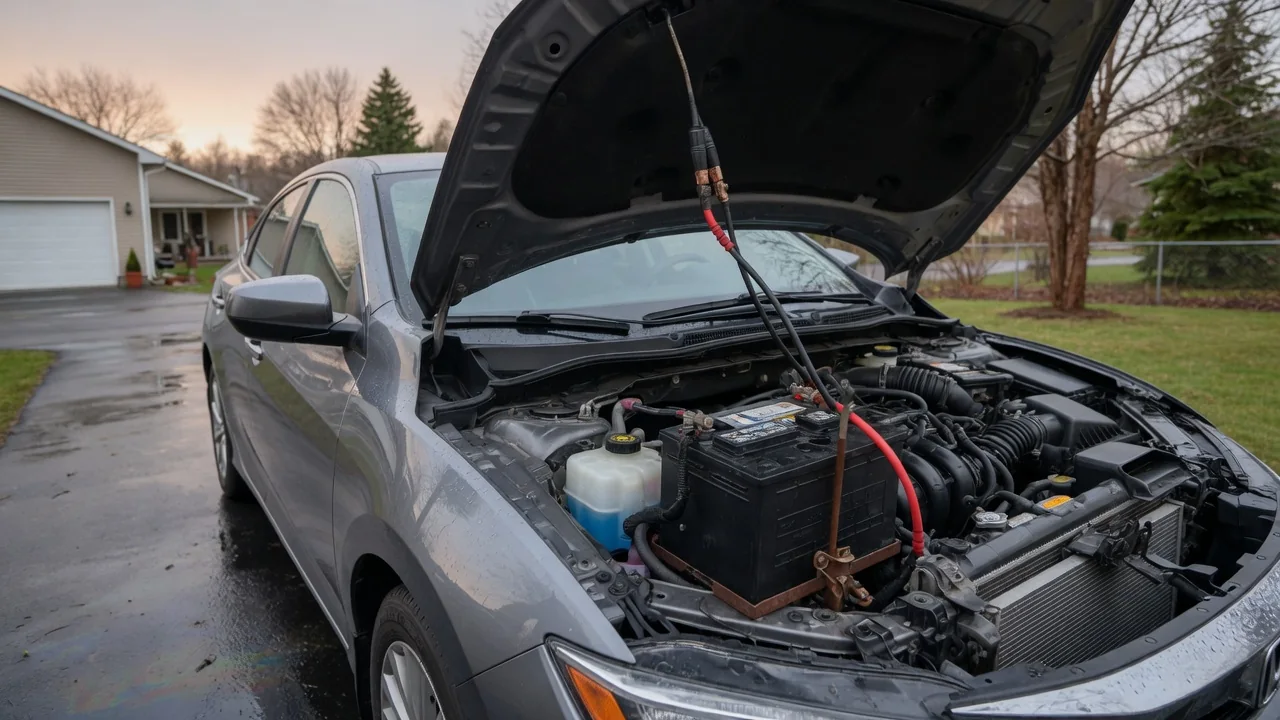
Short trips can quietly wear down a car battery's state of charge. Every start pulls a burst of energy from the battery, and the alternator needs time on the road to put it back. When drives are brief and frequent, recharging can fall behind. This guide explains how a car battery handles short trips, why a short drive battery recharge is often incomplete, and how to monitor charge before it turns into a no-start problem.
Starting draw: what each start takes from the battery
Starting the engine is the heaviest routine job a 12-volt car battery performs. For a few seconds, the starter motor draws a very large current, and battery voltage dips noticeably while it turns the engine over. Starting batteries are built for this kind of short, intense discharge, using plate designs that expose a large surface area to the electrolyte. Because a normal start lasts only a moment, the total energy removed is usually small compared with the battery's capacity. The issue on short trips is not one start in isolation but the fact that each start is a withdrawal that must later be repaid.
Several conditions make that withdrawal larger. In cold weather, thickened engine oil makes the engine harder to turn, while the battery's chemical reactions slow down and reduce the current it can deliver. Long cranking, repeated attempts, or an engine that is slow to fire all add to the draw. Modern vehicles also wake up numerous control modules, fuel pumps, and displays before and during a start, and many keep some systems active after shutdown. Vehicles with automatic start-stop restart the engine many times on a single drive; they are generally equipped with battery types intended for that heavier cycling, such as AGM or enhanced flooded designs, but the restarts still count as additional demand.
Charging time: why a short drive may not refill the battery
Once the engine runs, the alternator powers the vehicle's electrical system and sends surplus current back into the battery. That recharge is not instantaneous. A lead-acid battery accepts charge most readily when it is noticeably depleted, and acceptance tapers as it approaches full, so the last portion of the charge takes the longest. Cold temperatures reduce charge acceptance further. On a short drive, the alternator may also be busy feeding headlights, the blower fan, rear defroster, heated seats, and infotainment, leaving less surplus for the battery. Time spent idling or creeping in traffic can shrink the margin further on vehicles whose alternator output drops at low engine speed.
Many recent vehicles add another layer: a managed or smart charging strategy. Instead of holding a fixed charging voltage, the control system may keep the battery deliberately below full to reduce alternator load and improve efficiency, then charge more aggressively during deceleration or braking. Some systems rely on a battery sensor to decide how much charge to add. The exact logic varies by manufacturer and model, so the owner's manual or service information is the reliable reference for a particular vehicle. The practical effect is that even a moderate drive does not necessarily bring the battery to a full state of charge.
There is no universal number of minutes that guarantees a short drive battery recharge is complete. The answer depends on the battery's size, age, and condition, the temperature, the alternator's output, the electrical loads in use, and the vehicle's charging strategy. What matters most is the trend. When starts repeatedly take out more than the following drives put back, the battery settles into a partial state of charge. Kept there for long periods, lead-acid batteries are prone to sulfation, in which lead sulfate crystals harden and become difficult to convert back, gradually reducing usable capacity. Flooded batteries can also develop acid stratification when they rarely receive a full charge.
Monitoring battery charge when most drives are short
A digital multimeter offers a simple first check. Measure resting voltage across the battery terminals after the vehicle has sat with the engine off long enough for surface charge from the last drive to dissipate, then compare the reading with the battery manufacturer's state-of-charge chart, since thresholds differ by battery type. A reading taken with the engine running shows whether the charging system is supplying voltage, but it says little about how much energy the battery itself is holding. Recording readings over several weeks of mostly short trips can reveal a gradual decline that a single measurement would miss.
Voltage alone cannot confirm a battery's ability to deliver starting current. A load test or a conductance-type battery tester, commonly available through service shops and parts retailers, gives a better picture of health. Many newer vehicles include an intelligent battery sensor at the negative terminal that feeds data to the charging strategy; on some of these, a replacement battery must be registered or coded so the system charges it correctly. Everyday warning signs include slower cranking, interior lights dimming during a start, a battery or charging message on the dashboard, and, on start-stop vehicles, the system declining to shut the engine off. That last sign can have other causes, so it points toward a check rather than a diagnosis.
For a vehicle that mostly makes short trips, a quality battery maintainer or smart charger can periodically restore a full charge that driving alone may not provide. Choose a charger compatible with the battery type, whether flooded, AGM, enhanced flooded, or lithium, and follow both the charger and vehicle instructions for connection points, since some vehicles specify a particular grounding point rather than the battery's negative post.
Practical implications and limits
In daily use, a few habits help the battery keep up. Switching off nonessential loads such as seat heaters and the rear defroster once they have done their job leaves more alternator output for recharging. Combining errands into one longer outing replaces several start-and-stop cycles with a single start followed by more charging time. An occasional longer drive at steady speed, or a periodic session on an external charger, can bring the battery back toward full. Letting the engine idle in the driveway is generally a weak substitute, because idle output is often modest and accessories still consume part of it.
These points describe general lead-acid behavior, and individual vehicles can differ. Hybrids and electric vehicles usually charge their 12-volt battery from the high-voltage system through a DC-DC converter rather than a belt-driven alternator, so their short-trip behavior follows different rules. An aging battery has less reserve, so short trips may simply expose weakness that already existed rather than cause it. If a battery repeatedly runs flat despite regular charging, the cause may be an excessive parasitic draw, a charging system fault, or a failing battery, and testing is the way to tell them apart. For jump-starting, charging procedures, and battery replacement requirements, the vehicle's own documentation takes priority over general guidance.