How Do Parking Brakes Hold a Car on a Slope?
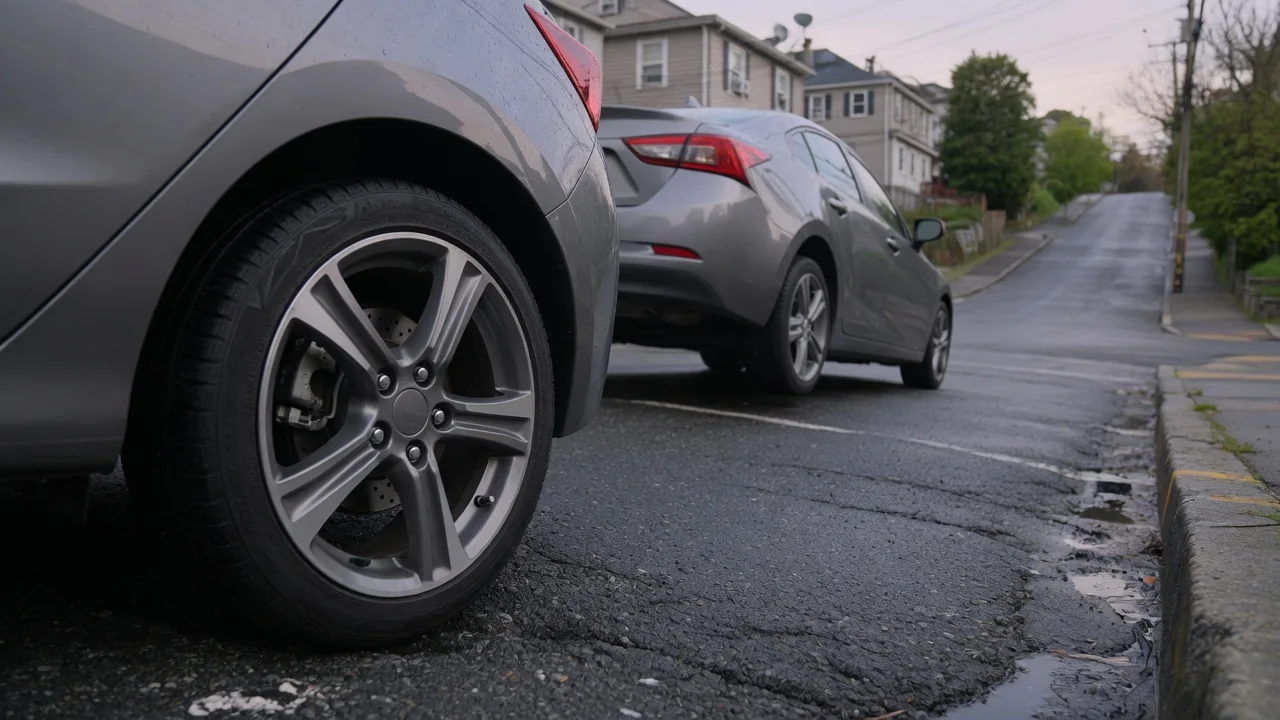
A parking brake holds a car on a slope by mechanically clamping the rear brakes so the wheels cannot turn, without relying on hydraulic pressure. Whether it succeeds depends on three things: how the rear brake mechanism turns lever, pedal or motor input into clamping force, how much load the slope places on that force, and whether the driver applies it correctly. Each of these explains why parking brake holding force is usually ample on ordinary grades and where it can fall short.
Rear brake mechanism
On most passenger vehicles, the parking brake acts on the rear wheels through a path separate from the hydraulic service brakes. That separation matters on a slope. Hydraulic pressure can slowly bleed away when a car sits for hours, but a mechanical lock does not. In a traditional layout, a hand lever or foot pedal pulls a cable. An equalizer splits the tension between the two rear wheels, and a ratchet keeps the cable taut until the release button or handle is used.
What happens at the wheel depends on the brake type. With rear drum brakes, the cable pulls a lever attached to one brake shoe, and a strut pushes the opposite shoe outward, so both shoes press against the inside of the drum. Drum geometry can be self-energizing: when the drum tries to rotate, friction tends to wedge one shoe tighter. With rear disc brakes, there are two common designs. One uses a small drum built into the hat of the rotor, called drum-in-hat, with its own set of parking shoes. The other builds the parking function into the caliper, where a screw, cam or ball-and-ramp mechanism converts the rotation of an external lever into piston travel that clamps the pads against the rotor.
An electronic parking brake replaces the lever with a switch. A control unit commands electric motors, often mounted on the rear calipers and driving a spindle through a gear reduction, or a central actuator that pulls conventional cables. The spindle mechanisms are generally designed so that clamping force remains when the motor is switched off, meaning the car does not need continuous electrical power to stay parked. Features such as automatic application, automatic release and re-clamping vary by vehicle.
Load
On a slope, the vehicle's weight splits into two components: one presses the car into the road surface, and the other pulls it downhill. That downhill component grows as the grade gets steeper and as the vehicle gets heavier. To hold the car, the friction torque at the rear brakes must exceed the torque that downhill force creates at the tire's rolling radius. Holding torque comes from the clamping force multiplied by the friction coefficient of the pads or shoes and by the effective radius at which they act. In practice, that is what parking brake holding force describes.
The brake is only half of the equation. Because only the rear wheels are locked, the car stays put only if the rear tires keep their grip on the road. That grip depends on the load carried by the rear axle and on the friction available from the surface. When a car is parked facing downhill, weight shifts toward the front axle, reducing rear tire load exactly when the demand on the rear wheels is highest. Facing uphill, the rear axle carries more weight. On ice, loose gravel or wet grass, locked rear tires can slide even though the brake itself is holding perfectly.
Several everyday factors change the load. Passengers, cargo and especially a trailer increase the downhill force the brakes must resist. Brake temperature also plays a role: friction material behaves differently when hot or wet, and rotors and drums change dimension as they cool after a long descent, which can alter clamping force. This is one reason some electronic systems are designed to re-tension the brake after the vehicle has been parked.
Proper use
Sequence matters with an automatic transmission. A common recommendation is to stop with the service brake, apply the parking brake firmly, shift into Park, and then release the brake pedal so the parking brake takes the load. The Park position engages a small pawl with a gear in the transmission. If the car is allowed to settle onto that pawl first, it carries the vehicle's weight, which stresses the parts and can make shifting out of Park stiff or accompanied by a clunk. With a manual transmission, owner's manuals typically advise applying the parking brake and leaving the car in a gear, often first when facing uphill and reverse when facing downhill.
Apply the brake fully. With a cable lever or pedal, that means pulling or pressing until it is firmly seated rather than stopping after a couple of clicks. With an electronic switch, hold or pull it until the indicator confirms the brake is applied. Turning the front wheels adds a backup: facing downhill, turn them toward the curb; facing uphill next to a curb, turn them away so the tire rests against the curb if the car creeps; with no curb, turn them toward the road edge. Before driving off, make sure the brake is fully released, because a partially applied parking brake drags and can overheat the rear brakes.
Weather can change the advice. In freezing, wet conditions, moisture can freeze brake shoes to drums or lock cables in their housings. Some owner's manuals address this situation directly, so follow the guidance for the specific vehicle, and consider wheel chocks where the manual suggests alternatives.
Practical implications and limits
A parking brake's ability to hold depends on its condition. Cables stretch and corrode, rear shoes and pads wear, and adjusting mechanisms can seize if the brake is rarely used. Warning signs include a lever or pedal that travels farther than before, a car that creeps on a grade it once held easily, or a warning light that stays on. Using the parking brake regularly helps keep its moving parts free, and periodic inspection catches wear before it shows up on a hill.
Vehicle safety standards in many markets require parking brakes to hold a loaded vehicle on a defined test grade, but real conditions can exceed what a test represents. Steep driveways, low-traction surfaces and trailers all push closer to the limits of both the brake and the rear tires. Layering methods, such as the parking brake plus Park or a gear, angled front wheels and wheel chocks, adds redundancy because each method fails in a different way.
Electronic systems bring their own considerations. Replacing rear pads on many vehicles requires a service mode or diagnostic tool to retract the caliper pistons, and a dead battery may prevent the brake from releasing normally. Emergency or manual release procedures differ between manufacturers, so the owner's manual is the reliable source for how a particular vehicle behaves.