How Do Engineers Test Rear-Seat Heating and Cooling?
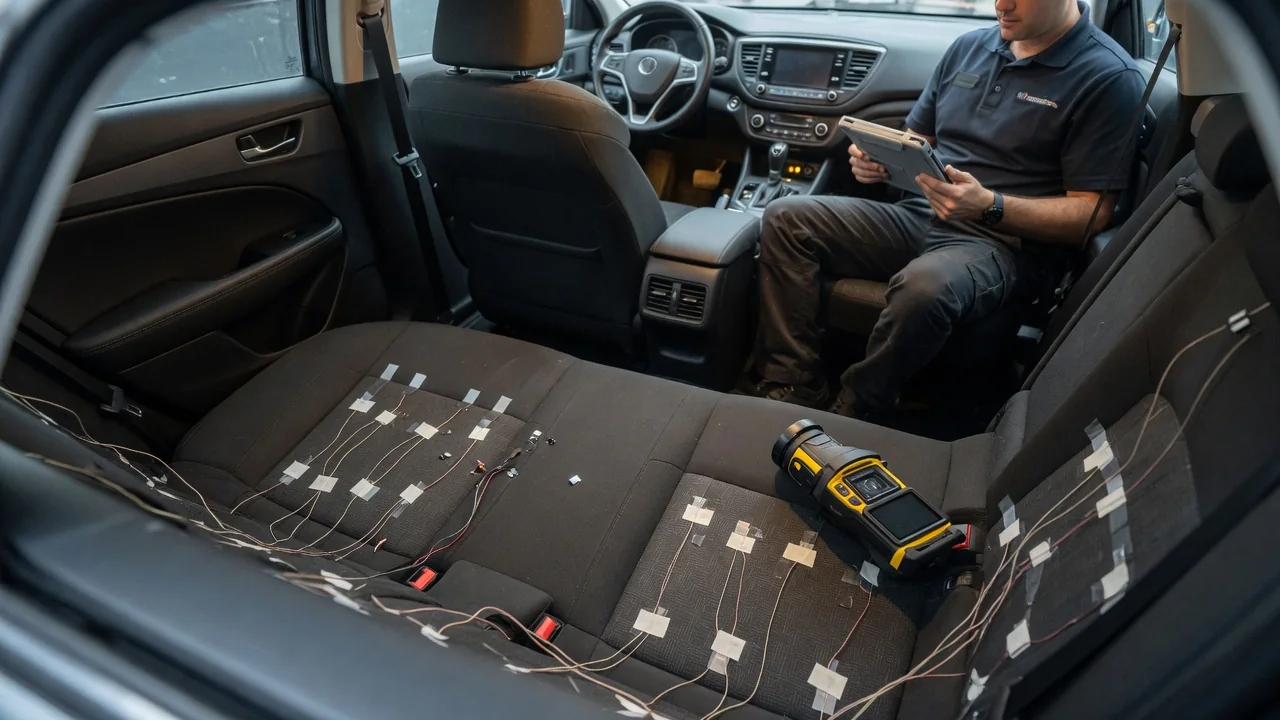
Rear passengers often experience a different cabin than the people up front, which is why rear-seat climate testing is treated as its own part of heating, ventilation, and air conditioning development. So how do engineers test rear-seat heating and cooling? They measure how fast rear temperatures change, map where conditioned air actually reaches each occupant, and then adjust controls and hardware until the back of the cabin keeps pace with the front.
Air temperature: measuring how the rear cabin heats and cools
Most evaluation starts in controlled conditions, such as a climatic chamber or a climatic wind tunnel where temperature, humidity, and simulated sunlight can be set and repeated. In a typical cooling test, the vehicle is soaked under hot conditions and lamps that imitate solar load until the interior is heat-saturated. The system is then switched on at defined settings, and engineers record how quickly the cabin pulls down toward a comfortable temperature. Heating tests reverse the idea: the car is cold-soaked, started, and tracked as the heater warms the interior. The key question for the rear is not only the final temperature but how far it lags behind the front seats during those first minutes.
To see that lag, engineers place temperature sensors, usually thermocouples, throughout the cabin. Common positions include head, chest, knee, and foot height at each seat, plus sensors directly in the outlets to capture discharge air temperature. Comparing outlet readings in the front and rear shows how much heat the air gains or loses on its way through longer ducts that run under the floor, through the center console, or up the pillars. The vertical readings reveal stratification, the tendency for warm air to collect near the roof while the floor stays cooler, which rear passengers often notice as warm heads and cold feet.
Air temperature alone does not describe comfort. Sun on the rear glass, cold door panels, and a hot headliner all exchange heat with occupants by radiation, and air speed changes how warm or cool a person feels. For that reason, many development programs also use thermal manikins, life-size figures with individually heated segments that report how much heat each body zone is losing. The results are often expressed as an equivalent temperature that blends air temperature, airflow, and radiation into a single comfort-oriented value. Laboratory findings are then checked on the road in hot and cold climates.
Passenger locations: where the air actually lands
Every seating position is evaluated separately because each one sits in a different thermal environment. Outboard rear seats are close to door panels and side glass, which act as large hot or cold surfaces. The center seat is farther from the glass but often closest to console-mounted vents, so it can receive a stronger direct jet. Third-row seats, where fitted, are farthest from the main HVAC module, which is why some larger vehicles use a separate rear unit or roof-mounted ducts. Engineers look for whether each position reaches a reasonable temperature within a comparable time, not just whether the cabin average looks acceptable.
Occupant size and posture also matter. Sensor trees and manikins are positioned to represent different body sizes, because a tall adult's face and a child's face sit at very different heights relative to the outlets. Floor outlets for rear passengers are frequently routed under or behind the front seats, so testers commonly check airflow with the front seats in several positions, from fully forward to fully back and lowered. Front-seat occupants, headrests, and rear child seats can all block or deflect airflow, so tests may be repeated with the cabin empty and with seats occupied by manikins or human volunteers.
To understand the path of the air, engineers combine measurement with visualization. Anemometers record air speed at specific points, while smoke or fog can make jets visible so teams can see whether air reaches the knees, hits a passenger's neck, or simply washes against a seatback. Earlier in development, computational fluid dynamics simulation is often used to predict these flow patterns before physical prototypes exist, and later tests confirm or correct those predictions.
Adjustments: tuning controls and hardware for the rear
Testing covers the full range of settings a passenger might use. That includes fan speeds, recirculation versus fresh air, and mode selections such as face, floor, bi-level, and defrost. When rear controls are fitted, engineers verify that changing the rear temperature or fan setting produces a predictable, proportional change at the rear outlets rather than a sudden jump or almost no effect. They also check that blend doors and mode doors move to their intended positions, since an actuator that stops short can quietly redirect airflow away from the back seats.
Results feed into calibration of automatic climate control. Automatic systems rely on inputs such as cabin temperature sensors, outside temperature, and a sun load sensor, and engineers tune how blower speed, mode position, and air mix respond to those inputs so the rear is not neglected while the system chases a front-seat target. When software tuning is not enough, hardware changes may follow: rerouting or insulating ducts, reshaping outlets, or sealing leaks where conditioned air escapes before reaching the rear.
Heated and ventilated rear seats get their own evaluation. Engineers measure how quickly the seat surface warms or cools and how evenly it does so; infrared thermal imaging is a common way to spot hot or weak zones across the cushion and backrest. Subjective assessment completes the picture. Panels of evaluators sit in each position and rate comfort, drafts, and noise, because a rear outlet that delivers plenty of air but sounds loud at higher fan speeds can still be judged a poor result.
Practical implications and limits
For owners, the testing approach explains some everyday advice. Rear floor airflow depends on clear passages, so bags, floor mats bunched under the front seats, or a front seat lowered as far as it goes can reduce what reaches rear passengers' feet. Bi-level or floor modes, rather than face-only settings, often help rear occupants in cold weather because they work with stratification instead of against it. Vent layouts, auxiliary units, and seat features differ widely, so the owner's manual is the reliable guide to what a specific vehicle offers and how its controls behave.
Testing also has limits. Laboratory conditions are standardized, while real trips involve different clothing, tinted or untinted glass, varying numbers of passengers, and short drives where the system never reaches a steady state. A vehicle that meets its development targets can still feel uneven to a particular passenger, since comfort is partly personal. And test results describe a system in good condition: if rear airflow or temperature seems weaker than it used to be, a clogged cabin air filter, a blocked duct, or a faulty actuator are possible causes worth having checked.