How Do Engineers Measure Cabin Noise? Microphones, Roads and Frequency
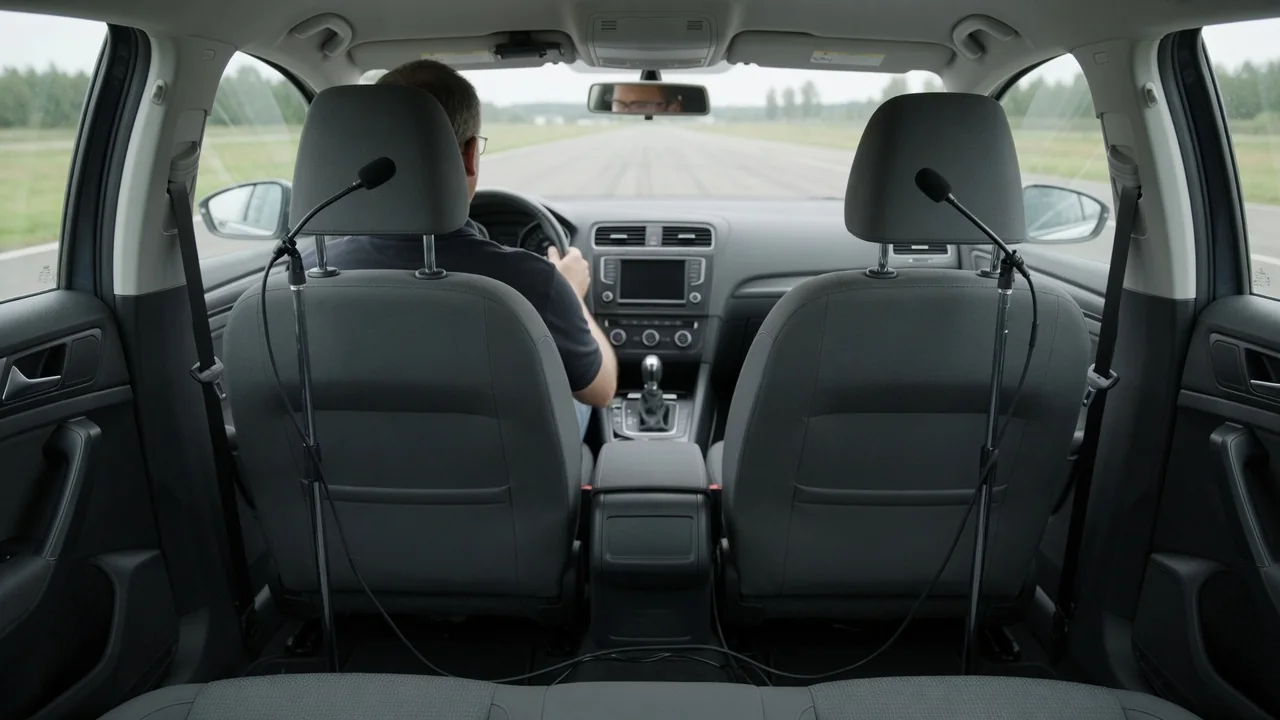
Cabin noise sounds like a simple number, but engineers treat it as a measurement problem with many moving parts. Vehicle cabin noise testing combines carefully placed microphones, controlled driving conditions and detailed frequency analysis so results can be repeated, compared and traced back to their sources. This guide explains, in general terms, how engineers measure cabin noise, what each part of the process captures, and why a single decibel figure rarely tells the whole story about how quiet a car feels.
Microphones
The core tool is a measurement-grade microphone connected to a data acquisition system. Unlike the microphone in a phone, it has a known, documented frequency response and is checked with an acoustic calibrator, a device that produces a reference tone at a defined level, usually before and after a test session. Microphones are placed where occupants actually hear the sound, most often near the driver's outer ear, with additional positions at the front passenger seat and the rear seats. Engineers mount them on rigid fixtures so the position stays the same from run to run, and they keep cables and mounts from touching trim panels, because a vibrating fixture can add noise that the car itself does not produce.
For a closer match to human hearing, many test programs use a binaural measurement system, sometimes called an artificial head or head and torso simulator. It places microphones inside ear-shaped openings on a model head and shoulders, so the recording includes the way the human body shapes incoming sound. These recordings can later be played back through headphones, which allows evaluators to listen to and rate different vehicles or design changes side by side in a quiet room rather than relying on memory from separate drives.
Microphones are rarely used alone. Accelerometers on engine mounts, suspension points, seat rails or the steering wheel record vibration, while engine speed, vehicle speed and throttle position are logged at the same time. Synchronizing these channels lets engineers connect a sound at the ear to the mechanical path that carried it into the cabin, a process often described as transfer path analysis.
Road conditions
Cabin noise changes with speed, engine load and the surface under the tires, so engineers define the driving condition as carefully as the microphone position. Proving grounds typically offer several known surfaces, such as smooth asphalt, coarse-textured asphalt, jointed concrete, cobblestones and impact strips. Common maneuvers include steady cruising at several fixed speeds, full-throttle acceleration through the gears and coasting with the powertrain disengaged or switched off. Comparing a coasting run with a powered run at the same speed helps separate powertrain noise from tire, road and wind contributions.
Small details matter. Tire pressure, tire wear and tire temperature all influence road noise, so they are set and recorded. Windows, sunroof and climate control settings are fixed, because a fan on a high setting can dominate a quiet cabin. Wind speed and direction, wet or dry pavement, and background noise from nearby traffic can all shift the results. To reduce random variation, engineers usually repeat each run several times and look at averaged data rather than a single pass.
Indoor facilities complement road testing. A chassis dynamometer inside a hemi-anechoic chamber, a room with sound-absorbing walls and a hard floor, lets a vehicle run at speed while outside noise is kept out. Rollers can be fitted with textured surfaces to simulate road input, and aeroacoustic wind tunnels isolate wind noise around mirrors, pillars and door seals. Labs offer repeatability, while real roads capture combinations of inputs that are hard to recreate indoors, so development programs generally rely on both.
Frequency
Human hearing covers roughly 20 Hz to 20 kHz, but the ear is not equally sensitive across that range. That is why overall cabin noise is often reported in dB(A), a level adjusted with A-weighting, which reduces the influence of low frequencies to approximate how people perceive moderate sound levels. The trade-off is that deep, low-frequency boom can feel more intrusive than its A-weighted number suggests, so engineers also review unweighted or differently weighted data when low-frequency content is a concern.
Beyond the overall level, recordings are broken into their frequency content. A Fast Fourier Transform produces a detailed spectrum, while octave and one-third-octave bands group energy into broader ranges that are easier to compare. Plotting the spectrum against engine speed or vehicle speed reveals patterns that a single number hides. Order analysis is especially useful: noise tied to rotating parts, such as engine firing pulses, rises in frequency as rpm rises, while structural or acoustic resonances stay near a fixed frequency regardless of speed. Telling these apart points engineers toward the right component.
In general terms, different sources tend to occupy different regions. Low frequencies are often associated with powertrain boom and road inputs transmitted through the suspension and body. Tire and road noise frequently concentrates in the middle range, while wind noise from seals, mirrors and gaps tends to extend into higher frequencies. Tonal sounds, such as gear whine or electric motor whine, appear as narrow peaks. Engineers may also calculate psychoacoustic measures like loudness, sharpness and speech intelligibility indices, which estimate how easy it is to hold a conversation in the cabin.
Practical implications and limits
Published cabin noise figures are only comparable when the conditions behind them match. A reading taken at a different speed, on a different pavement, with a different microphone position or with different tires can differ noticeably for the same vehicle. A single overall value also says nothing about whether the sound is a steady hum or an irritating tone, so two cars with similar numbers can feel quite different from the driver's seat.
Owners who try their own measurements with a smartphone app should treat the results as rough and relative. Phone microphones are not individually calibrated, apply their own processing and are sensitive to how the phone is held or mounted. Used consistently in the same car, on the same stretch of road and at the same speed, they can still hint at changes, for example after new tires are fitted or a door seal deteriorates, but they are not a substitute for engineering-grade instrumentation.
Measurement and perception are also not the same thing. A quiet cabin can make remaining sounds more noticeable, which is one reason electric vehicles, lacking an engine to mask other noises, can reveal wind, tire and accessory sounds more clearly. For this reason engineers combine instrument data with structured listening evaluations, and any result describes a specific vehicle configuration under specific conditions rather than a permanent property of a model.