How Do Engine Mounts Affect Cabin Vibration?
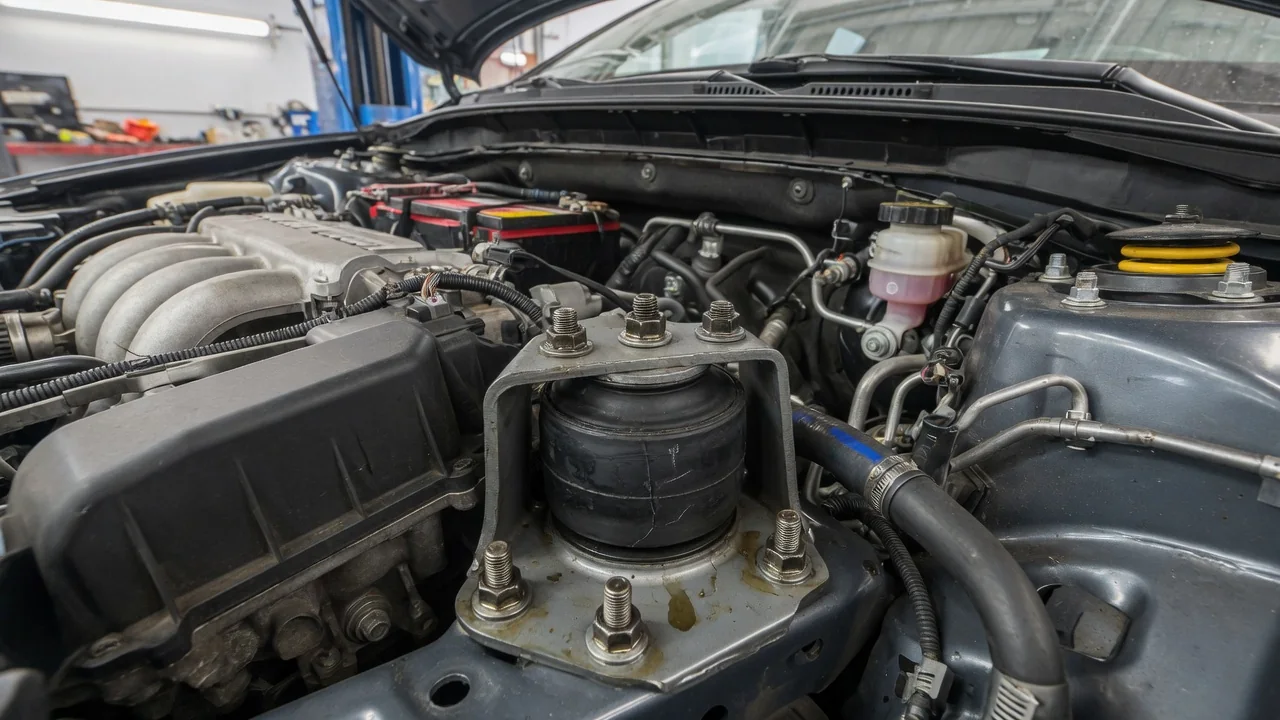
Engine mounts hold the engine and transmission in place. They also decide how much of the powertrain's constant shaking reaches the body, seats, steering wheel, and floor. When they work as designed, most drivers never notice them. When they harden, crack, or collapse, cabin vibration is often one of the first symptoms. This guide explains how engine mounts affect cabin vibration through isolation, idle feel, and wear. It also covers where engine mount NVH reasoning reaches its limits.
Isolation: Keeping Engine Vibration Out of the Body
Every running engine shakes. Combustion pulses arrive in a rhythm tied to engine speed and cylinder count. Pistons and connecting rods create inertial forces, and the drivetrain twists in reaction to torque. The mounts are the main structural link between that moving powertrain and the vehicle's body or subframe. Most are built from rubber bonded to metal brackets. The rubber's elasticity lets the engine move slightly instead of driving its vibration straight into the structure. That small, controlled movement is what isolation means in practice.
Mount design is a balance. A softer mount generally filters small, fast vibrations better, but it lets the engine rock more when torque changes, which can feel loose or cause clunks. A stiffer mount controls movement but passes more vibration into the cabin. Many vehicles manage this trade-off with fluid-filled hydraulic mounts. These add damping for large, slow motions while staying relatively compliant for small, high-frequency vibration. Some vehicles use electronically or vacuum-controlled mounts that change their behavior depending on operating conditions. Torque struts or rods are often added to limit fore-and-aft rocking without making every mount stiff.
Mounts are not the only path. Vibration also travels through exhaust hangers, subframe bushings, driveshafts, axles, shift cables, and hoses. Once it reaches the body, panels and the steering column can amplify it or radiate it as low-frequency boom. That is why engine mount NVH is best understood as one part of a system. Healthy mounts reduce what enters the structure, but the body and other connections determine how much of it the occupants ultimately feel and hear.
Idle Feel: Why Problems Often Show Up at Low RPM
Idle is where mount behavior is often easiest to notice. Engine speed is at its lowest, so the firing pulses come at a low frequency. That frequency can sit closer to the natural frequencies of the body, seats, and steering column. At higher speeds, wind, tire, and road noise tend to mask a mild buzz, but a stationary car offers little to cover it. When mounts have lost their compliance or damping, idle is frequently where occupants first notice that the car feels rougher than it used to.
Load matters as much as speed. Selecting Drive or Reverse in an automatic, or holding the car on the brakes, adds torque reaction that preloads the mounts in one direction. Accessory loads such as the air conditioning compressor can also change idle speed and load. A common pattern with mount-related vibration is a noticeable change when shifting from Park or Neutral into gear, or when an accessory switches on. Occupants may feel it through the seat, floor, or steering wheel, or see it as a shaking rearview mirror.
It is important to separate the source from the path. Mounts transmit vibration; they do not create it. An engine can shake noticeably even with perfect mounts if it has a misfire, an unstable idle, an accessory drive problem, or an air-intake leak. A smooth-running engine on worn mounts and a rough-running engine on good mounts can feel similar from the driver's seat. For that reason, idle vibration alone is not proof of a mount problem.
Wear: How Aging Mounts Change What You Feel
Rubber mounts degrade over time. Heat from the engine and exhaust, exposure to oil, coolant, or other fluids, ozone, and repeated flexing can all take a toll. The rubber may harden, crack, or separate from its metal bonding. Some mounts sag or collapse, so the engine sits lower or at a different angle than intended. Hydraulic mounts can leak their internal fluid and lose much of their damping. Active mounts can develop electrical, actuator, or vacuum faults, depending on their design.
Each failure changes cabin vibration in a different way. Hardened rubber behaves more like a stiff connection, so more vibration passes into the body. A cracked, separated, or collapsed mount may allow excessive engine movement. That can produce clunks on acceleration, during gear engagement, or when lifting off the throttle. In some cases it allows metal-to-metal contact that sends sharp impacts into the cabin. Because several mounts share the load, one weak mount can shift extra work onto the others and accelerate their wear. Excess engine motion can also stress connected parts such as exhaust components, hoses, wiring, and shift linkages.
Inspection usually starts with a visual check for cracks, torn rubber, fluid residue around hydraulic mounts, and gaps or contact marks that suggest the engine has shifted. Technicians may also observe engine movement under controlled load. Any check that involves applying torque with the engine running carries real risk. Do it carefully, with a helper and the vehicle secured, following the procedure in the vehicle's service information.
Practical Implications and Limits
For diagnosis, the most useful clue is what the vibration follows. Vibration that changes with engine speed, gear selection, or engine load, and that appears while the car is stopped, points toward the powertrain and its mounting. Vibration that grows with road speed regardless of gear points more toward tires, wheels, brakes, or driveline components. Note when the vibration happens, what makes it better or worse, and whether it began after other work was done. Those details give a technician far more to work with than a general complaint of shaking.
Replacement choices also affect cabin feel. Mounts designed to the original specification aim to restore the factory balance between isolation and control. Stiffer aftermarket or performance mounts, including polyurethane designs or inserts, deliberately reduce engine movement. They usually transmit more vibration and noise into the cabin as a result. Installation matters too. A mount tightened with the powertrain out of its normal position can end up preloaded and transmit more vibration than expected. Follow the service procedure and torque specifications for the specific vehicle.
There are limits to what mounts can explain or fix. They cannot smooth out an engine that is running poorly, and new mounts will not cure vibration that originates in the wheels or driveline. Vehicles differ in the number, type, and location of their mounts, in how sensitive they are to mount condition, and in how long mounts typically last. There is no universal replacement interval or single symptom that applies to every car. The vehicle's own service information is the reliable reference for specifications and procedures.