How Do Designers Review Car Surface Reflections?
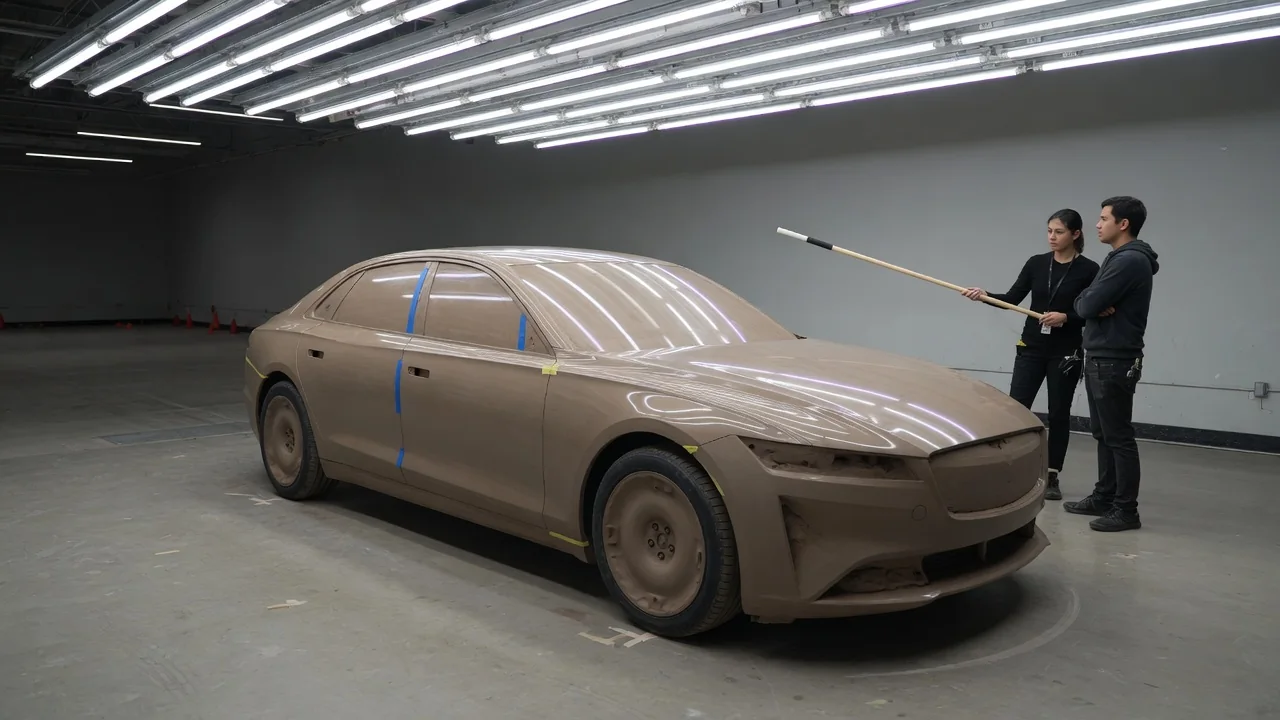
Designers review car surface reflections because the eye reads a body panel mostly through the light it reflects, not through its outline. A surface that looks acceptable as a wireframe can show wobbles, flat spots or kinked highlights once it is glossy and placed under real light. An automotive surface highlight review therefore combines digital analysis, physical models and controlled lighting to judge how reflections travel across panels, how curvature changes, and whether the form reaches the intended quality.
Light lines
The most common way to review reflections is to look at light lines, meaning the reflections of long, straight light sources on the body. In a design studio this often means rows of parallel overhead tube lights or a dedicated light tunnel. In surfacing software the same idea appears as zebra stripes or reflection lines, where a virtual pattern of parallel stripes is mirrored onto the digital surface. Some tools also use highlight lines, a simplified version that does not change with the viewer's position, which makes them convenient for checking a surface without moving the camera.
Reviewers watch how these lines behave rather than where they sit. On a well-resolved panel the lines flow smoothly, change width gradually and do not jump or kink where two surface patches meet. Where a crisp character line is intended, the highlight should change sharply and cleanly along that edge, not wander. Designers also move around the model to see how quickly the lines travel. A surface where reflections slide slowly reads as calm and taut, while one where they race or bunch together suggests a change in curvature that may or may not be deliberate.
Physical models need help to show reflections. Raw modeling clay is matte, so clay models are often covered with a thin reflective film or painted before a review. Teams frequently take models outdoors as well, because the sky and the horizon create a long reflected line along the body side that is hard to reproduce indoors and reveals uneven surfaces quickly.
Panel curvature
Reflections are sensitive because they depend on the direction the surface faces at each point, and that direction is controlled by curvature. A tiny change in shape that a ruler would barely detect can bend a reflection noticeably. Surfacing work therefore pays close attention to continuity between patches. Surfaces can meet with only matching position, with matching tangent direction, or with matching curvature, often described as G0, G1 and G2. At a tangent-only joint the stripes stay connected but show a visible bend; at a curvature-continuous joint they flow through without a break. Some visible surfaces are built to an even higher level of continuity so that the rate of curvature change is also smooth.
To see curvature directly, designers and surface modelers use curvature combs drawn along section curves and color maps that show how strongly each area bends. These reveal flat spots, unwanted inflections where a convex area briefly turns concave, and abrupt changes hidden inside a large panel. Large panels are usually given a slight outward crown. A nearly flat sheet can look sunken under reflection, and in stamped metal it can also be prone to flexing, sometimes called oil canning.
Transitions matter as much as main surfaces. The fillets and radii that connect a hood to a fender or a door face to a sill determine whether highlights turn a corner softly or snap around it. Designers balance these choices against manufacturing needs such as how deeply a panel can be drawn in a press, which is why surface reviews usually involve both design and engineering staff.
Quality
Visible exterior surfaces are typically developed to what the industry calls Class-A standards. The term has no single universal definition, but it generally means clean continuity, a sensible patch layout, no unintended ripples, and faithful reproduction of the approved design shape. A common workflow scans a clay model, rebuilds the surfaces digitally, mills a new model from that data and reviews it again under light, repeating until the reflections match the intent.
Quality also depends on how panels relate to each other. A reflected line should continue across a door gap into the next panel without stepping up, down or changing angle. If two panels are not flush, the highlight visibly breaks at the shut line even when each panel is smooth on its own. In production, stamped and painted bodies are commonly inspected under striped lighting so that dents, waviness and assembly mismatches show up as distorted lines. Paint texture plays a role too, since a finish with more orange peel softens and blurs reflections compared with a smoother coat.
Final judgment is not purely numerical. Analysis tools point to problems, but sign-off usually relies on trained reviewers looking at physical models and realistic renderings in several lighting conditions, because the goal is how the car reads to a person, not only whether a measurement passes.
Practical implications and limits
For owners, the same principle offers a simple way to look at a body. Viewing a panel at a shallow angle while it reflects a straight edge, such as a fluorescent fixture or a roofline, can make small dents, uneven repairs or poorly matched replacement panels easier to notice. Color and finish change how much shows: dark, high-gloss paint tends to expose surface deviations more readily than light or metallic colors, and matte finishes hide many of them by diffusing reflections.
There are limits to what reflections can tell anyone. What a surface looks like depends heavily on the surroundings, so a panel can appear flawless in one setting and uneven in another. Digital checks cannot fully predict paint behavior, material differences between steel, aluminum and plastic parts, or production tolerances on a particular vehicle. Some sharp changes in reflection are intentional styling, not defects. A general explanation like this one describes how reviews work, but it cannot establish the surface quality of any specific make or model.