How Do Brake Pad Materials Affect Feel?
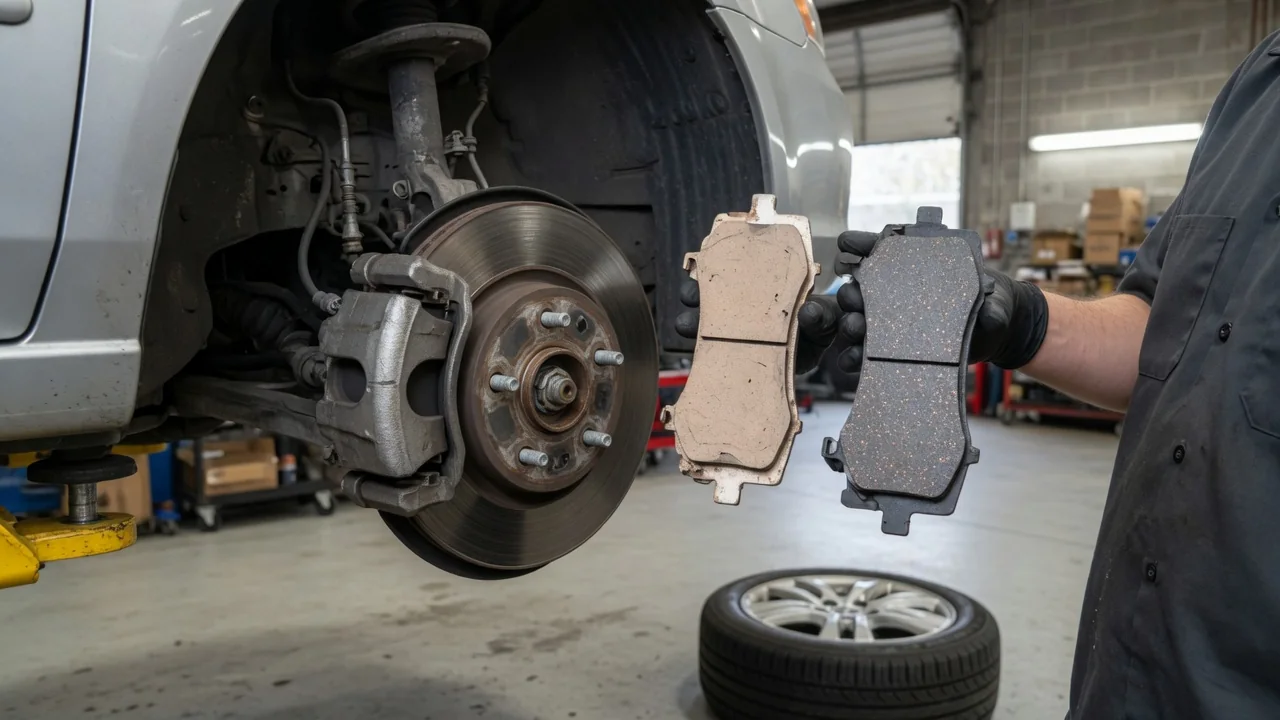
Brake pad material is one of the main reasons two cars with similar brake hardware can feel different under the pedal. The friction compound affects how quickly the brakes bite, how consistent the response stays as temperatures rise, how much noise the system makes, and how the pads and rotors wear. This guide explains brake pad material behavior in general terms. It separates mechanisms that apply broadly from details that depend on a specific vehicle, caliper design, or pad formulation.
Friction and temperature
Pedal feel is largely the relationship between the force you apply and the deceleration you get. For a given hydraulic system, that relationship depends heavily on the pad's friction coefficient, which describes how much braking force the pad generates for a given clamping force. A compound with a higher coefficient produces more deceleration for the same pedal effort, which drivers often describe as a stronger bite. A lower coefficient requires more pedal pressure for the same stop. Neither is inherently better. The brake system as a whole, including master cylinder size, caliper piston area, and booster assistance, is designed around an expected friction level. A pad that departs significantly from that expectation can make the pedal feel either grabby or wooden.
Friction is not constant. Every compound has a temperature range in which its friction is relatively stable, and outside that range it behaves differently. Organic pads, also called non-asbestos organic pads, typically offer good friction when cold and a soft, progressive engagement. Their resins and fibers can break down at high temperatures, however, which leads to fade: the pedal needs more force or travels further for the same stop. Semi-metallic pads, which contain steel fibers or other metals, tend to tolerate and shed heat better and often hold friction well when hot, although some formulations feel less aggressive until they warm up. Ceramic compounds are generally known for stable friction across normal street temperatures and smooth, predictable engagement, but formulations vary widely in how they handle sustained heavy use.
Material also affects pedal firmness through compressibility. A pad that compresses more under load lets the pedal travel slightly further and can feel softer, while a denser compound tends to feel firmer and more immediate. In addition, most pads work partly by depositing a thin transfer layer of friction material on the rotor surface. An even transfer layer helps provide consistent bite. An uneven one, often caused by improper bedding or overheating, can produce pulsation or inconsistent grip that drivers sometimes attribute to warped rotors.
Noise
Brake noise usually comes from vibration. As the pad slides against the rotor, friction can excite the pad, caliper, and rotor into resonance, producing squeal at higher frequencies or groan and grind at lower ones. Pad material influences this through its stiffness, its ability to damp vibration, how its friction changes with sliding speed, and how abrasive it is against the rotor. Compounds whose friction rises as speed drops can be more prone to certain low-speed noises, while harder, stiffer materials can transmit vibration more readily.
In general terms, semi-metallic pads are more often associated with audible noise and a slightly grittier feel, partly because of their metal content and abrasiveness. Ceramic and many organic formulations are generally regarded as quieter in everyday driving. These are tendencies rather than rules, because pad makers tune noise behavior with chamfers, slots, backing plate shims, damping layers, and compound additives. A well-engineered semi-metallic pad can be quiet, and a poorly matched ceramic pad can squeal. Noise also connects directly to feel: vibrations too faint to hear can still be sensed through the pedal or steering wheel, and many drivers perceive a quiet, smooth stop as more refined even when stopping performance is unchanged.
Wear
Wear is a trade-off between the pad and the rotor. Softer, less abrasive compounds such as many organic pads tend to be gentle on rotors but may wear themselves faster, particularly under heat. Semi-metallic pads are typically more abrasive, which can help them clean and grip the rotor surface but may increase rotor wear. Ceramic pads are generally associated with lower rotor wear and less noticeable dust, since the lighter-colored dust they produce stands out less on wheels. Actual wear depends heavily on driving style, vehicle weight, terrain, and the specific formulation, so a material category alone cannot predict a service interval.
Wear also changes feel over time. Glazing, a hardened pad surface caused by overheating, can reduce friction and make the brakes feel less responsive. Rotor condition matters as well: grooving, uneven deposits, or thickness variation alter how the pad contacts the disc, which can show up as pulsation, noise, or a change in bite. When new pads are installed, bedding them in with a series of controlled stops builds the initial transfer layer and helps the pad and rotor surfaces conform to each other. That process lets the brakes settle into their intended feel instead of developing uneven deposits early in the pad's life.
Practical implications and limits
For most drivers, the sensible starting point is the vehicle manufacturer's specification or a pad designed as a direct equivalent for that application. Brake balance between the axles and the overall relationship between pedal force and deceleration are engineered around expected pad characteristics. A compound chosen only for stronger bite or lower dust can shift that balance in ways that are not obvious in casual driving. Front and rear pads should generally be chosen to work together, because changing friction at one end can alter how braking effort is distributed.
It also helps to match the compound to how the vehicle is actually used. Frequent towing, long mountain descents, or track driving place more weight on heat tolerance, while mostly moderate-speed commuting often favors quiet operation, low dust, and smooth response when the brakes are cool. Labels such as ceramic or semi-metallic describe broad families, not guaranteed performance. Two products in the same category can differ substantially in friction level, noise behavior, and wear.
Finally, pad material is only one part of brake feel. Fluid condition, air in the hydraulic lines, caliper slide function, hose condition, rotor state, and booster operation all influence how the pedal responds. A soft or inconsistent pedal is not automatically a pad problem, and changing compounds will not correct a hydraulic or mechanical fault. If brake feel changes suddenly, or the car pulls, grinds, or shows a brake warning light, the system should be inspected before assuming that a different pad material is the answer.