How Did Cars Switch From Mechanical to Electronic Throttles?
For most of automotive history, pressing the accelerator pulled a steel cable that opened the throttle directly. Today, the pedal usually sends an electrical signal and a computer decides how far the throttle opens. Understanding how did cars switch from mechanical to electronic throttles means following a gradual change driven by emissions rules, fuel injection, cruise control, and stability systems rather than one sudden redesign.
Cable linkage
In a traditional setup, the accelerator pedal pivots on a bracket and pulls a braided steel cable running through a sheath across the firewall. The far end hooks to a cam or lever on the throttle body, or on older engines a carburetor, rotating the throttle plate against a return spring. Lift your foot and the spring snaps the plate closed. The relationship is purely physical: pedal travel equals plate angle, shaped only by the geometry of the cam and the length of the linkage.
On a cable-equipped car, you can usually see the linkage by opening the hood and watching the throttle lever move while a helper presses the pedal with the engine off. Electronics crept in around this hardware long before replacing it. Idle air control valves bypassed the closed plate to steady idle speed, cruise control used vacuum or electric actuators tugging a second cable, and a throttle position sensor reported plate angle to the fuel injection computer. Layouts differ by manufacturer, and some vehicles used rods instead of cables.
Sensors and motor
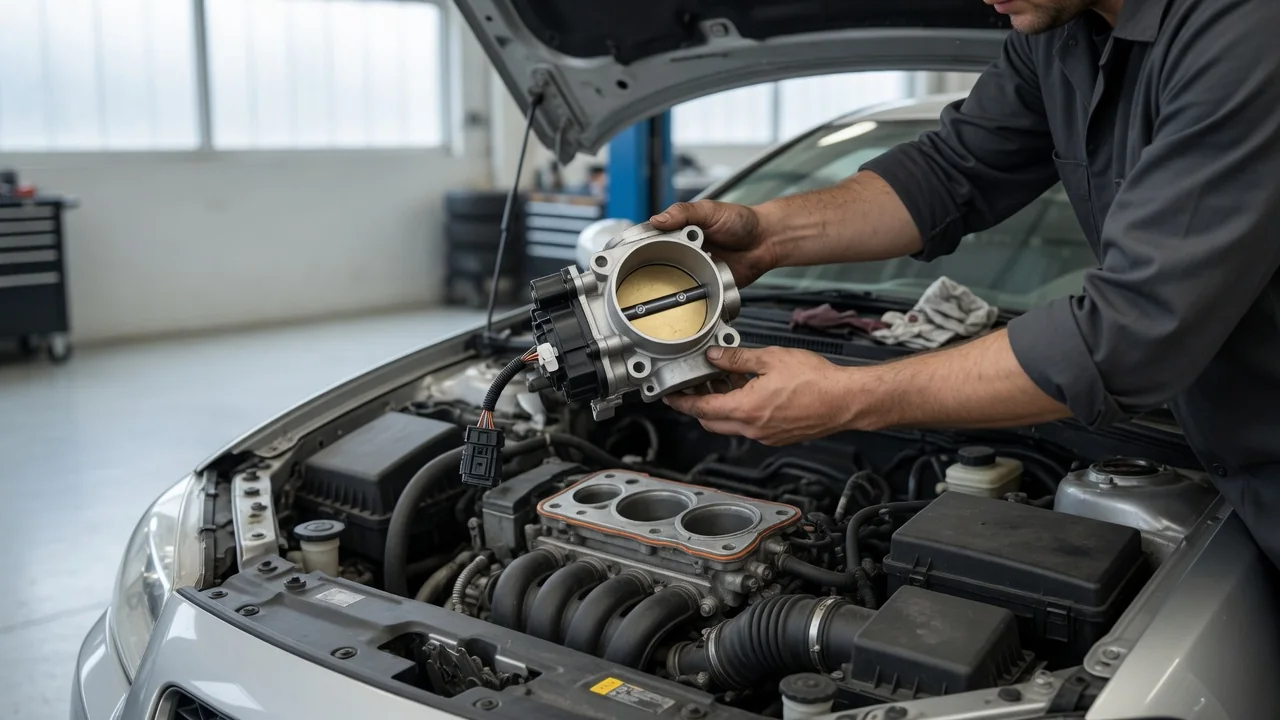
Electronic throttle control, often called drive-by-wire, removes the cable and replaces it with three pieces. An accelerator pedal position sensor assembly at the pedal converts foot movement into voltage signals. The engine control module reads those signals alongside engine speed, airflow, temperature, and transmission data. A small electric motor on the throttle body then turns the plate through reduction gears, while throttle position sensors report the actual angle back so the module can correct any difference between commanded and measured position.
Because a single faulty signal could otherwise command unwanted acceleration, designers built in redundancy. Pedal assemblies typically carry more than one sensor track, and the control module compares them continuously; throttle bodies generally use paired position sensors as well. If the signals disagree, the system usually limits power and lights a warning. Springs inside the throttle body commonly hold the plate at a slightly open default position when the motor is unpowered, allowing limited movement. Exact sensor types, voltages, and fallback strategies vary by manufacturer and model year.
Driver feel
A cable gives direct feedback: the pedal effort reflects the return spring and cable friction, and the engine answers as quickly as air can rush past the plate. With electronic control, the pedal is a spring-loaded sensor module whose resistance is engineered, not inherited. The control module interprets pedal position as a torque request, so the same pedal angle can produce different throttle openings depending on gear, engine speed, and selected drive mode. Sport settings often open the plate earlier, while economy settings soften the initial response.
Some drivers of early electronic systems noticed a slight hesitation between pressing the pedal and feeling the engine respond, partly because calibrations smoothed abrupt inputs to reduce emissions and driveline shock. Later calibrations and faster processors narrowed that gap considerably on many vehicles. The trade-off brought real benefits: smoother automatic transmission shifts, because the module can briefly trim torque, and steadier cold-start behavior without a separate idle valve. How lively or muted a particular car feels still depends heavily on the manufacturer's tuning choices.
Everyday Use and Observations
In daily driving, the switch shows up in features that would be clumsy or impossible with a cable. Cruise control no longer needs its own actuator; the module simply holds the throttle angle needed for the set speed. Traction control and stability control can reduce engine torque the instant a wheel slips, regardless of pedal position. Adaptive cruise, hill descent functions, and automatic rev-matching on some manual transmissions all depend on the computer having authority over the throttle plate.
Owners can often tell which system they have with a quick look. A cable car shows a sheathed cable running to the throttle body, while an electronic unit has only a wiring connector and a motor housing on its side, and nothing mechanical leaves the pedal assembly. With the ignition on and the engine off, a faint whir or click from the throttle body is common on some vehicles as the system checks itself. Hybrids and electric vehicles use the same pedal-sensor concept, although the request goes to motor controllers rather than a throttle plate.
Limits and Next Steps
Electronic throttles are not immune to problems. Carbon deposits can make the plate sticky, wiring connectors can corrode, and pedal or throttle sensors can wear. Typical symptoms include an unstable idle, a warning lamp, or a reduced-power mode that restricts acceleration. A stored fault code pointing toward the throttle or pedal circuit is evidence to interpret, not proof that a component has failed; wiring faults, low system voltage, and intake leaks can produce similar results, and many code definitions are manufacturer-dependent and need vehicle-specific confirmation.
For anyone tracing a concern, sensible next steps are to check the owner's manual for what the warning lamp means, note when the symptom occurs, and have the stored codes and live sensor readings reviewed with a capable scan tool. Some vehicles require an idle or throttle relearn procedure after cleaning or battery disconnection, and the method varies by make. Because the plate is motor-driven and tied to safety logic, repairs beyond inspection are best left to a qualified technician working from service information for that exact vehicle.