How Did Car Keys Become Electronic?
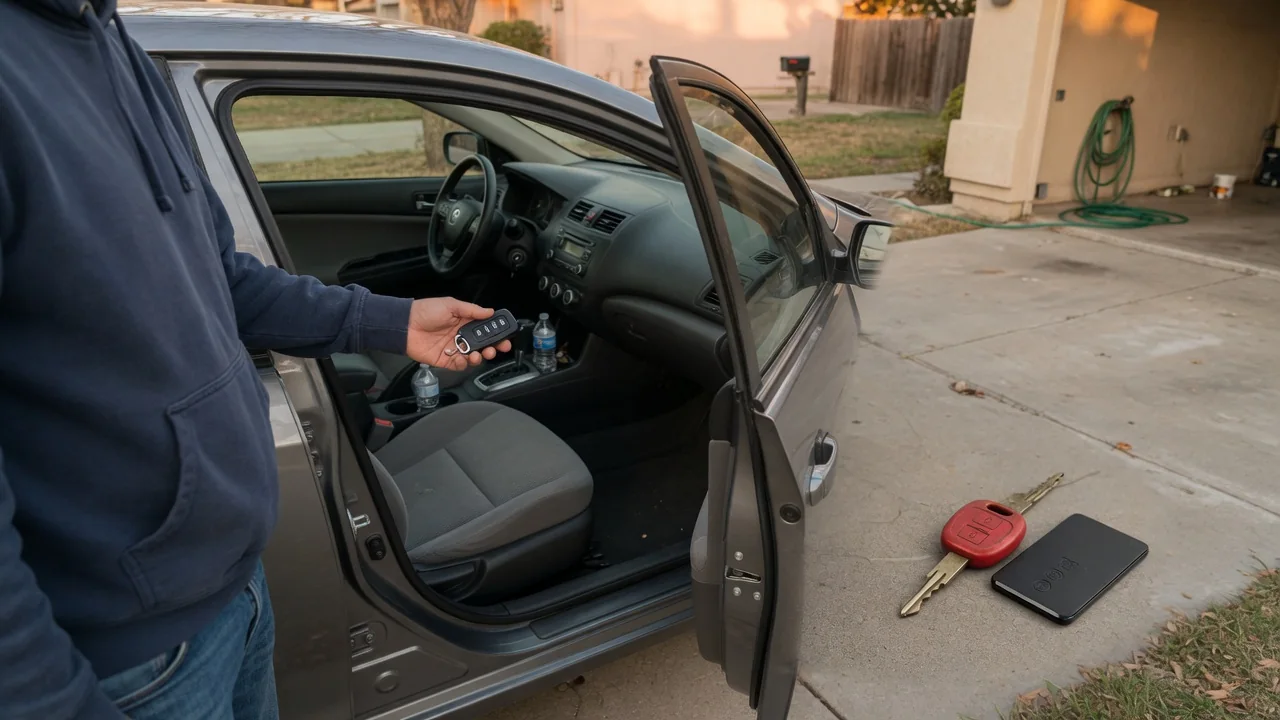
For decades, a car key was nothing more than a shaped piece of metal. So how did car keys become electronic? The change came in stages, as automakers added a coded chip to the key, then remote buttons, and eventually a fob that never has to leave a pocket. Each step answered a weakness in the one before it.
Mechanical lock
The traditional car key works purely by shape. Cuts along the blade lift a row of small spring-loaded tumblers or wafers inside the lock cylinder to the correct height, which frees the cylinder to rotate. In the door, that rotation moves a rod or cable to release the latch. In the steering column, it turns the ignition switch and withdraws the steering lock. The key proves nothing except that its profile matches, so any accurate copy cut from blank stock works just as well as the original.
That simplicity was also the weakness. A worn cylinder could sometimes be turned with a poorly matched key, a forced lock could be rotated with a tool, and the ignition wiring behind the switch could be bridged to start the engine without any key at all. Many drivers can still see this heritage on their own vehicle: a metal blade, a keyhole in the driver's door, and on older models a column-mounted ignition barrel. Blade styles vary, from edge-cut patterns to grooves milled into the flat face.
Electronic authorization
The first major electronic step was the immobilizer. A small transponder chip is molded into the plastic head of the key, and an antenna ring around the ignition barrel energizes it when the key is inserted. The chip replies with a code, and a control module compares that reply to the values it has stored. Only when they agree does the engine computer allow fuel delivery, ignition, or starter operation. The cut blade still turns the lock, but the turn alone no longer authorizes the engine to run.
Later systems moved from a fixed code to encrypted challenge-and-response exchanges, which made simple copying of the signal far less practical. Remote locking developed alongside, first as a separate transmitter and then as buttons built into the key head, often using codes that change with every press. Proximity fobs combined both ideas: the car detects the fob nearby, verifies it by radio, and permits a push-button start. The exact architecture, including which modules hold the key data, differs between manufacturers and generations.
Owner implications
For owners, the biggest change is that a replacement key now involves two jobs instead of one. The blade still has to be cut to match the locks, but the chip or fob must also be registered to the vehicle before the engine will start. A hardware-store copy of a transponder key may open the door and turn the ignition, yet leave the engine cranking without firing or not cranking at all. Depending on the vehicle, programming may require dealer equipment, a specialist locksmith, or an existing working key.
This makes a spare key more valuable than it was in the mechanical era. On many vehicles, adding a key while a working one is still available is simpler than starting from scratch after every key has been lost, although the procedure and security requirements are manufacturer-dependent. Proof of ownership is commonly requested before a key is programmed. The trade-off has been worthwhile for theft resistance, because bypassing the ignition wiring no longer satisfies the electronic check that the engine computer expects.
Everyday Use and Observations
Daily life with an electronic key leaves visible clues to the technology at work. Many instrument clusters show a security indicator, often a key or padlock symbol, that goes out once the key is recognized and flashes or stays lit when it is not. With a proximity fob, the doors may unlock as a hand touches the handle, and the start button responds only with the fob inside the cabin. A cluster message about the key not being detected is the system reporting that authorization has not been completed.
The transponder chip in a conventional chipped key usually needs no battery, since it is powered by the antenna field at the ignition. Remote buttons and proximity functions do rely on a small coin cell, and shrinking range is a common early sign that it is fading. Most fobs hide a mechanical emergency blade for the door, and many cars provide a backup spot where a weak fob can be held to start the engine. The location of that spot is described in the owner's manual.
Limits and Next Steps
Electronic keys are not flawless. Proximity systems have been targeted by relay equipment that extends the fob's signal, which is why some fobs now go to sleep when motionless and why some owners store them away from exterior doors. Fobs can also suffer from water, drops, and cracked circuit boards. When a car refuses to start, a stored immobilizer fault code is evidence to interpret, not proof that the key has failed, because antennas, wiring, modules, and low vehicle battery voltage can produce similar symptoms.
The progression has not stopped at the fob. Some newer vehicles accept a smartphone or a card as a digital key, using short-range radio to perform the same authorization the transponder introduced. For an owner, the practical next steps are modest: learn which type of key the vehicle uses, keep a working spare, replace the fob battery when range drops, and find the emergency blade and backup start method before they are needed. Where a starting problem persists, vehicle-specific diagnosis is the reliable path.