How Big Is an EV Battery? Capacity, Weight, Dimensions, and Range
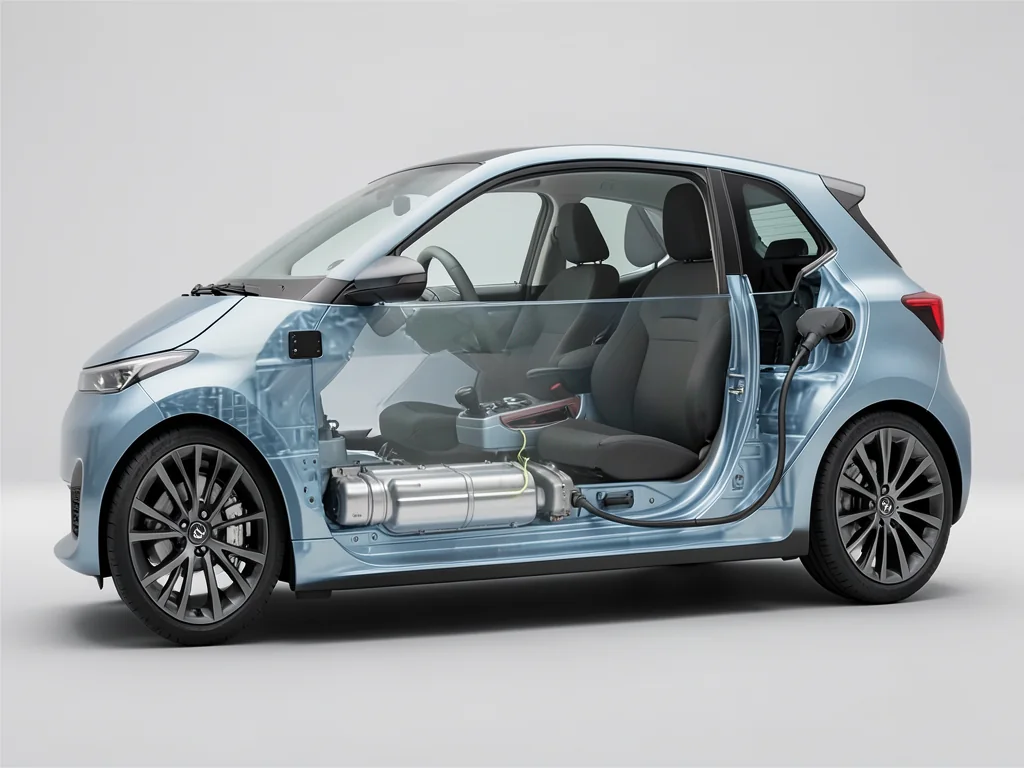
Understanding EV battery capacity means connecting stored energy in kilowatt-hours to real-world range, physical pack size, and weight. Buyers often ask how big an EV battery is, but that single question spans energy storage, dimensions, mass, and vehicle efficiency. This guide explains typical capacities across passenger cars and pickups, how kWh relates to EPA-rated range, and which production EVs carry the largest documented packs and longest range.
What EV Battery Capacity in kWh Actually Measures
The traction battery is the high-voltage energy store that powers an electric vehicle's drive motor. Its capacity is measured in kilowatt-hours (kWh), where one kWh represents one kilowatt of power delivered for one hour. A larger kWh value means more stored electrical energy is available to turn the motor, run climate systems, and support auxiliary loads before the pack must be recharged. This metric is the primary way to compare how much energy different EV batteries can hold.
Manufacturers specify both gross and usable capacity. Gross capacity is the total energy the cells can store when new, while usable capacity is the portion the battery management system allows for driving. The difference is a buffer that protects cells from deep discharge and full charge stress, extending pack life. Power is measured separately in kilowatts (kW), which describes how quickly energy is delivered or accepted. High kW charging speeds do not change the pack's kWh storage capacity.
Typical Battery Capacities in Passenger EVs
Passenger EV battery capacities typically range from roughly 40 kWh in compact cars to over 100 kWh in large sedans and SUVs. Vehicles designed for urban commuting often carry smaller packs to reduce cost and weight, while long-range models use larger packs to meet highway driving expectations. Model year and vehicle category matter: a subcompact hatchback and a full-size luxury SUV may have vastly different capacities even if both are labeled as EVs.
A vehicle name alone does not establish battery capacity because automakers frequently offer multiple pack options for the same model. For example, one trim may include a standard-range pack of about 60 kWh while another trim offers an extended-range pack near 90 kWh. The chosen configuration, along with the vehicle's energy consumption, determines practical range. Buyers should confirm the specific pack size for the exact trim and model year they are considering.
What an Average EV Battery Size Can Tell You
An average EV battery size is only meaningful when the market, time period, and included vehicles are defined. Averages based on all available configurations globally will differ from those limited to a single country or vehicle segment. For example, an average that includes commercial vans and pickups will be higher than one covering only compact passenger cars. Without clear scope, a single average number can mislead buyers comparing vehicles.
Two different averages answer different questions. An average calculated from available configurations treats every listed variant equally, while a sales-weighted average reflects what consumers actually purchase. If most buyers choose longer-range packs, the sales-weighted average will exceed the configuration average. Any published average should also state whether gross or usable capacity is used. When a defensible numerical average is unavailable, a clearly scoped typical range such as 55 to 75 kWh is more honest.
Estimating Driving Range From Usable Battery Capacity
Driving range can be estimated by multiplying usable battery capacity in kWh by the vehicle's energy consumption in miles per kWh. For a hypothetical EV with 75 kWh of usable capacity and an assumed consumption of 3.5 miles per kWh, the estimated range would be approximately 262 miles. This calculation uses an average consumption rate, so the result is a planning figure rather than a guaranteed distance.
Real-world range varies with speed, outside temperature, climate control use, terrain, and payload. Highway speeds and cold weather can reduce miles per kWh significantly, while gentle city driving may improve it. EPA-rated range is determined under standardized test conditions and should be distinguished from an individual trip forecast. For accurate trip planning, drivers should use consumption data from their own driving conditions rather than relying solely on rated range.
Physical Battery Dimensions and Complete Pack Weight
The word size in an EV battery context can mean energy capacity, exterior dimensions, or mass. A large-capacity pack is not necessarily physically larger or heavier than a lower-kWh pack because cell chemistry and pack design affect energy density. Buyers should clarify which meaning is intended when reading specifications. Physical pack size matters for installation and underfloor packaging, while weight affects vehicle efficiency and payload.
A complete battery pack includes much more than the individual cells. The enclosure, cooling hardware, wiring, busbars, and protective structures all add mass. Most modern EVs mount the pack under the floor between the axles, which lowers the center of gravity but constrains pack height. Because pack dimensions and weight depend on cell format, module count, and thermal management, kWh alone cannot establish them. Documented complete-pack specifications from the manufacturer are the reliable source; lifting or opening a pack is unsafe and should never be attempted.
Battery Capacity in Electric Pickup Trucks
Electric pickup trucks face demanding energy requirements because of their high mass, bluff aerodynamics, and intended payload and towing capability. These factors increase energy consumption per mile, so trucks need larger battery packs than passenger cars to achieve acceptable driving range. Automakers balance capacity against cost, weight, and packaging, often offering a standard pack and an extended-range option with capacity exceeding 100 kWh.
Representative pickup battery capacities must be tied to a specific model year and configuration. For example, one full-size electric truck may offer a standard pack of around 98 kWh and an optional pack near 131 kWh, but available options change frequently. Towing range cannot be predicted from pack capacity alone because trailer weight and aerodynamic drag increase consumption dramatically. Drivers should use load-specific consumption data for realistic range planning.
The Largest EV Packs and Longest Rated Driving Range
Identifying the largest EV pack or longest range requires defining the eligible market, model year, and production scope. Demonstrator vehicles and announced but unavailable specifications should be excluded. As of current production vehicles available to customers, certain luxury sedans and SUVs offer battery packs exceeding 110 kWh, but exact figures vary by configuration and certification standard. A largest-pack record is only valid for the stated criteria.
Maximum battery capacity alone does not establish maximum range because vehicle efficiency determines how far each kWh goes. A heavy, powerful SUV with a 120 kWh pack may travel less distance than a sleek sedan with an 85 kWh pack. Range claims should specify the exact configuration and testing standard, such as EPA or WLTP. Record holders for longest rated range are typically aerodynamically efficient sedans rather than the vehicles with the largest packs.