How Are Soft-Touch Car Buttons Made?
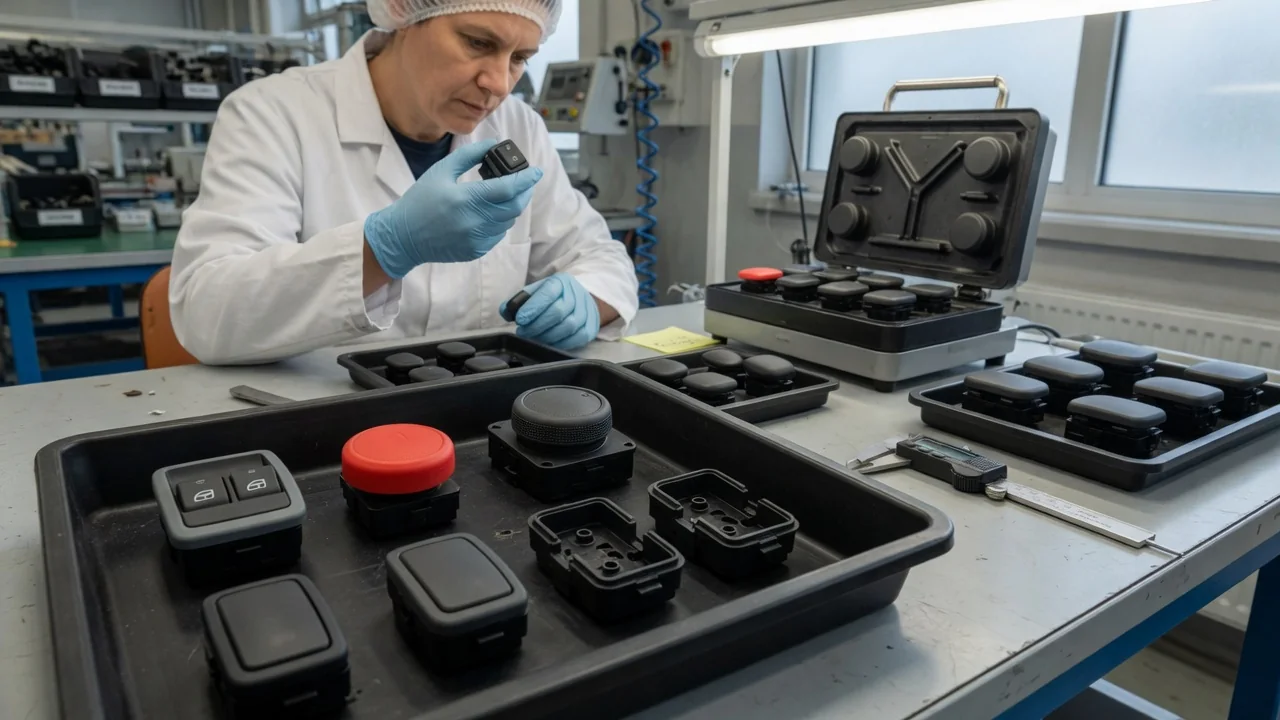
Soft-touch car buttons look like simple pieces of plastic, yet most are layered parts built to feel warm, slightly velvety and quiet under a fingertip. The feel usually comes from a thin specialized coating or a soft overmolded skin rather than from the whole button being soft. Understanding how soft touch automotive buttons are made means looking at three things: the surface coating, the rigid substrate underneath, and the ways that combination wears over years of daily use.
Surface coating: where the soft feel comes from
In many interiors, the soft-touch effect is a paint layer rather than a different plastic. A common type is a two-component polyurethane coating: a resin and a hardener are mixed shortly before spraying, then react to form a flexible, crosslinked film. Formulators adjust the polyol and isocyanate chemistry so the cured film is softer and more elastic than a typical hard clear coat. Fine matting particles are added to scatter light and give the low-gloss, slightly suede-like appearance, while other additives tune slip so the surface feels smooth rather than grabby.
The coating is usually sprayed in controlled booths, often by robots, onto parts held in fixtures, and then cured with heat. Depending on the manufacturer, the system may be solvent-borne or waterborne, and it may sit on top of a primer or adhesion promoter that helps it bond to the plastic. The film is thin, far thinner than the button wall itself, which is why the soft sensation is subtle: the finger feels the coating's surface friction and slight give, not deep cushioning.
Backlit buttons add another step, commonly described as paint and laser etch. A translucent button is coated with a light-transmitting color layer and then an opaque layer, and a laser removes the opaque paint in the shape of the symbol so light can pass through at night. A protective soft-touch or clear topcoat may then cover the whole surface. The exact layer order varies by supplier and part, but the principle is the same: both the graphics and the tactile finish live in a few thin films on the surface.
Substrate: the rigid part underneath
Beneath the coating, the button body is usually an injection-molded engineering thermoplastic. Materials such as ABS, polycarbonate and PC/ABS blends are widely used for interior switch caps because they mold accurately, hold fine detail, accept paint well and stay dimensionally stable across the temperature swings inside a parked car. For backlit buttons, the substrate is often a translucent or clear grade so light from an LED behind the switch can reach the etched symbol.
Not every soft button relies on paint. Some parts are made by two-shot molding or overmolding, where a rigid core is molded first and a soft thermoplastic elastomer is molded directly onto it. This produces a genuinely flexible skin with some thickness, which tends to appear more on grips, knobs and larger pads than on small, precise switch caps. Separately, many switch assemblies use a molded silicone rubber keypad underneath the visible cap. That rubber dome provides the click and return action, and it often carries a conductive contact that closes a circuit on a printed circuit board. In those designs, the soft feel on top and the mechanical feel underneath come from different components.
Substrate preparation matters for the coating's life. Molded parts may be cleaned, treated or primed so paint adheres reliably, because contamination such as mold release residue can weaken adhesion. Geometry plays a role too: sharp edges and raised areas tend to receive thinner coating coverage and more finger contact, which is one reason button edges are often slightly rounded.
Wear: how soft-touch surfaces age
Soft-touch coatings face several kinds of wear at once. Mechanical abrasion from fingertips, fingernails, rings and keys gradually polishes or scuffs the matte surface, producing shiny spots on the most-pressed buttons. With enough rubbing, the film can thin through and expose the layers below, which on backlit buttons may reveal the underlying color or blur the edges of a laser-etched symbol.
Chemical exposure is the second factor. Hand lotion, sunscreen, insect repellent, skin oils and some household or alcohol-based cleaners can soften, swell or discolor polyurethane films over time. Heat and humidity add a third: certain polyurethane formulations, particularly those based on polyester polyols, can undergo hydrolysis, a slow chemical breakdown driven by moisture and accelerated by warmth. The visible result can be the familiar sticky or tacky surface on older interior parts, sometimes followed by flaking or peeling. Sunlight through the glass can also contribute through UV and heat exposure, although interior coatings are generally formulated with that in mind.
How quickly any of this happens depends on the specific coating chemistry, film thickness, climate, how often a button is used and what touches it. A button pressed many times a day in a hot, humid region lives a different life than one rarely used in a mild climate, even if both came from the same production line.
Practical implications and limits
For owners, the main takeaway is that the soft feel is a surface property, so care should protect the surface. A soft microfiber cloth lightly dampened with water or a mild interior cleaner suited to coated plastics is a cautious choice, while strong solvents, alcohol-heavy wipes, abrasive pads and silicone-heavy dressings can do more harm than good on some finishes. Testing any product on an inconspicuous area first is a sensible habit, and the owner's manual may list approved interior cleaning products.
Once a coating has become sticky or worn through, the options are limited. Some people remove the degraded film and leave the bare plastic, but on laser-etched backlit buttons the symbols can be part of the same paint stack, so stripping the coating may also remove or damage the markings. Refinishing with an aftermarket soft-touch paint is possible in principle, yet matching the original feel, sheen and light transmission is difficult. Replacing the switch or bezel is often the most predictable fix where parts are available.
Construction also varies widely. One vehicle may use painted rigid caps, another overmolded elastomer, and another a hard plastic textured to look soft. Without manufacturer documentation, appearance alone cannot reliably reveal which method was used or how a specific part will age, so general guidance like this should be applied with that limitation in mind.