How Are Defroster Lines Added to Rear Glass?
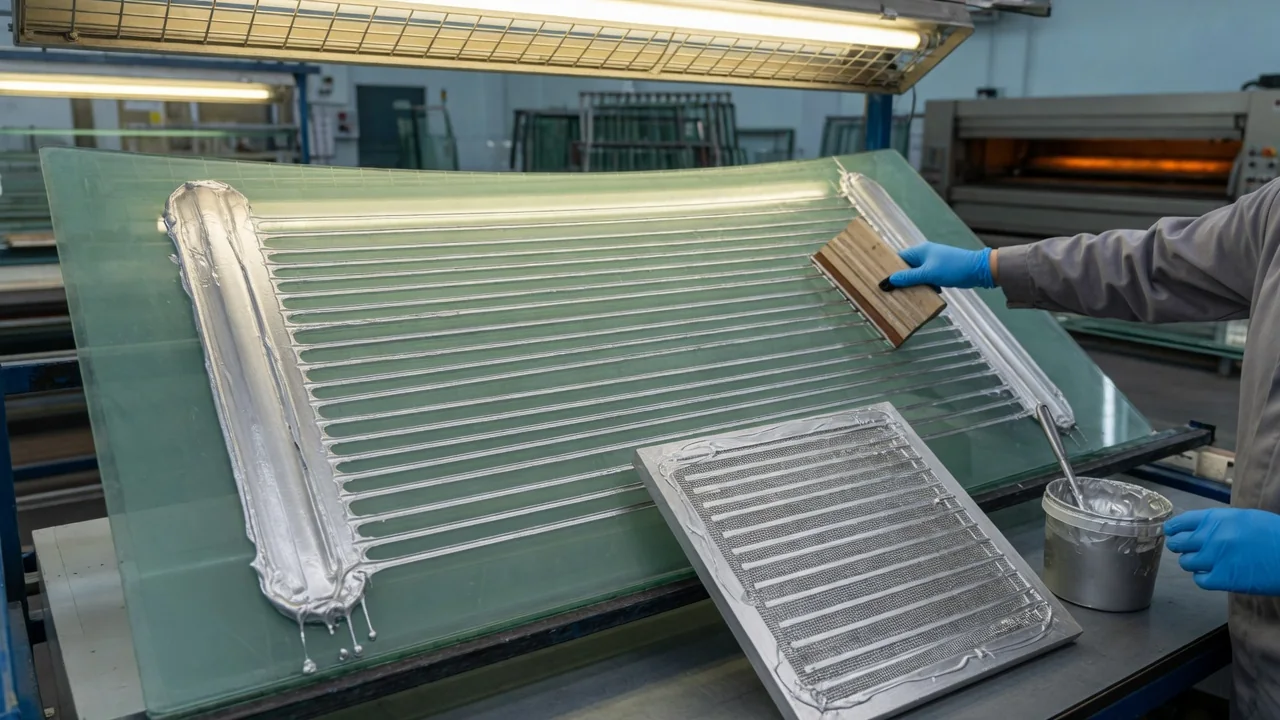
Most rear windows clear frost by turning electricity into heat through thin conductive lines on the glass. These lines are not stickers or film. In typical rear window heater grid manufacturing, they start as a silver-bearing paste and are fused to the glass during the same high-temperature process that shapes and tempers it. Knowing how defroster lines are added to rear glass explains why they last for years, how they get power, and why they can still be damaged.
Conductive traces printed and fired onto the glass
The grid usually begins as a conductive paste made of fine silver particles, a small amount of glass frit, and an organic carrier that makes the paste printable. While the rear glass is still a flat cut sheet, the paste is screen-printed onto the side that will face the cabin. The pattern is a set of thin horizontal lines running between two wider strips near the edges of the glass. Many rear windows also have a dark ceramic enamel band around the perimeter, and the wider strips are often printed over or near that band so they are less visible from outside. After printing, the paste is dried so the sheet can be handled without smearing the pattern.
The key step is firing. As the glass is heated for bending and tempering, the organic carrier burns away. The glass frit in the paste softens and bonds to the glass surface, locking the silver particles into a continuous conductive layer. The glass is then shaped and rapidly cooled to temper it. Because the traces are fused rather than glued, this process cannot be used to add them to a finished tempered window, since reheating tempered glass would undo its temper. The glass designer chooses the width, spacing, and thickness of the lines to balance heat output, even coverage, and visibility, and these values vary between designs.
Electrical connection through bus bars and terminals
The thin lines are wired in parallel between the two wide strips, which are called bus bars. One bus bar receives power from the vehicle and the other connects to ground, so current flows through every line at the same time and each line heats along its length. Because the lines share the load in parallel, a break in one line usually stops only that line from heating while the rest keep working. To attach the wiring, small metal terminals or connector tabs are soldered to the bus bars at the factory, using a solder formulated to bond with the fired silver layer. In many markets, regulations have pushed manufacturers toward lead-free solder alloys for this joint.
From the terminals, a wiring harness runs into the vehicle's electrical system. In a typical setup, the defroster switch triggers a relay that carries the relatively high current the grid draws. A timer or control module then switches the circuit off after a set period to limit electrical load, and a fuse protects the circuit. Details vary by vehicle. Some designs link rear defrost to mirror heaters or climate controls, and some rear windows carry extra printed lines that serve as radio or other antennas alongside the heater grid. For a specific vehicle, the wiring diagram and owner's manual are the reliable reference.
Damage to traces and connections
Fired traces are durable, but they are a thin layer on the exposed interior surface. Scratches are the most common problem. Cargo sliding against the glass, rings or tools, abrasive cleaning pads, and razor blades used to remove stickers or old tint film can cut a line and break the circuit at that point. Peeling off tint film or decals applied over the grid can also lift sections of the conductive layer. If the glass itself cracks or shatters, the grid is lost entirely, since tempered rear glass breaks into small pieces.
The terminals are a second weak point. Repeated vibration, tugging on the wiring connector, or careless work around the rear trim can pull a tab off its bus bar, which disables most or all of the grid depending on which connection fails. A failed relay, timer, fuse, switch, or harness can look the same from the driver's seat, so a dead defroster does not automatically mean the glass is at fault. Technicians commonly find the cause by checking for voltage at the terminals and then along individual lines, where a sudden change in the reading points to a break.
Practical implications and limits
These construction details shape everyday care. Clean the inside of the rear glass with a soft cloth, moving along the lines rather than across them, to reduce the chance of snagging an edge. Use scrapers only on the outside of the glass, and pad or move anything stored against the rear window. Window tint is usually applied to the interior surface over the grid, so installation and especially removal should use methods that do not scrape or lift the traces.
Repair has clear limits. Small breaks in individual lines can often be bridged with a conductive repair compound, and detached tabs can be reattached with conductive adhesive. Applying soldering heat directly to tempered glass risks thermal stress, so adhesive products are commonly preferred for owner-level repairs. A repaired line may not match the original exactly in resistance or appearance. Damage to a bus bar, many broken lines, or a cracked window usually means replacement glass, which arrives with the grid already fired in place. Even a fully working grid heats gradually and is meant to clear frost and fog over a period of minutes, not to melt heavy ice instantly, so expectations should follow the specific vehicle's manual.