How Are Car Wires Sized for Different Loads?
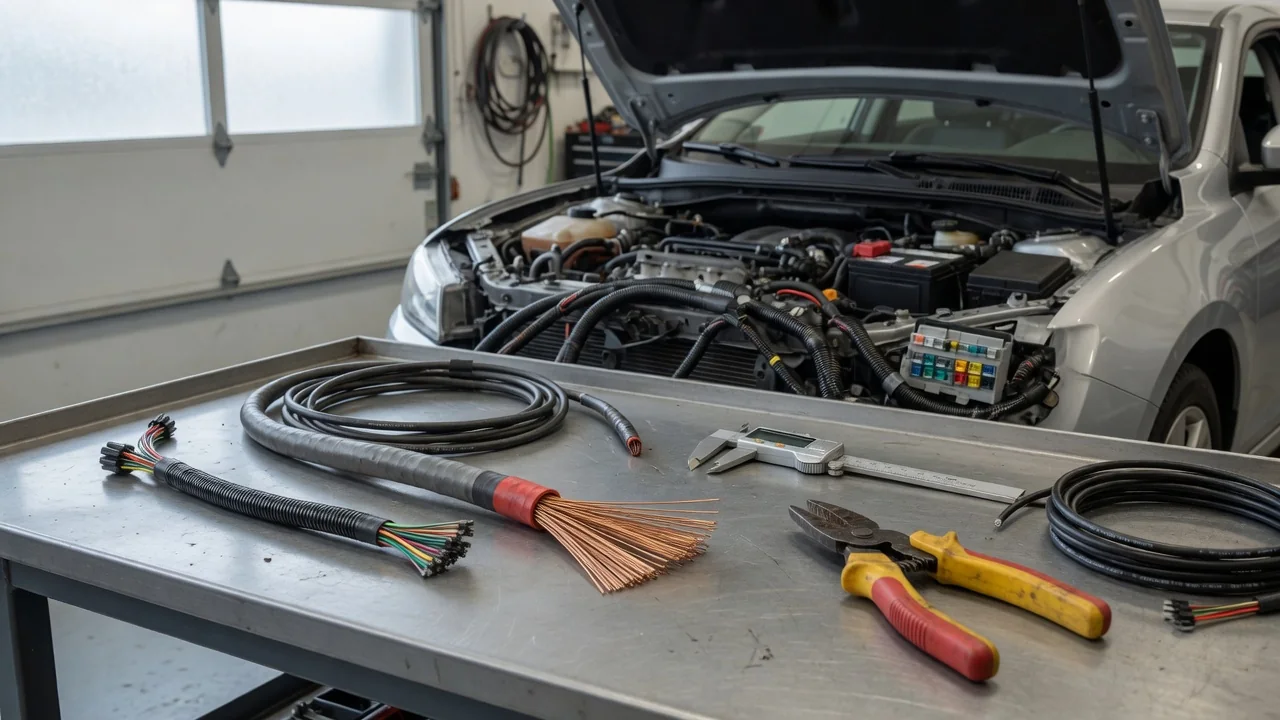
Car wires are sized by balancing three requirements. The conductor must carry its load current without overheating, it must deliver enough voltage to the device at the far end, and it must be paired with protection that opens the circuit before the wire is damaged. Choosing automotive wire gauge for a given load therefore depends on more than amperage alone. Length, routing, temperature, and the type of load all affect the final size an engineer selects.
Current capacity: matching the conductor to the load
Every conductor has resistance, so current flowing through it produces heat. A thicker copper cross-section has lower resistance per unit length and generates less heat at a given current. Current capacity, often called ampacity, is how much continuous current a wire can carry before its temperature exceeds what the insulation can tolerate. Ampacity is not a fixed property of the copper. It depends on how quickly heat can escape. A wire running alone through a cool cabin can carry more current than the same wire packed into a harness bundle beside other current-carrying conductors. The same applies to a wire routed through an engine compartment, where ambient temperatures are already high. Insulation material matters too, because different compounds are rated for different maximum temperatures. Designers typically start with the steady-state current of the load, then adjust the required size for bundling, ambient temperature, and insulation rating. In North America, sizes are commonly expressed in AWG, where a smaller number means a thicker wire. Many manufacturers instead specify metric cross-sectional area in square millimeters.
The type of load also shapes the choice. A lamp or heating element draws a fairly steady current. Motors, compressors, and solenoids can draw a much higher inrush current for a moment at start-up. A short peak heats a wire less than a continuous current of the same size. The conductor is therefore usually sized for the sustained demand, while the peak is handled in the protection and voltage drop calculations. Duty cycle matters as well. A load that runs intermittently lets the wire cool between operations, while one that runs for long periods must be sized for its full continuous current.
Voltage drop: delivering usable voltage at the device
A wire thick enough to stay cool may still be too thin to do its job. Because the conductor has resistance, part of the supply voltage is lost along its length before reaching the load. The relationship follows Ohm's law: the drop equals the current multiplied by the resistance of the path. Doubling either the current or the length roughly doubles the loss. On a nominal 12-volt system, even a modest loss is a meaningful share of the available voltage. Long runs to the rear of the vehicle, a trailer connector, or a roof-mounted accessory therefore often need a larger gauge than current capacity alone would suggest. The calculation must cover the complete circuit, not only the positive feed. Many automotive circuits return current through the body and chassis, while others use a dedicated ground wire. Every ground strap, splice, and connector adds resistance to the total.
The effects of excessive voltage drop depend on the load. Lamps glow dimmer, motors run slower and draw current for longer, and heaters produce less heat. Electronic modules can be more sensitive. If their supply voltage sags below their operating range, they may reset or behave erratically, especially during engine cranking, when system voltage is already low. Designers therefore set an allowable drop for each circuit based on what the device needs. They then choose a wire size that keeps the loss within that budget at the expected current and length. For sensitive loads, separate feeds or dedicated grounds can keep other devices on a shared path from pulling the voltage down.
Protection: fuses are sized to protect the wire
Overcurrent protection exists mainly to protect the wiring, not the device it powers. If a wire chafes through its insulation and touches the body, or a component fails internally, current can rise far beyond what the conductor can handle. The insulation can then melt or ignite. A fuse, fusible link, or circuit breaker interrupts that current before the wire reaches a damaging temperature. The rating is chosen with two limits in mind. It must be high enough that normal operation, including brief inrush currents, does not blow it. It must also be low enough to open well before the protected wire is overloaded. Fuses also have time-current characteristics: a moderate overload may take some time to open the fuse, while a hard short opens it almost instantly. Designers select fuse types whose timing suits the load.
Placement matters as much as rating. Protection is normally located as close to the power source as practical, because any wire upstream of the fuse is unprotected. Large feeder cables from the battery are often covered by high-current fuses or fusible links at the battery or in a main distribution box. Smaller branch circuits are then protected individually downstream. Where a circuit branches into a thinner wire, that thinner section generally needs its own protection matched to its lower capacity. Relays let a small, lightly protected switch circuit control a heavy load on a separately sized and fused power circuit. Some vehicles also use electronic power distribution that monitors current and shuts off a faulted output, but the underlying goal is still to protect the conductor.
Practical implications and limits
For owners and technicians, the main consequence is that wire size, fuse rating, and load form a matched set. Installing a higher-rated fuse to stop repeated blowing removes the margin that protects the harness. It can turn a simple fault into a wiring fire. A fuse that blows repeatedly usually points to a short, a failing component, or an added load, and the cause should be found rather than worked around. Likewise, repairing a damaged section with thinner wire than the original reduces both current capacity and the voltage reaching the device, even if the circuit seems to work at first.
Adding aftermarket equipment such as lighting, audio amplifiers, or auxiliary power outlets calls for the same reasoning. Estimate the continuous current, measure the real routing length including the return path, consider where the wire will run, and fuse the new circuit near its source. Tapping into an existing circuit adds load that its wire and fuse may not have been sized for. These general principles explain how sizing works, but they do not replace the specifications for a particular vehicle. Manufacturers choose sizes based on their own temperature ratings, insulation materials, harness layouts, and validation work. The service information or wiring diagram for the specific vehicle remains the authoritative reference for original wire sizes and fuse ratings.