How Are Car Interior Mockups Used in Vehicle Design?
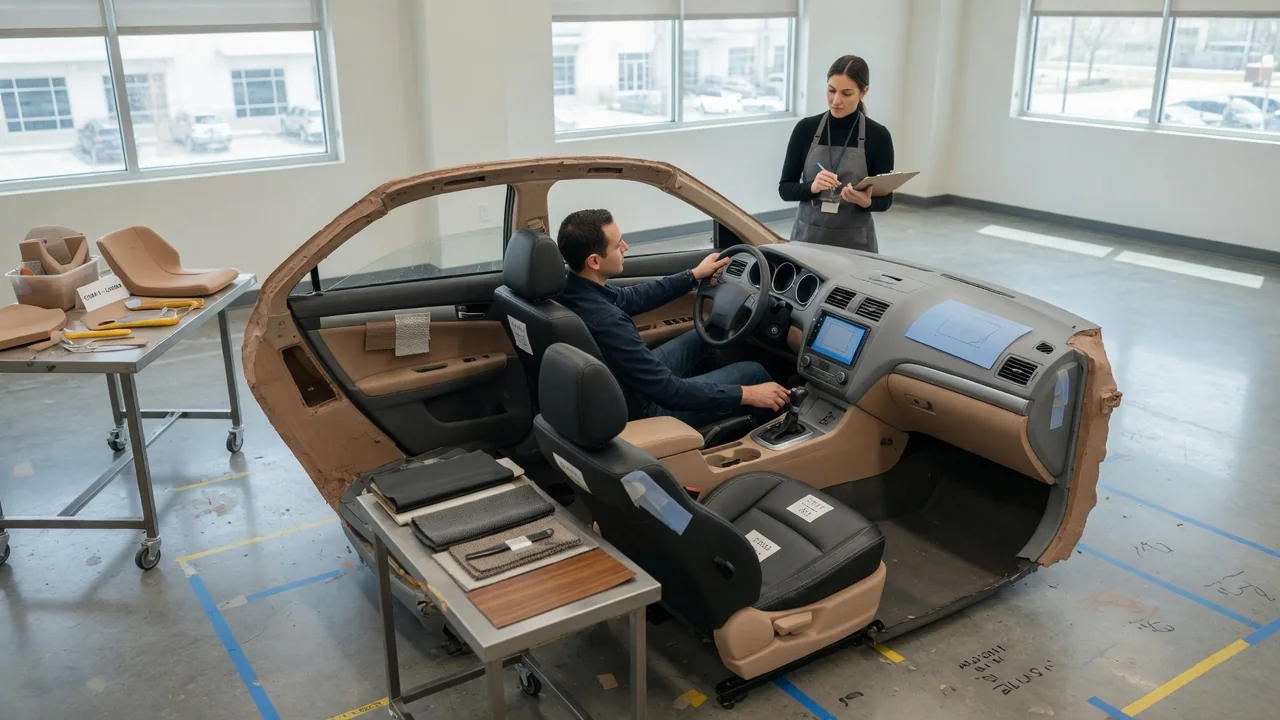
Before a new cabin reaches production, designers and engineers need to sit in it, reach across it, and touch it. Car interior mockups make that possible long before production tooling exists. A mockup is a physical model of all or part of a vehicle cabin, usually built at full scale so real people can evaluate reach, space, sightlines, and surface feel. This guide explains how interior mockups are used, focusing on ergonomics, the materials they are built from, and how they evolve through iteration.
Reach and space
The most basic use of an interior mockup is checking whether people of different sizes fit the cabin and can operate the vehicle comfortably. Digital human models in CAD software can predict much of this, but a physical buck lets evaluators sit down and confirm what the screen suggests. Typical questions include whether the driver can reach the steering wheel, pedals, shifter, and touchscreen without stretching or pulling away from the seatback; whether the knees clear the lower dashboard and steering column; and whether there is enough headroom with the seat raised. In vehicle cabin mockup testing, engineers usually evaluate a range of occupant sizes rather than a single average person, because a layout that suits a mid-sized adult may crowd a taller driver or leave a shorter one struggling to see over the hood.
Space checks extend beyond the driver. Rear-seat mockups are used to judge legroom, foot space under the front seats, and how easy it is to climb in through the door opening. Evaluators also study entry and exit, often called ingress and egress, by repeatedly getting in and out to see where heads, hips, and shoulders contact the roof rail, door sill, or pillars. Storage is another space question: cupholders, door pockets, and console bins can look generous in a rendering yet prove awkward when someone tries to place a phone or bottle while seated and belted.
Visibility often belongs to the same exercise. Mockups with pillars, mirrors, and window openings in position let teams judge obstruction zones and how much of the instrument display is hidden by the steering wheel rim. These findings feed back into the seating position and control placement, which become difficult to change late in a development program.
Materials
Interior mockups are built from different materials depending on the question they need to answer. Early ergonomic bucks are often simple structures of wood, aluminum extrusion, steel tube, or foam board, with adjustable mounts so the seat, steering wheel, and pedals can be repositioned quickly. These rigs prioritize adjustability over appearance. They may look nothing like a finished car, but they hold the critical dimensions accurately enough to study posture and reach.
As the design matures, appearance and feel become more important. Teams commonly use milled foam, modeling clay, and plastic parts made by 3D printing or CNC machining to represent dashboards, door panels, and consoles. Surfaces may be painted, wrapped in film, or covered with sample fabric, leather, or synthetic trim to suggest color, grain, and texture. Higher-fidelity mockups sometimes include working displays, lighting, and switches so evaluators can judge how controls feel when pressed, how ambient lighting reads in a darkened room, and whether glossy surfaces reflect into the driver's line of sight.
Material choice is always a trade-off. A prototype part that looks correct may not match the stiffness, temperature, or sound of the eventual molded component, so tactile impressions from a mockup are treated as indicative rather than final. Durability, crash behavior, and long-term wear are assessed through separate engineering tests on production-intent parts, not on display-grade models.
Iteration
Mockups are rarely built once. A cabin program generally moves through several rounds, starting with rough, highly adjustable bucks and progressing toward detailed models that closely resemble the intended production interior. Each round answers a narrower set of questions. Early versions settle fundamental layout decisions such as seating height and steering wheel position, while later versions refine the shape of armrests, the location of individual switches, and the appearance of trim seams and panel gaps.
Iteration works because mockup parts are relatively quick and inexpensive to change compared with production tooling. Moving a cupholder on a foam model is a modest task, while moving it after injection molds have been made is typically far slower and more costly. Review sessions with designers, engineers, and sometimes participants drawn from target customer groups produce feedback that is translated back into the digital model. Updated parts are then reproduced and installed, and the cycle repeats until the team is satisfied that the interior meets its targets.
Digital tools have changed this process without fully replacing it. Virtual reality and simulation allow teams to explore many options quickly, and some evaluations now happen partly or entirely in virtual environments. Physical mockups remain valuable for judgments that depend on touch, real body contact, and the subtle perception of space that headsets do not always reproduce. Many programs combine both, using virtual reviews to narrow choices and physical mockups to confirm them.
Practical implications and limits
For car owners, this process explains why many interior details feel deliberate: the distance to a climate knob, the angle of a screen, or the height of a center armrest has usually been checked by real people sitting in a test cabin. It also explains why some compromises remain. A layout is tuned for a defined range of body sizes and intended uses, so individuals near the edges of that range may still find a pedal too close, a headrest awkward, or a roof rail too low.
Mockups also have inherent limits. A stationary buck cannot reproduce vibration, road noise, cabin heat, or the fatigue of a long drive, so problems that appear only after hours behind the wheel may surface later through prototype road testing or owner feedback. Results also depend on who takes part and how sessions are run, which is why manufacturers generally treat mockup findings as one input alongside simulation, design standards, and on-road prototype evaluation. Details of how any specific vehicle was developed are usually not public, so a general description of the process should not be read as a claim about a particular model.
The same logic is useful when you evaluate a cabin yourself. Set the seat and steering wheel to your normal driving position first, then check reach to frequently used controls, visibility around the pillars, and ease of getting in and out before paying attention to trim appearance.