How Are Car Interior Fabrics Laminated to Foam?
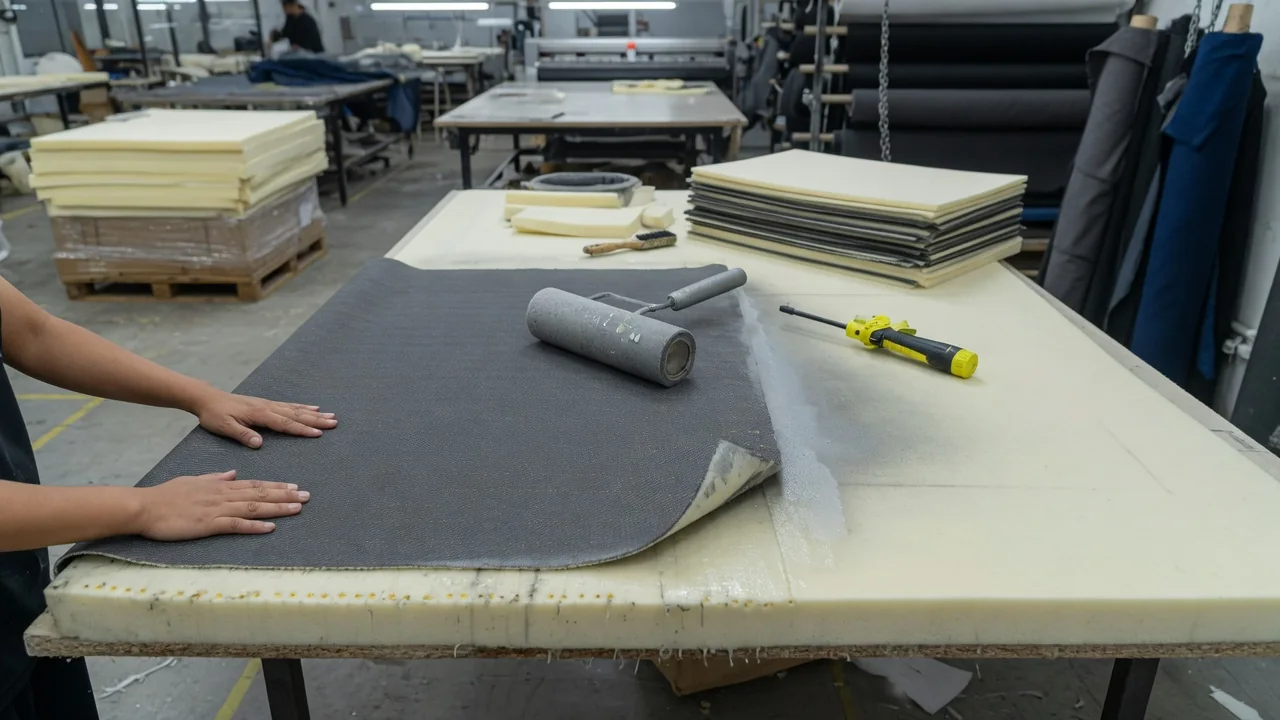
Most of the fabric inside a car, on seats, door panels and headliners, is not a single layer. Before it is cut and sewn, the face fabric is usually bonded to a thin sheet of foam, and often to a lightweight backing fabric on the other side. This article explains how car interior fabrics are laminated to foam, why the method matters for comfort, and how the bond behaves as the material ages.
Layer bonding: flame and adhesive lamination
The long-established method in automotive upholstery foam lamination is flame lamination. A continuous sheet of polyurethane foam passes over a controlled gas flame that melts a very thin surface layer of the foam. While that surface is still molten and tacky, rollers press the face fabric against it, and the foam forms a bond as it cools. No separate glue is added because the foam itself acts as the adhesive. A second burner often treats the other side of the foam so a backing layer, usually a light knit or nonwoven scrim, can be attached in the same pass. The result is commonly called a trilaminate: face fabric, foam and scrim. The process is fast and economical. Burning foam releases fumes, though, so lines need extraction and emission control, and the foam must be a grade formulated to melt and bond predictably.
Adhesive lamination is the main alternative. A separate bonding agent joins the layers. It is typically a hot-melt adhesive, applied as a powder, as a fusible web or film, or as a melted coating that an engraved roller transfers in a dot or line pattern. The layers are then brought together under heat and pressure. Reactive polyurethane hot melts keep curing with moisture after application, which gives them more heat and chemical resistance than a simple thermoplastic glue. Some applications use water-based adhesives instead. Adhesive systems avoid open-flame fumes and can bond foams and fabrics that do not flame-laminate well, but they require extra material and closer process control. Which method a manufacturer uses depends on the materials, the part and the supplier, and it is not usually visible in the finished trim.
Whatever the method, the bond has to survive cutting, sewing and stretching over a seat frame. It also has to stay thin and flexible enough that the laminate still drapes and stretches like fabric. The scrim layer helps with this. It protects the foam from tearing at seams, lets the cover slide over the cushion foam during assembly, and keeps stitching from pulling through.
Comfort: what the foam layer adds
The laminated foam is thin compared with the seat cushion beneath it and does not provide the main support. Its job is to shape how the surface feels and looks. It gives the fabric a soft, padded feel, spreads out small pressure points, and smooths over the contours and seams of the molded cushion so the cover looks full rather than stretched. It also helps the cover resist wrinkling and keeps stitched details such as decorative seams or pleats looking rounded and defined. On door panels and armrests, the same foam backing adds a soft-touch feel over hard plastic.
The bonding method also affects breathability. Flame lamination melts the foam surface into a skin that can be fairly continuous, which tends to restrict how freely air and moisture vapor pass through the layers. Adhesive applied in dots, lines or open webs leaves gaps, so it can preserve more airflow. This matters for comfort in hot weather. It matters even more for ventilated seats, where air has to move through the cover and perforated face materials are typically used. Heated seats add another consideration. The laminate sits between the heating element and the occupant, so its bond must tolerate repeated warming without softening or separating.
Wear: how the bond and foam age
A laminate can wear out in ways that have nothing to do with the face fabric itself. The most noticeable is delamination, where the fabric separates from the foam. It shows up as bubbles, loose areas, or a cover that shifts and wrinkles when someone sits on it. Heat is a major contributor, because parked cars get very hot inside and thermoplastic bonds soften when warm. Sunlight, humidity and repeated flexing at high-traffic spots add to the stress. A typical example is the outer bolster of the driver's seat, where people slide in and out.
The foam can also degrade. Polyurethane foams come in polyester-based and polyether-based types. Polyester-based foams have traditionally been favored for flame lamination but are generally more prone to breaking down from heat and moisture over time. Polyether-based types resist this hydrolysis better. As foam ages it can lose resilience, turn powdery and crumble. Once that happens the bond fails no matter how good the original adhesion was, because nothing solid is left to hold the fabric. This is the familiar mechanism behind sagging headliners in older vehicles. Compression set, where foam flattens permanently under repeated load, can also leave seat covers looking slack.
Cleaning habits influence wear as well. Soaking upholstery, using strong solvents, or applying concentrated heat from steam can weaken some adhesives or speed up foam deterioration, especially in older laminates. If abrasion wears through the face fabric, the exposed foam tears and crumbles far more easily than the fabric that protected it.
Practical implications and limits
The lamination layer explains why some interior problems cannot be fixed by gluing the surface back down. If a seat cover or headliner has separated because the foam has turned to dust, spraying adhesive behind the fabric usually fails quickly or bleeds through and stains, since there is no sound surface for it to grip. A durable repair generally means removing the deteriorated foam and then either relaminating with fresh foam-backed material or replacing the trim panel or cover. For this reason, upholstery and headliner materials sold for repair often come prelaminated. Headliner work usually calls for an adhesive rated for high cabin temperatures.
Small, localized separation on a seat whose foam is otherwise healthy is a different case, and a trim specialist may be able to repair it. Gentle cleaning with limited moisture, shading the cabin from direct sun, and dealing with bolster wear early all reduce stress on the bond, though none of them can stop foam from aging.
Only so much can be said in general terms. Manufacturers choose foams, adhesives and backing layers part by part. A laminate's age, climate exposure and pattern of use affect it as much as the original method. Seats and headliners in the same vehicle may use different constructions, and suppliers can change between production periods. For a specific vehicle, the service information, an original replacement part or an experienced trim shop is the reliable guide to how the material is built and how to repair it.