How Are Car Headlight Housings Molded?
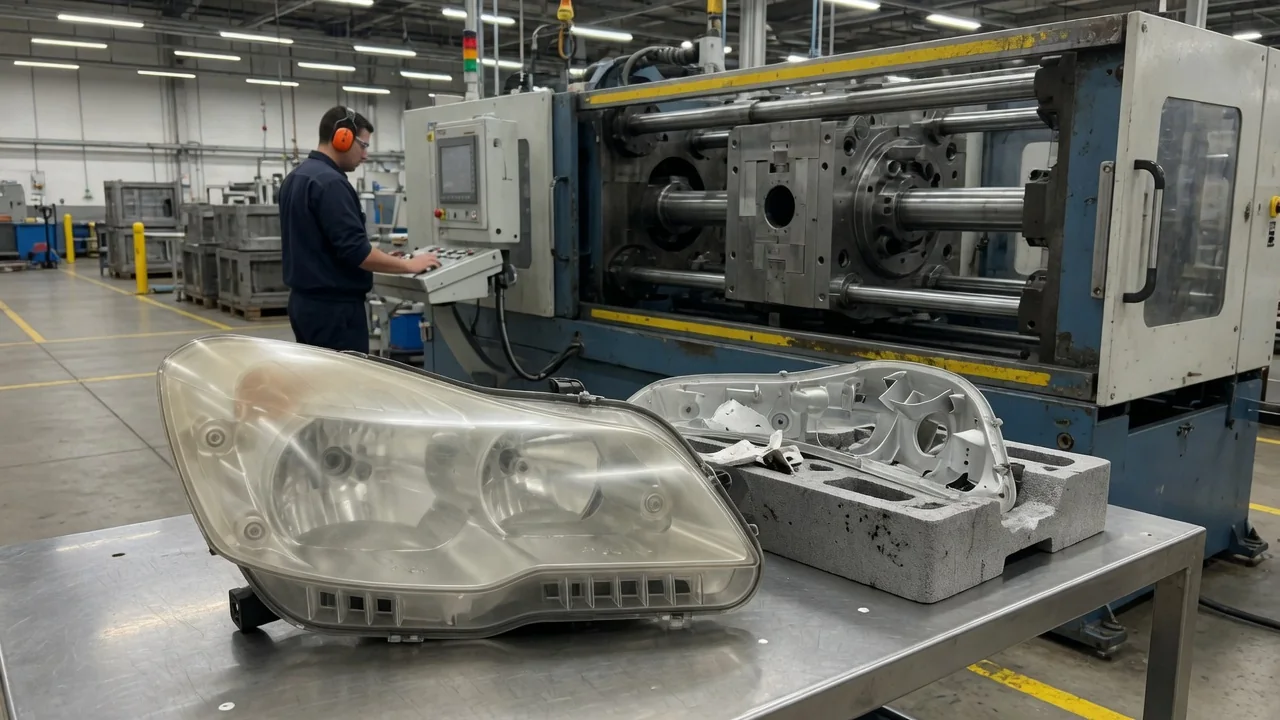
Most modern car headlights are assemblies of several molded polymer parts, not a single piece. Knowing how car headlight housings are molded explains why a lamp is shaped the way it is, why it usually stays dry, and how it tolerates the heat of its light source. Automotive headlight housing production generally combines injection molding of the rear housing and clear lens, a sealing step that joins them, and material choices that account for heat. Details vary by manufacturer and lamp design.
Polymer Shape: How the Housing and Lens Are Formed
The rear housing, sometimes called the shell or bucket, is usually made by injection molding. Plastic pellets are melted and forced under pressure into a closed steel mold. The part cools until it holds its shape and is then ejected. The mold cavity defines everything the housing needs: mounting tabs, bulb or module openings, adjuster pivots, wiring pass-throughs, and the groove or flange where the lens will later attach. Because one mold produces very large numbers of identical parts, these features are designed into the tool rather than added afterward. Common housing materials include filled polypropylene, polycarbonate blends, and other engineering thermoplastics. Stiffness, dimensional stability, and cost drive the choice.
The outer lens is also typically injection molded, most often from polycarbonate because it is clear, light, and impact resistant. Molding a large, curved, optically clear part is demanding. The melt must fill the cavity evenly, and cooling has to be controlled so the lens does not warp or carry internal stress that could later cause distortion or cracking. Polycarbonate degrades under ultraviolet light, so lenses generally receive a hard coat after molding to protect against UV exposure and abrasion. Some lamps use multi-shot molding, where a second material is molded onto the first in the same tool, for example to add an opaque or colored border to a clear lens.
Inside the lamp, reflectors and decorative bezels are molded separately. Reflectors may be made from thermoplastics or from thermoset compounds such as bulk molding compound, which hold their shape well under heat. Their reflective surface is usually created by vacuum metallizing, which deposits a thin aluminum layer over the molded surface. As a result, the accuracy of the molded shape directly influences how well light is directed onto the road.
Sealing: Joining the Lens to the Housing
Once the housing and lens exist as separate parts, they must be joined into an enclosure that keeps out water, dust, and road spray. Two broad approaches are used. In adhesive sealing, a bead of sealant is laid into a channel molded around the housing perimeter, and the lens flange is pressed into it. Butyl-type sealants stay soft and can be reheated, while some silicone or polyurethane adhesives cure into a more permanent bond. In welding, the lens and housing are fused directly by methods such as vibration, hot-plate, infrared, or laser welding. Welding requires compatible materials and a joint geometry designed in from the start, and the resulting bond is not meant to be opened.
A sealed headlight is not usually airtight in the strict sense. Air inside the lamp expands and contracts as it heats and cools, so housings commonly include vents that let pressure equalize while limiting the entry of liquid water and dirt. These vents are often covered with a breathable membrane or routed through a cap or labyrinth path. Gaskets and grommets seal the openings where bulbs, LED modules, and connectors pass through the rear of the housing, and rear access caps typically have their own rubber seals. The overall seal therefore depends on several components working together, not on the lens joint alone.
Heat Management: Materials and Design Around the Light Source
Every light source produces heat, and the molded parts must tolerate it without softening, warping, or discoloring. The type of source matters. Halogen and other filament bulbs release a large share of their energy as heat directly inside the lamp, so the reflector and the housing areas closest to the bulb face the highest temperatures. That is one reason heat-resistant materials, such as thermoset compounds or high-temperature thermoplastics, are used for reflectors, and why some designs add metal heat shields near the bulb. High-intensity discharge systems also generate significant heat, both in the capsule and in their ballast electronics.
LED headlights shift the problem rather than eliminate it. LEDs send relatively little heat forward in the beam, but the chips and their driver electronics generate heat at the back that must be removed to protect the LEDs. Housings for LED lamps therefore often include openings or mounting points for metal heat sinks, and some designs add small fans, to carry heat out of the enclosure. Because less heat reaches the lens, LED lamps may be slower to clear frost, snow, or internal condensation than lamps with hot filament bulbs, which designers address through venting and airflow choices.
Heat management also shapes molding decisions. Wall thickness, rib placement, and vent paths are planned in the mold design to spread heat, avoid hot spots, and let warm, moist air move through the lamp. Materials are selected for both heat resistance and thermal expansion, since a housing and lens that expand at different rates place stress on the seal between them.
Practical Implications and Limits
For owners, the molding and sealing method largely determines what kind of repair is realistic. Lamps assembled with reheatable butyl sealant can sometimes be opened by warming the assembly, which is how some people clean interiors or replace internal parts. Welded assemblies are not designed to be separated, and attempting it usually damages the lens or housing. Many housings carry molded material codes identifying plastics such as polypropylene or polycarbonate, which help in choosing compatible adhesives or plastic-welding rods for broken mounting tabs. Even so, a repaired tab or resealed joint may not match the original's strength or durability.
Light fogging that clears after the lamps have been on, or after a drive, is often a normal effect of venting and temperature change. Standing water, persistent heavy condensation, or moisture that returns quickly points instead to a failed seal, cracked housing, missing cap, or blocked vent. Yellowed or hazy lenses usually reflect breakdown of the protective hard coat on the polycarbonate; polishing can improve appearance, but lasting results generally require a new UV-resistant coating.
Heat limits matter as well. A higher-wattage bulb, or a light source the housing was not engineered around, can exceed the heat tolerance of the reflector or housing material and may also alter the beam pattern. Replacement and aftermarket housings can differ from original parts in material, coating, and sealing quality. The principles here explain how headlights are generally built, but the behavior of any specific lamp depends on its particular design and condition.