How Are Car Exhaust Pipes Bent? Bend Radius, Flow Path, and Fit
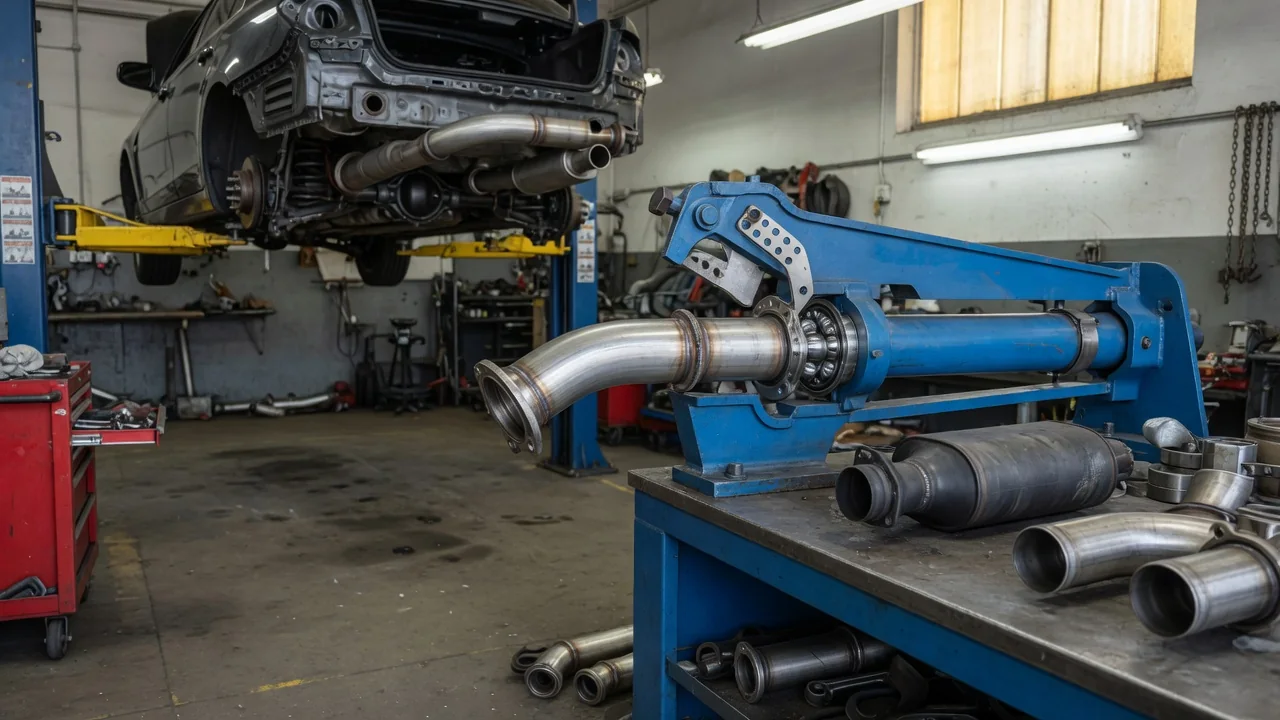
Car exhaust pipes are bent from straight metal tubing, usually steel or stainless steel, on machines that wrap the tube around a curved die. The goal is to route exhaust gas from the engine to the tailpipe around the floor, suspension, and fuel system without crushing the tube or creating leaks. Automotive exhaust tube bending comes down to three linked ideas: how tight each bend is, how smoothly gas can travel through it, and how well the finished pipe fits the vehicle.
Bend radius and bending methods
Every bend has a centerline radius, measured from the center of the curve to the middle of the tube. It is often expressed as a multiple of the tube's outside diameter, so a bend described as 1.5D has a centerline radius one and a half times the tube diameter. The radius is set by the bending die, a grooved form the tube is drawn or pressed around. A factory or shop can only produce the radii for which it has tooling, which is one reason exhaust systems tend to reuse a limited set of curves.
When a tube bends, the metal on the outside of the curve stretches and thins, while the metal on the inside is compressed. The tighter the radius relative to the tube diameter and wall thickness, the more pronounced this becomes. Too tight a bend can wrinkle the inside wall, thin the outside wall excessively, or flatten the round cross-section into an oval. Thin-wall tubing, which is common in exhaust work, is especially prone to these problems, so the bending method matters as much as the radius itself.
Two broad methods are used. Compression or press bending, often called crush bending, forces the tube into a die with nothing supporting it from the inside; it is simple and fast but typically leaves the bend partly flattened or wrinkled. Mandrel bending places a supporting rod, usually tipped with articulated balls, inside the tube at the point of bending so the wall holds a nearly round shape through the curve. Production exhaust systems are generally made on CNC tube benders that repeat programmed bends, while some repair shops rely on simpler press benders for custom or replacement pipes.
Flow path through the bends
An exhaust pipe's job is to carry hot gas away from the engine with as little restriction as is practical for the design. Each bend changes the direction of the gas, which adds some resistance, and that effect grows when the cross-section shrinks or becomes irregular. A mandrel bend that stays close to the original diameter keeps the internal area consistent along the curve. A crush bend that flattens or wrinkles reduces the open area at that spot and adds turbulence, effectively creating a small restriction partway along the pipe.
Flow path is also about the overall route, not only individual bends. Designers try to limit the number of bends and avoid abrupt direction changes where space allows, while keeping the pipe away from parts that cannot tolerate heat. Gentler, larger-radius bends generally give a smoother path, but they need more room, so the final route is a compromise between flow, packaging, and cost. Components such as catalytic converters, resonators, and mufflers sit along this path and are joined to the bent tube sections by welds, clamps, or flanges.
How much a particular bend affects performance depends heavily on the engine, its exhaust volume, and the rest of the system. A slightly flattened bend may be insignificant on one vehicle and more relevant on a high-output engine moving more exhaust gas. Claims that a specific bending method adds a fixed amount of power are not reliable without measurements on the actual setup.
Fit under the vehicle
A bent exhaust pipe must follow a three-dimensional route under the car. In production, that route is described as a sequence of straight lengths, bend angles, and rotations between bends, which a CNC bender executes in order. Because tubing springs back slightly after it is released from the die, the machine overbends by a compensating amount established for that material and tooling. Small errors in angle or rotation accumulate along the pipe, so a pipe that is a few degrees off near the front can miss its mounting point toward the rear.
Fit involves more than reaching the mounting flanges. The pipe needs clearance from the floor pan, fuel and brake lines, wiring, suspension parts, and driveline components, and it must sit high enough to stay clear of the road surface. Hangers with rubber isolators hold it in place while allowing movement as the engine rocks on its mounts, and many systems include a flexible section for the same reason. Heat shields are commonly fitted where the pipe runs close to the body or to heat-sensitive components.
When a custom or replacement pipe is made by hand, a fabricator often assembles it from prebent sections such as U-bends and J-bends, cutting and welding them to match the original path. Some shops copy the old pipe directly or shape a bendable rod as a template before bending the real tube.
Practical implications and limits
For owners, these factors explain why direct-fit replacement exhaust parts usually install more easily than universal parts, and why a custom-built section may work well but look different from the original. When choosing parts or a shop, it is reasonable to ask whether bends are mandrel-formed, what tubing material and wall thickness are used, and whether the part was designed for the specific vehicle rather than adapted to it. A poorly fitting pipe can rattle against the body, overload hangers and joints, or develop leaks at its connections over time.
Bending alone cannot solve every routing problem. Very tight spaces may call for a cast or fabricated elbow instead of a bent tube, and some routes are only possible by welding several pieces together, with each joint needing a proper seal. Stainless steel resists corrosion but can be harder to bend cleanly than mild or aluminized steel. Whether a given repair, upgrade, or modification is suitable also depends on emissions equipment, noise requirements, and local regulations, which vary by location and vehicle, so the vehicle's own service information remains the best guide for a specific car.