How and Where to Add Transmission Fluid Without Overfilling
Topping off transmission fluid looks simple. It only goes well when you've confirmed the level is low, have the right fluid, and pour it into the correct opening. Many modern transmissions have no dipstick for the owner to use. This guide explains how to find the fill point and add fluid in small measured amounts. It also covers when to stop so an overfill doesn't create a new problem.
Confirm That the Transmission Needs Fluid
Before opening anything, confirm the level is actually low using the checking procedure your vehicle's maker prescribes. Harsh shifts, slipping, or delayed engagement can come from low fluid. They can also come from worn fluid, control problems, or internal wear, so a symptom alone doesn't justify adding fluid. The reading often depends on fluid temperature, whether the engine is running, and where the gear selector sits. Some vehicles are checked warm in park and others are not, so follow the specified conditions instead of a generic routine.
Your owner's manual or vehicle-specific service information should tell you the transmission type and the approved fluid specification. It should also say whether owners are meant to check the level at all. Park on level ground, set the parking brake, and give the fluid time to settle so a tilt doesn't skew the reading. The manual may send you to a dealer or show no dipstick you can reach. In that case the job belongs with a technician, especially if it means lifting the vehicle or working near exhaust components.
Locate the Correct Transmission Fluid Fill Point
Transmission fluid stays inside a sealed system, so it can only go in through the transmission's designated fill point. It never goes into the engine oil filler, the coolant reservoir, or the washer reservoir. On many automatics that owners can check, the fill point is the dipstick tube itself: you check the level there and pour fluid into the same tube. Use the engine-bay diagram in the manual and any label on the dipstick handle to find it. Handle colors and locations vary between makes and engine layouts.
Many newer transmissions have no dipstick. They use a fill plug or dedicated service port on the transmission case instead, sometimes with a separate check plug and a level test that needs a specific fluid temperature. These designs often call for lifting equipment and a scan tool to monitor temperature. Don't loosen a bolt you think might be the fill plug. It could be a drain plug, which lets fluid out instead of in. If you can't confidently identify the opening, stop there.
Prepare the Correct Fluid and a Clean Funnel
Match the fluid to the exact specification in your manual, and look for that name or approval on the container itself. A bottle labeled simply as automatic transmission fluid doesn't prove it's compatible, because transmissions use different formulas with different friction properties. Continuously variable and dual-clutch transmissions often need their own dedicated fluids. If the label doesn't clearly state the required specification, wait instead of guessing. The wrong fluid can change how the transmission shifts and may add to wear over time.
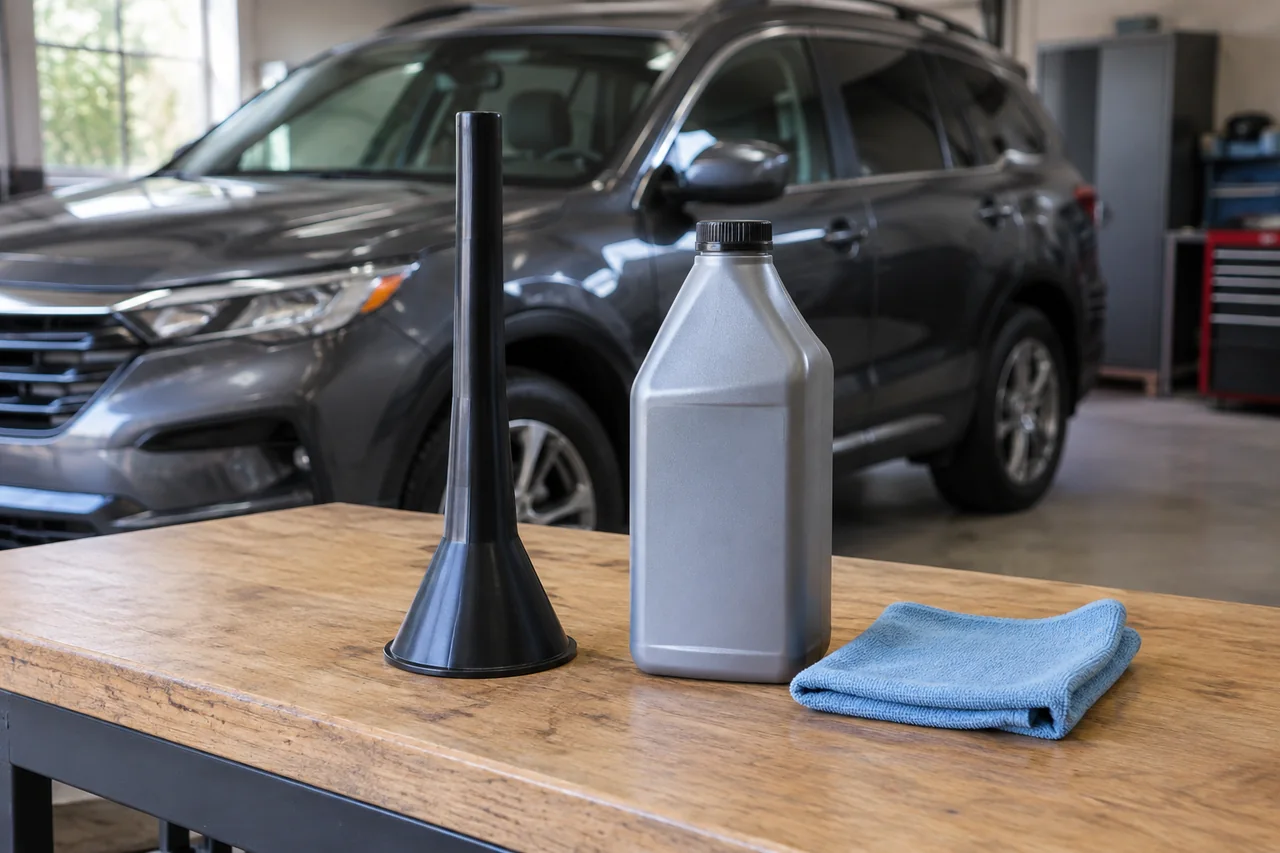
If the manufacturer allows filling through the dipstick tube, a long-neck funnel with a narrow spout that fits the tube makes it much easier to pour with control. The funnel should sit steadily without wobbling. It must be completely clean, with no water, grit, or leftover oil, coolant, or other fluid that could contaminate the transmission. Keep a measuring container for each small addition, plus rags or an absorbent pad for drips. A funnel won't help with a plug-based system, which uses different equipment.
Add Fluid Through an Approved Dipstick Fill Tube
Once you've confirmed the fill tube, wipe around its opening so dirt can't fall in when the dipstick comes out. Remove the dipstick, lay it on a clean surface, and seat the funnel firmly in the tube. Fill with the engine running or off, whichever the manufacturer specifies. If it must run, keep hands, sleeves, hair, and tools away from the belts, the cooling fan, and hot exhaust or engine parts. Keep the vehicle in park or whatever position the manual calls for.
Pour a small measured amount slowly, then pause so it can drain down the tube. The tube is narrow, so pouring quickly can back fluid up in the funnel and spill it onto hot parts. After the fluid has drained, remove the funnel and recheck the level using the prescribed method. Then push the dipstick fully back in so it seats and seals. These steps cover a top-off only. Refilling after draining the fluid or changing it follows a separate procedure specific to your vehicle.
Use Small Measured Additions and Recheck the Level
How much to add depends on a valid level reading, not on the transmission's total capacity. A capacity figure describes a complete fill, while a top-off usually makes up a much smaller shortfall. Some manufacturers say how much to add between checks, and you should follow that when it's available. Otherwise, add a small measured amount, recheck, and repeat. Don't assume the space between the dipstick marks equals a set volume. That varies between transmissions, so the marks don't tell you how much to pour.
Take every recheck under the same conditions as the first reading: fluid temperature, engine running or off, selector position, and the specified way to wipe, insert, and read the dipstick. Changing any of these can make the level look higher or lower than it really is. Stop as soon as the level is within the acceptable range. If you overfill, moving parts can whip the fluid into foam. Foamy fluid can cause erratic shifting or overheating, or get pushed out through a vent.
Know When to Stop Adding Fluid and Get Help
Stop and get qualified help if the readings seem inconsistent, if you think the level is now above the range, or if you can't confirm the fluid meets the required specification. Fixing an overfill means removing fluid, which is best left to a technician with the right equipment. It's also worth figuring out why the level dropped. Fresh drips or spots under the parked vehicle, or a level that keeps reading low after a top-off, suggest a leak that a technician should diagnose.
Don't expect a careful top-off to fix every symptom, even when it brings the level back to where it should be. If slipping, a delay when shifting into drive or reverse, or a transmission warning light continues afterward, have the vehicle checked. A stored fault code is a clue to read with vehicle-specific information, not proof that a part has failed. Leave it to a qualified technician if the transmission fills through a plug, the vehicle has to be raised, the work is near hot exhaust, or fluid temperature must be monitored precisely.