Honda Odyssey TCC Solenoid Identification and Location: 2004 and 2006
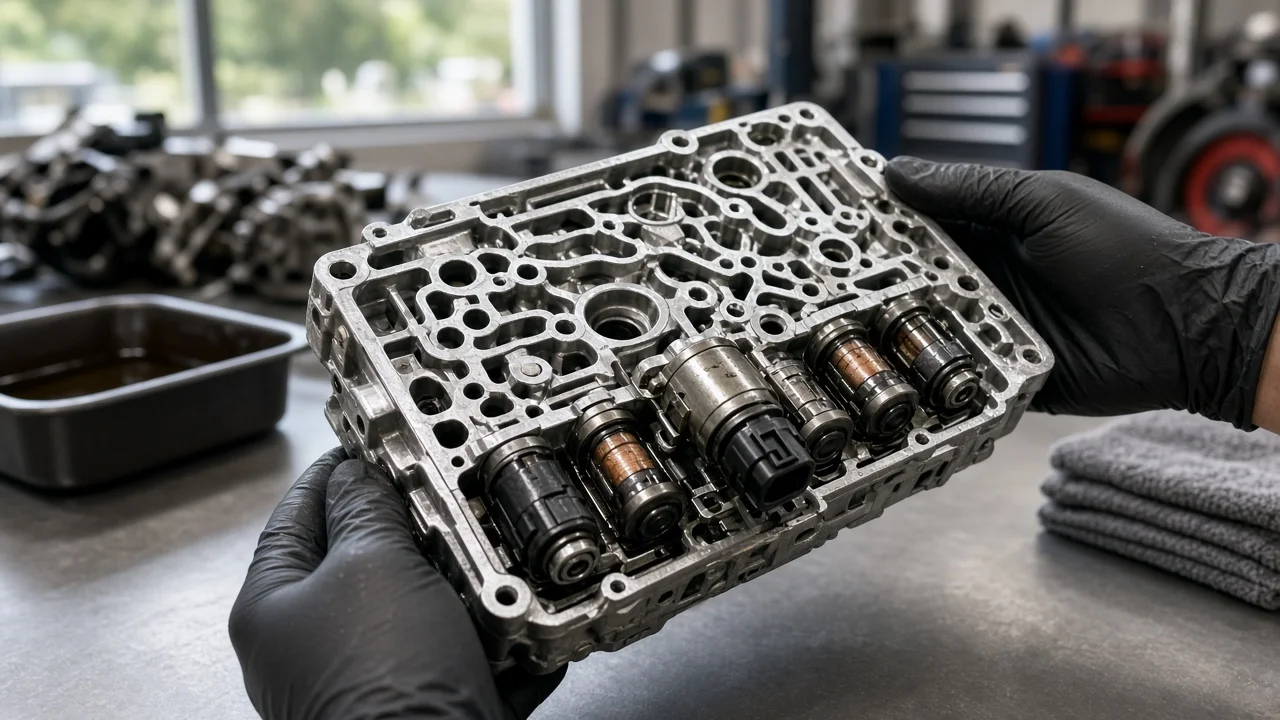
Owners looking for the torque converter clutch solenoid on a 2004 or 2006 Honda Odyssey often find that no part carries that exact name. Honda automatics manage converter lock-up through solenoid valves mounted on the outside of the transmission case, and Honda names them by its own terminology. This guide explains how to identify the right component, where to look, and why a lock-up code or shudder does not by itself confirm that a solenoid has failed.
Where the lock-up solenoid is on a 2004 or 2006 Odyssey
On both the 2004 and the 2006 Odyssey, the solenoids that control torque converter lock-up are bolted to the exterior of the automatic transmission case rather than hidden inside a pan. Honda transmissions of this era do not have a conventional oil pan with a valve body underneath, so there is nothing to drop to reach them. Each solenoid has its own electrical connector and is held by a few bolts, with a gasket or O-ring at the mounting face.
The important qualification is naming. In Honda service literature, the lock-up function may be handled by a component described as a lock-up control solenoid valve, or by a combination of shift solenoid valves and an A/T clutch pressure control (linear) solenoid valve, depending on the exact transmission. That means the part a parts counter calls a TCC solenoid may be one of several solenoids on the case, and buying the wrong one is a common mistake. The precise position, connector and part number should be confirmed against service information for your vehicle's transmission code before you unbolt anything.
How torque converter lock-up works
A torque converter couples the engine to the transmission through fluid, which allows the van to idle in gear but wastes some energy as slip. Once road speed and load are suitable, the transmission control logic engages a clutch inside the converter that locks the engine and transmission together. This lowers engine speed at cruise, reduces heat in the fluid and improves fuel economy.
The clutch is applied hydraulically. The control module commands one or more solenoids, which direct or regulate fluid pressure to the lock-up circuit. Honda units can apply lock-up partially and progressively, so pressure control matters as much as simple on or off switching. Because of this, lock-up quality depends on the electrical command, solenoid response, fluid condition, the valves it feeds and the converter clutch itself. A fault anywhere along that chain can produce similar shift behavior.
What changes the answer: model year, transmission code and wiring
The 2004 Odyssey belongs to the earlier generation, while the 2006 model is from the redesigned generation introduced for 2005. Both use five-speed automatics, but they are different transmission families with different case designs, solenoid arrangements and connectors. Parts and procedures from one year should not be assumed to fit the other. Even within one model year, trim and production changes can affect fitment, so the transmission identification code stamped or labeled on the case, together with the VIN, is the reliable reference.
Operating conditions also change what a symptom means. Lock-up typically engages only at certain speeds, throttle positions and fluid temperatures, so a converter that appears not to lock on a cold morning may behave normally once warm. Fluid specification is another variable: Honda specifies its own automatic transmission fluid for these vans, with Honda ATF DW-1 now listed as the replacement for the earlier ATF-Z1. Incorrect or degraded fluid can alter lock-up feel and slip without any electrical fault.
Checks an owner can make before buying parts
Start by reading diagnostic codes with a scan tool that can access transmission data, not only generic engine codes. Under the standard OBD-II definitions, P0740 refers to a torque converter clutch circuit malfunction and P0741 to a circuit performance or stuck-off condition, but Honda may also store manufacturer-specific codes that point to a particular solenoid or circuit. Record every code and its freeze-frame data before clearing anything. A circuit code suggests an electrical problem in the solenoid, wiring or connector, while a performance code often means the converter is not locking as commanded for mechanical or hydraulic reasons.
Next, check the fluid level and condition using the procedure in the owner's manual, and note whether the fluid smells burnt or looks dark. Review the service history: when the fluid was last changed, what fluid was used, and whether any transmission work or software updates have been done. Then inspect the visible solenoid connectors and harness on the transmission case for oil contamination, corrosion, loose locks or chafed wires. On many Honda automatics, solenoids seat against small filter screens that can collect debris, which is worth noting if a solenoid is removed.
Finally, observe the symptom carefully. A light shudder at steady cruise, engine speed that flares slightly without acceleration, or higher than usual highway RPM are typical lock-up complaints, but each can also come from fluid condition, the converter clutch, internal valves or engine misfire. Note the speed, temperature and throttle position when it happens, because that information helps a technician separate a solenoid fault from other causes.
Limitations and next step
This guide describes the general arrangement and diagnostic path; it cannot confirm which specific solenoid on your transmission handles lock-up or whether that part has failed. Electrical testing of resistance and circuit integrity, commanded solenoid tests with a capable scan tool, and pressure checks require vehicle-specific values from Honda service information. Without those values, replacing a solenoid is a guess, and on these Odysseys the underlying cause is sometimes internal wear that a new solenoid will not fix.
If codes return after a fluid service and connector inspection, or if shift behavior worsens, have a transmission technician confirm the diagnosis before committing to repair options. They can verify the transmission code, test the solenoid circuits directly and judge whether a solenoid replacement, a valve-related repair or a rebuild is appropriate. Bringing your code history, freeze-frame data, symptom notes and service records will shorten that process.