Honda Civic Type R FK8 Wastegate Actuator: How to Identify It
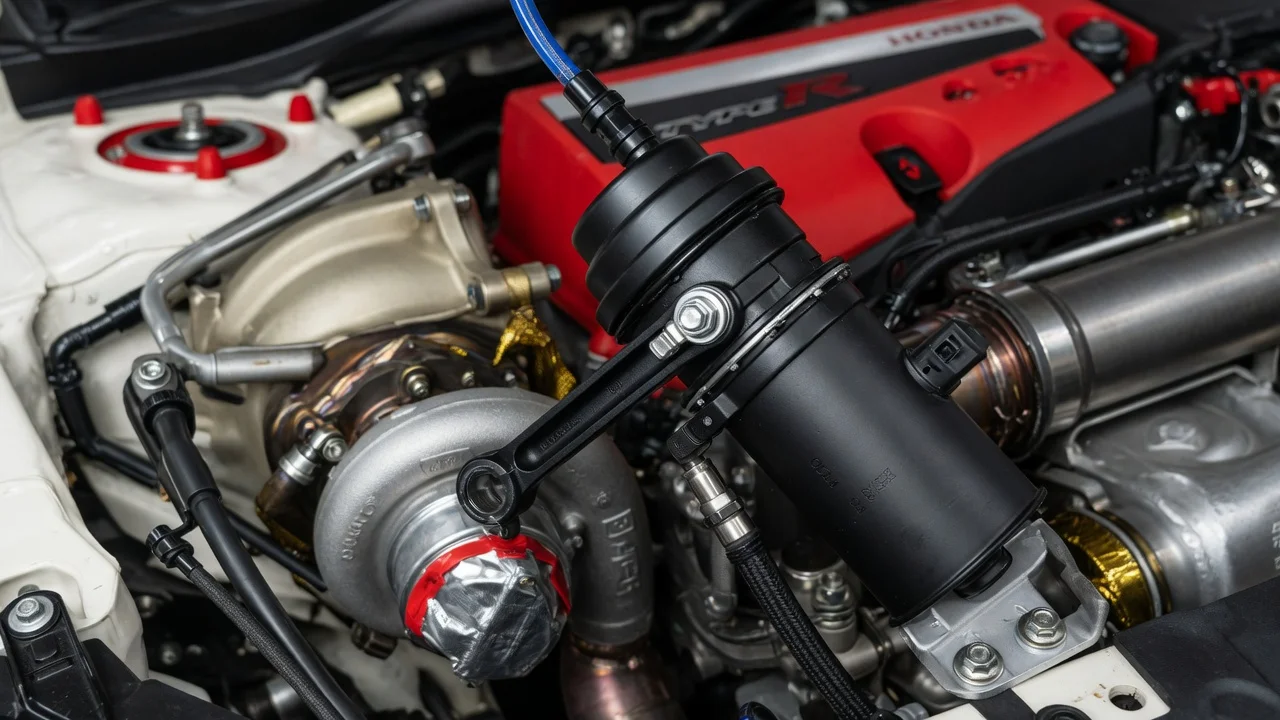
Owners looking for the FK8 wastegate actuator often expect the vacuum canister found on many older turbocharged cars. On a factory-configured Civic Type R, that is not what you will find. This guide explains how to recognize the original actuator and how it manages boost. It also covers which modifications or repairs can change what is under the hood, what you can safely check yourself, and when to use vehicle-specific service information or a professional.
How to identify the FK8 wastegate actuator
On an FK8 with its original turbocharger, an electrically operated actuator drives the wastegate. It is not a pressure-diaphragm canister fed by a boost reference hose. The actuator sits in the turbocharger area on the exhaust side of the K20C1 engine, and heat shielding and nearby components usually hide much of it. Look for three features: an actuator body with an electrical connector and wiring harness, a linkage rod running from the actuator to the wastegate arm on the turbine housing, and no vacuum or boost hose connected to the actuator itself. If you see a round canister with a hose nipple and a spring-loaded rod instead, the car most likely has a non-factory setup.
Treat the visual check as a starting point, not final confirmation. Turbo-related sensors and valves in the same area also have electrical connectors, so a part with a plug is not automatically the wastegate actuator. To confirm what you are looking at, follow the linkage to the wastegate arm and read any part number printed on the actuator or the turbocharger label. Then match that number against a parts catalog lookup using the vehicle identification number.
How the electric wastegate controls boost
The wastegate is a valve in the turbine housing that lets part of the exhaust bypass the turbine wheel. With the valve closed, more exhaust energy drives the turbine and boost rises. When the valve opens, turbine speed and boost are limited. On the FK8, the engine control module commands the actuator to move the linkage and position the valve, based on inputs such as boost pressure, throttle demand and engine load. Electric actuators of this type typically report their position back to the control module, which compares the commanded position with the actual one.
This matters for diagnosis. Because control is electrical, a fault usually shows up as a stored diagnostic trouble code, a warning lamp or reduced power, not a split hose. The actuator is only one part of the system, though. A worn or binding wastegate valve, a loose linkage, damaged wiring or a connector problem can produce similar symptoms. A code that points toward wastegate control does not by itself prove the actuator has failed.
What can change the answer for your car
The biggest variable is vehicle configuration. Aftermarket turbocharger upgrades may use a different actuator design, and some builds replace the factory control with a pneumatic actuator or another boost control arrangement. An engine tune can change how the wastegate is commanded even when the hardware is stock. A car that has had its turbocharger replaced may carry a remanufactured or non-original assembly with different labeling. Before relying on any description of the stock layout, review the service history and ask previous owners or shops what was changed.
Operating conditions also matter. Repeated track sessions and sustained high-load driving expose the actuator and its wiring to more heat than commuting does, so pay close attention to connectors and insulation during inspection. Some symptoms appear only under certain conditions, such as hard acceleration with a hot engine, so note when a problem occurs. Part numbers can also differ between production periods or markets, which is why a VIN-based lookup is more dependable than a generic FK8 listing.
What the owner can check
Start with a careful inspection on a cold engine with the ignition off. Look at whatever part of the actuator you can reach. Confirm the electrical connector is fully seated and locked, and check the visible wiring for melted insulation, chafing or broken clips. Make sure the linkage rod is attached at both ends with its retaining hardware in place. Do not pry on the linkage or force the wastegate arm to test it, because that can bend parts or disturb the adjustment. If you hear a metallic rattle from the turbo area, note whether it happens at idle, when lifting off the throttle or over bumps.
Next, read stored codes and freeze-frame data with a scan tool that supports the vehicle. Write down the exact codes, the conditions recorded when they set, and any symptoms you noticed, such as lack of power, inconsistent boost or a dashboard warning. Do not clear the codes before recording them, because that erases information a technician may need. If the car is modified, also note the tune and hardware details, since they affect how the codes should be interpreted.
If replacement looks likely, record the part number from the actuator or turbocharger label. Check the parts catalog to see whether the actuator is sold separately or only as part of the turbocharger assembly. Check the service information for any initialization or relearn procedure required after replacement. Follow the manufacturer specifications for fasteners and connectors rather than generic values.
Limitations and next step
This guide covers how to recognize the factory electric actuator. It cannot confirm the part number, removal steps, torque values or test procedures for your car; those come from the official service information for your VIN. Do not assume a fixed replacement interval for the wastegate actuator unless your service information lists one in the maintenance schedule. Without such an entry, inspection and replacement decisions should follow symptoms and proper diagnosis.
Get professional help in three situations: a scan tool shows wastegate-related faults that you cannot trace to an obvious wiring or connector issue, actuator testing requires dealer-level software, or access means removing heat shields or turbocharger components. A Honda dealer or an experienced turbo specialist can command the actuator, compare commanded and actual position, and tell an actuator fault apart from a wiring or valve problem. For modified cars, involve the tuner who calibrated the engine. If the car may still be under warranty, check coverage before any work is done.