Honda Civic EP3 Wheel Offset: Standard Fitment and Practical Limits
The direct answer
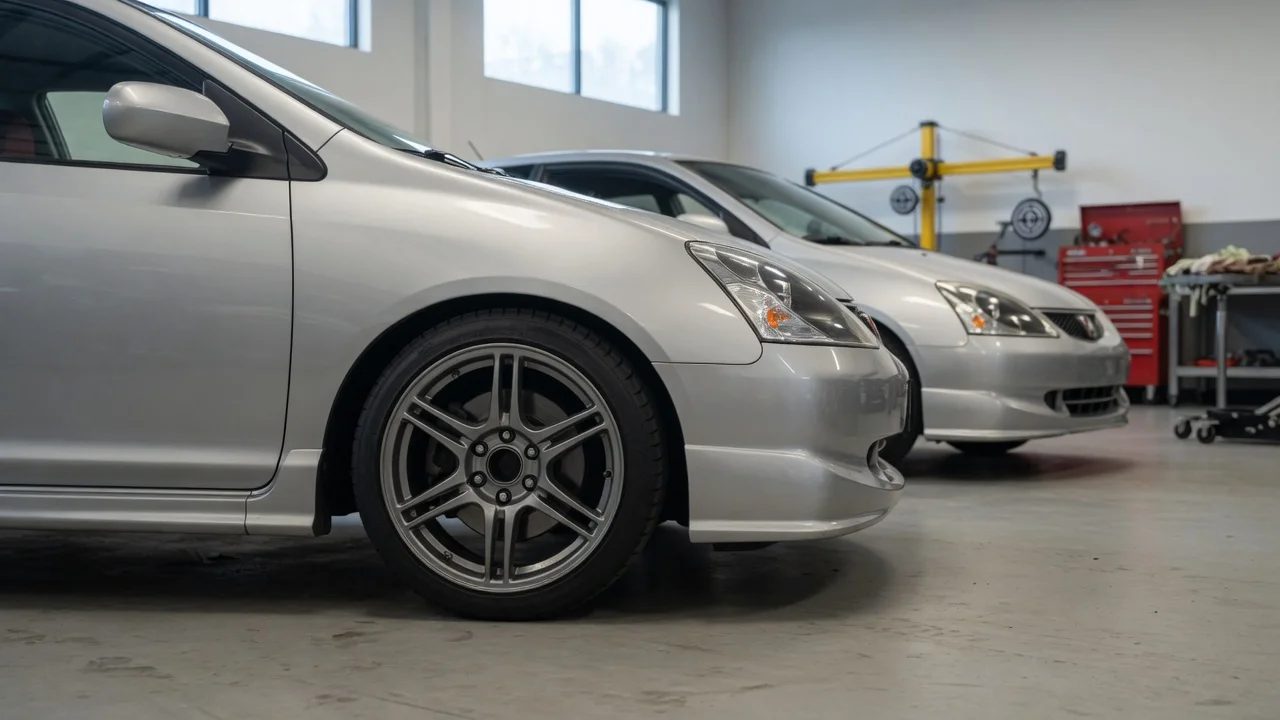
For a Honda Civic EP3, the commonly cited factory wheel offset is around ET45 for the original 17-inch wheels. This value is normally paired with a 7-inch-wide rim, and it positions the wheel and tire inside the arch with enough clearance for the suspension and brake components on factory cars.
Offset is not a fitment that should be copied on its own. The final position of the tire depends on wheel width as well as offset, so a wider aftermarket wheel needs a different offset to keep similar clearance or intentionally change the stance.
What wheel offset means
Wheel offset, usually written as ET followed by a number, is the distance between the wheel mounting face and the exact centerline of the rim. Positive offset means the mounting face is toward the outside of the wheel, which pulls the wheel body inward. Negative offset pushes the wheel outward.
Most front-wheel-drive cars, including the EP3, use a relatively high positive offset. This keeps the tire inboard and helps preserve the intended steering and suspension geometry.
Why width and offset must be checked together
Offset alone does not tell you where the outer face of a wheel will sit. As an example, keeping ET45 while moving from a 7-inch-wide wheel to an 8-inch-wide wheel would move both the inner and outer rim edges by roughly the same amount. The inner edge would move about 12 to 13 mm farther inboard, and the outer edge would move about the same amount outward.
To keep the outer position close to stock on a wider wheel, you would lower the offset, which moves the wheel outward. That can improve outer-arch clearance but reduces inboard clearance and increases the chance of contact with the strut, inner fender liner, or suspension arm.
Practical guidance for EP3 fitment
The original ET45 measurement should be treated as the reference point for a factory-width wheel, not as a limit that automatically works with every width. Fitment depends on the specific wheel diameter, width, offset, tire size, ride height, alignment, and any aftermarket suspension or brake changes.
Before fitting aftermarket wheels, compare the complete package against the current setup rather than matching offset alone. Measure or check clearance at the suspension upright, brake caliper, fender lip, and inner arch, and account for suspension travel and steering lock.
Facts not stated here
This guide does not invent figures for market-specific wheels, optional factory sizes, or maximum safe aftermarket offsets. Model year, engine, market, and original wheel option can affect the baseline specification, so a workshop manual or measurements from the vehicle itself should be used to confirm any non-standard fitment.