Fix Honda Civic no-start from anti-theft after power loss
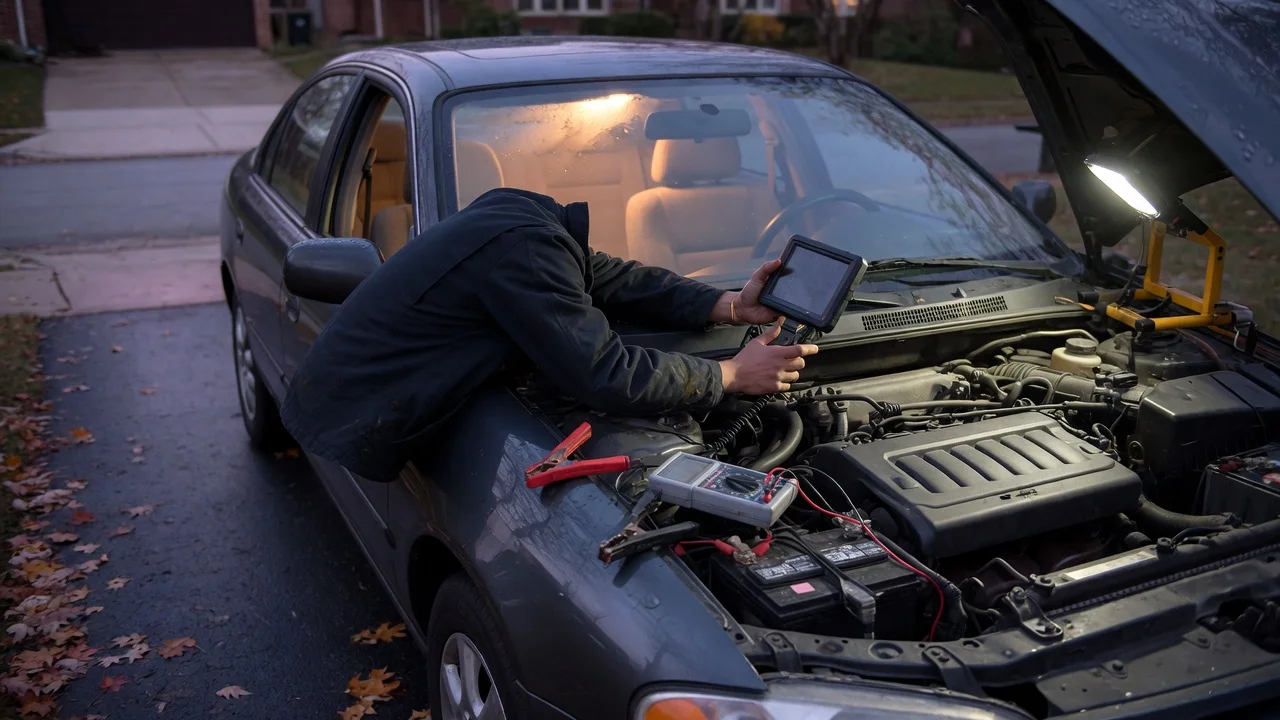
If your Honda Civic won't start after the battery went flat, was disconnected or was replaced, the anti-theft system is often blamed first, but it is rarely the root cause. Losing battery power does not normally erase the engine immobilizer's memory of your key. More often, the battery or its connections are still the problem, the security alarm needs resetting, or the 'anti-theft' message you are seeing is the radio asking for its code, which does not stop the engine. The useful first step is to identify which system is involved and whether the engine cranks. Procedures, indicator designs and key types differ across Civic generations, model years and markets. Key-start and push-button-start cars also behave differently. Treat the steps below as a general diagnostic order, and confirm specifics in the owner's manual for your car.
Three different 'anti-theft' systems
Owners use 'anti-theft' for three separate Honda systems, and each behaves differently after a power loss.
Engine immobilizer: a transponder chip in the key or smart fob is recognized by the car before the engine is allowed to run. Many Civics show a key-shaped indicator on the instrument panel that stays on or flashes when the key is not recognized. Security alarm: on equipped models, the alarm can sound or interfere with starting if it is triggered or left armed. This can happen when power is restored while the car was locked. Audio anti-theft code: on many older Civics, the radio or audio unit shows a prompt such as 'CODE' after power is lost and stays locked until the correct code is entered. This affects only the audio system, not the engine.
Start by sorting the symptom
What you observe | What it most likely points to | What to check next; No crank, rapid clicking, dim or flickering dash lights | Low battery charge or a poor terminal connection | Battery charge and terminal tightness and cleanliness; No crank, dash lights normal, single click or nothing | Starting circuit fault, or shifter or clutch interlock not satisfied | Shifter in Park or Neutral, clutch fully pressed on manuals, then professional diagnosis; Cranks normally but won't fire, key-shaped indicator flashing or staying on | Immobilizer not recognizing the key | Spare key, key condition, fob battery on smart-key cars; Cranks but won't fire, no immobilizer indicator | Fuel, ignition or other engine fault unrelated to anti-theft | Read stored fault codes, then professional diagnosis; Alarm sounds or horn and lights flash when you try to start | Security alarm still armed | Unlock with the remote or key to disarm; Engine runs, radio shows a code prompt | Audio anti-theft lock only | Enter the audio code; the engine is unaffected
Checks to make, in order
1) Confirm the battery and connections
After a dead battery or a battery swap, low voltage and loose clamps are the most common reasons for a no-start. A battery that has been deeply discharged may light the dashboard but not have enough capacity to crank the engine, and low voltage can make electronic modules, including the immobilizer, behave erratically. Check that both terminal clamps are tight and free of corrosion, and that the battery is properly charged or tested. If the dash lights dim sharply or the starter clicks rapidly, deal with the battery before suspecting anti-theft.
2) Watch the immobilizer indicator
Turn the ignition on, or press the start button without pressing the brake on push-button cars, and watch the instrument panel. If the key-shaped indicator flashes or stays lit and the engine cranks without starting, the car is probably not recognizing the key. If it goes out normally and the engine still won't start, the immobilizer is less likely to be the cause. The exact indicator behavior varies by model, so check your manual for what the light means on your car.
3) Try the spare key
If the spare key starts the car, the problem lies with the first key: a damaged transponder, a dropped or water-damaged fob, or interference from another transponder key or security tag on the same ring. Remove other keys and cards from near the ignition or start button and try again. If neither key works, suspect a fault in the car's immobilizer components or wiring. That points away from a single faulty key.
4) On push-button models, rule out a weak fob battery
Smart-key Civics need to detect the fob before starting. If the fob battery is weak, the car may not detect the fob even though the car battery is fine. Honda owner's manuals for push-button models generally describe a backup method, such as holding the fob against the start button, for starting with a weak fob battery. Follow the exact method in your model year's manual, then replace the fob battery.
5) Disarm the security alarm
If the car was locked when power was restored, or the alarm sounds when you open a door, unlock the car with the remote or the physical key to disarm it, then try starting again. The precise disarm and reset method depends on whether the car has a factory or aftermarket alarm. Aftermarket alarms and remote-start units are a common source of starting problems after a power loss, and they are not covered by Honda's documentation.
6) Enter the radio code if prompted
A code prompt on the audio unit after battery work is expected on many Civics, and it does not cause a no-start. The code is often recorded on a card or sticker supplied with the car's documents, and a Honda dealer can usually retrieve it with proof of ownership. Some later models with integrated infotainment may not require a code at all. Check your manual.
Using fault codes
If a scan tool shows stored codes, treat them as leads to investigate rather than proof of a failed part. A code relating to the immobilizer or key communication can be caused by low voltage during the power loss, not a defective module. Note the codes, fix any battery or connection problems, then clear and recheck. A code that returns under normal voltage is the stronger signal.
When to stop and get professional help
Neither key is recognized and the battery is confirmed healthy: Honda immobilizer key registration and module replacement generally require dealer-level or specialist equipment. You smell burning, see melted insulation, or terminals or cables get hot: stop using the car and disconnect only if it is safe to do so. The battery was connected backward, even briefly: this can damage fuses and electronics and calls for inspection. The engine cranks but won't fire and the immobilizer indicator behaves normally: the fault is probably elsewhere in fuel, ignition or engine management. An aftermarket alarm or remote starter is fitted: have the installer or a qualified auto electrician check it. Repeated cranking without starting: limit attempts to avoid draining the battery and overheating the starter.
What this guide cannot confirm
No model-year-specific Honda service information was available for this article. That means exact indicator behavior, fob backup-start steps, alarm reset sequences, radio-code requirements and any post-reconnection relearn procedures for a particular Civic are not confirmed here. Your owner's manual, Honda service information or a Honda dealer can confirm the procedure for your specific generation, trim and market.