Honda Brake Booster Check Valve: Identifying the Correct Part by Model
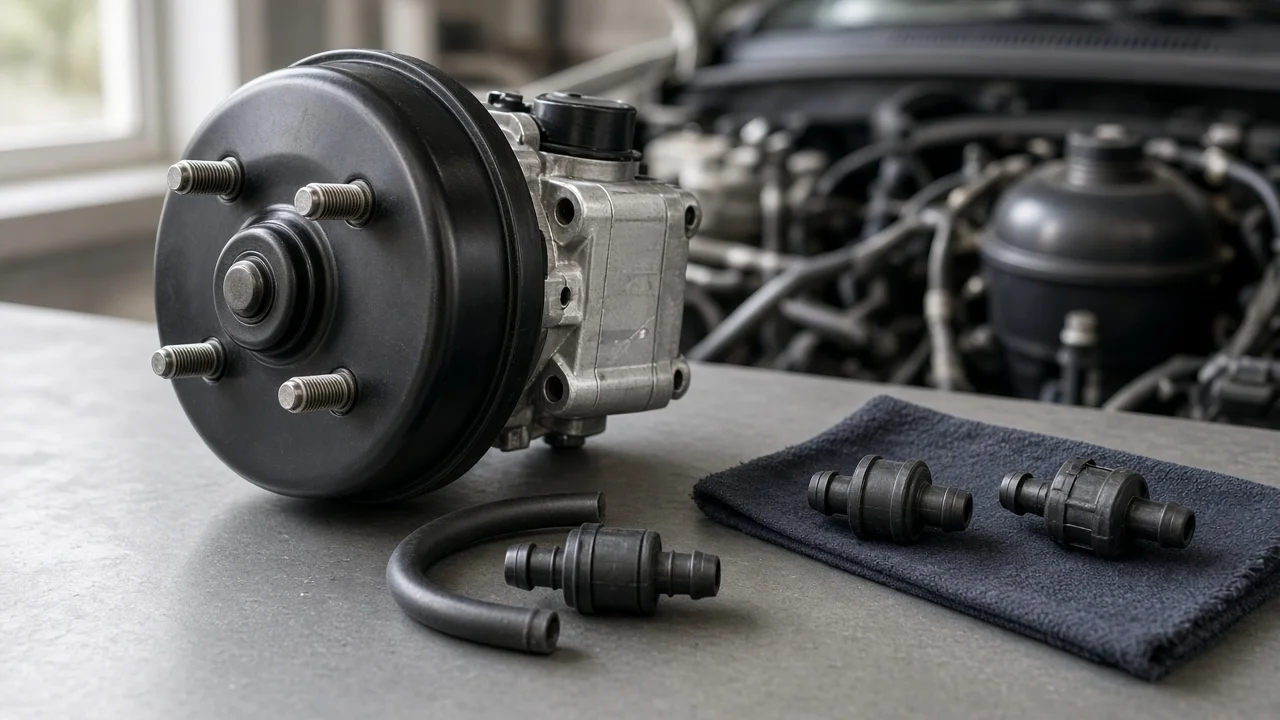
The brake booster check valve is a small one-way valve in the vacuum line that feeds the power brake booster on most Honda models. It lets air leave the booster toward the engine and blocks it from flowing back, so assist stays in reserve when vacuum drops. Before you order a replacement, confirm that the valve is actually at fault and that the part matches your vehicle's year, engine and trim. Routing and valve design can differ between Honda models.
Establish the symptoms
Start by noting exactly when the pedal feels wrong. A failing check valve typically shows up as a hard, high pedal on the first stop after the car has been parked for a while. The pedal often improves once the engine has idled for a few seconds. Some owners notice it after hard acceleration followed immediately by braking, when manifold vacuum is briefly low. Record whether the effort is constant or only occasional, whether the engine is cold or warm, and whether the pedal is hard, soft or sinking. These are different complaints with different causes.
Note any associated signs, such as a hiss near the booster or vacuum hose, a rough or high idle, a check engine light, brake or ABS warning lamps, or a change in brake fluid level. Also write down any recent work. Replacing brake pads, brake rotors or a caliper, flushing the fluid, working on the intake or throttle body, or anything else that disturbed the vacuum hose can point the diagnosis in a specific direction.
Distinguish plausible causes
A check valve that sticks fully or partly closed restricts vacuum to the booster and gives a consistently heavy pedal. A valve that leaks lets the booster lose its stored vacuum when the engine stops or vacuum drops. In that case the first press after a rest is hard, but assist returns quickly with the engine running. A cracked, collapsed or loose vacuum hose or grommet produces similar symptoms and often adds a hiss or an idle change. On many Honda applications the valve and hose are serviced as one assembly, so this distinction matters less for buying parts than for knowing what to inspect.
A leaking booster diaphragm also causes a hard pedal and a hiss. Usually the hiss changes when the pedal is pressed, and assist may fade even with the engine running steadily. Low engine vacuum from an intake leak or idle problem weakens the booster regardless of the valve's condition. Engines that rely on a separate vacuum pump, and hybrid models with electrically assisted braking, work differently altogether. A pedal that is soft, spongy or slowly sinks is a hydraulic problem involving the brake fluid, master cylinder, lines or calipers, not the check valve. Worn friction material on the brake pads lengthens stopping distances but does not normally make the pedal hard to push.
Checks in a useful order
Begin with safe observations. With the car parked and the engine off, pump the brake pedal several times until it firms up. Then hold moderate pressure on the pedal and start the engine. The pedal should drop slightly as vacuum builds; if it does not, the booster is not receiving or using vacuum. Next, run the engine for a minute, switch it off, wait a short time and press the pedal. A healthy booster with a sealing check valve normally gives one or more assisted applications before the pedal turns hard. Inspect the vacuum hose for cracks, softness and secure connections, and check the brake fluid level against the reservoir marks without opening the system.
Testing the valve itself means removing it or its hose assembly. Air should pass in the direction from the booster toward the engine and be blocked in the opposite direction. A hand vacuum pump gives a more reliable result than blowing through it. Other tests call for tools and the vehicle-specific service procedure, including measuring engine vacuum with a gauge, checking the booster diaphragm for leakage, testing a mechanical or electric vacuum pump, and interpreting brake system fault codes. If you are not comfortable with these tests, or the vehicle uses an electric servo brake system, leave the work to a qualified technician.
Interpret the findings
If the pedal drops at engine start and the car holds assist for at least one stop after shutdown, the check valve and booster are probably sealing, and the complaint lies elsewhere. If the pedal drops at start but assist is gone almost immediately after shutdown, a leaking check valve, hose or grommet becomes the leading suspect. This is especially likely when the bench test shows air passing in both directions. A valve that blocks flow both ways, with no pedal drop at start, explains a constantly heavy pedal. These results support replacing the valve but do not prove the diagnosis on their own.
Before ordering parts, confirm that engine vacuum meets the specification in the service information. Also confirm that the booster holds vacuum once a known-good valve and hose are in place. A hiss that follows pedal movement, or vacuum loss with a good valve, points to the booster itself. A sinking or soft pedal, uneven wear on the brake rotors or pads, or fluid loss shifts the job to the hydraulic side. There, wear limits and component condition must be measured rather than assumed. Replacing the valve when the real fault is elsewhere wastes money and leaves the braking problem in place.
Urgency and next action
Stop driving and arrange professional service if any of these happen: the pedal goes to the floor or sinks under steady pressure, it feels spongy, the brake warning lamp stays on, fluid is leaking or the reservoir is low, or assist disappears while you are driving. A heavy pedal caused by a vacuum fault still lets the brakes work, but stopping takes far more force, and that margin is unpredictable. No remaining distance can be called safe without an inspection, so have the car checked before relying on it in traffic.
To get the correct part, identify the vehicle by its VIN rather than by model name alone. Valves, hose assemblies and connectors can differ across Honda model years and engines. Some versions combine the valve and hose, so they are sold only as an assembly. Turbocharged engines and hybrids may use different vacuum sources or no vacuum booster at all. Give the parts supplier or shop the VIN, model year, model, trim, engine and transmission, along with the symptoms and test results you recorded. This confirms vehicle fitment and shows the technician what has already been ruled out.