High Pressure Radiator Cap: What It Does and When a Higher-Rating Cap Makes Sense
Direct answer
A high pressure radiator cap raises the cooling system’s normal operating pressure above the stock rating, which increases the coolant boiling point. A higher-pressure cap can reduce localized boiling and coolant loss under hard use, but it does not fix an overheating engine by itself. Its benefit depends on the radiator, hoses, heater core, water pump seal, and head gasket being able to tolerate the extra pressure.
How a radiator cap controls pressure and boiling point
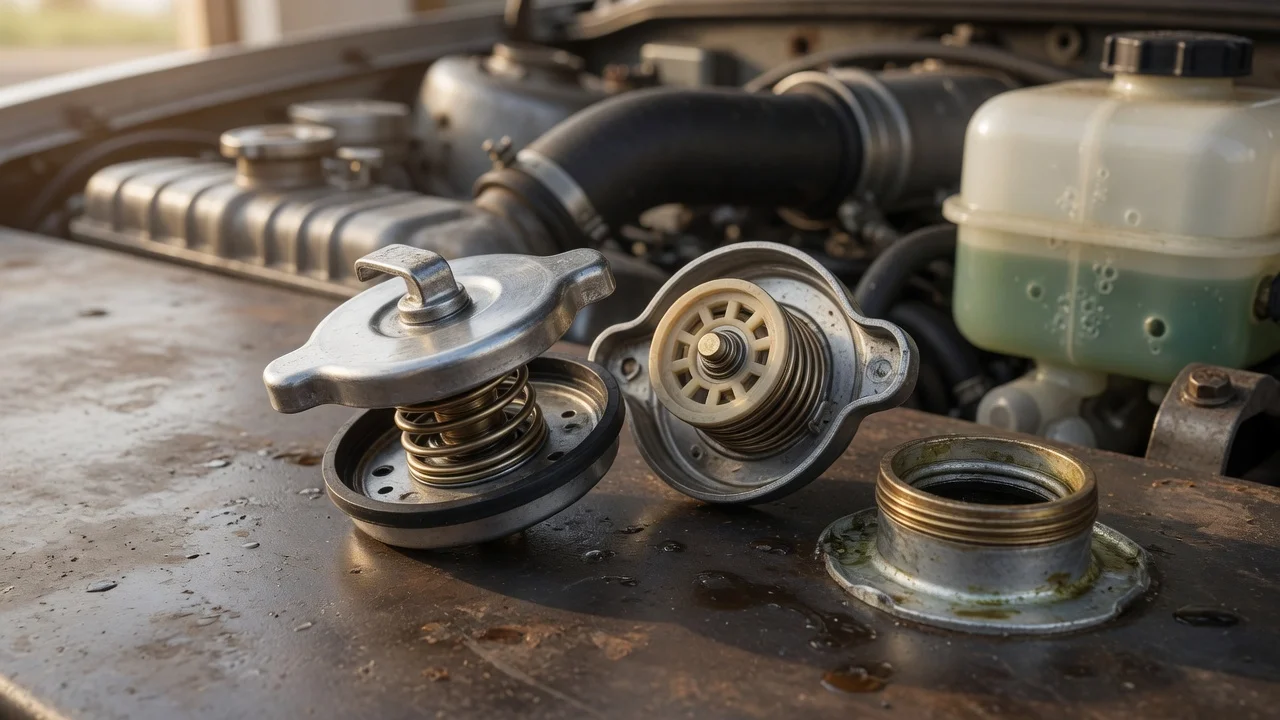
A radiator cap is a pressure-relief valve. As the engine warms up, coolant expands and pressure builds inside the sealed cooling system. Once pressure reaches the cap’s rated value, a spring-loaded valve opens and allows a small amount of coolant to move into the overflow or expansion tank. When the engine cools, a second valve allows coolant to be drawn back.
Raising system pressure raises the boiling point of the coolant. A common stock rating is about 0.9 to 1.1 bar, often shown as 13 to 16 psi. A higher-pressure cap may raise that to roughly 1.3 bar or more. This extra margin can help prevent steam pockets from forming around hot cylinder heads or exhaust valve areas during hard acceleration, towing, or track use.
Where the benefits are real
A higher-pressure cap can be useful on a vehicle that already has a healthy cooling system but is being used in sustained high-load conditions. The most direct benefit is a wider safety margin before the coolant reaches its boiling point and turns to vapor. Vapor conducts heat less effectively than liquid coolant, so avoiding localized boiling can keep metal temperatures more stable in the cylinder head.
This is different from making the system remove more heat. A pressure cap does not increase radiator airflow, coolant flow, or radiator surface area. If the engine is already running too hot because the radiator is undersized, clogged, or lacking airflow, a high pressure cap only masks a small part of the problem.
Compatibility and the risks of too much pressure
A higher-pressure cap raises stress on the entire cooling system. The risk is not theoretical: stock radiators with plastic end tanks, older coolant hoses, heater cores, and water pump seals may be rated for the original pressure, not an increased value. A modest increase may be tolerable, but a large increase can cause a weak component to fail before the cap releases.
The most vulnerable points are often the plastic radiator tanks and hose connections. On an older vehicle, a high pressure cap may expose a marginal hose or a corroded heater core. The result can be a sudden coolant loss under load, which is worse than the localized boiling the cap was intended to prevent.
How to choose a higher-pressure cap
If a higher-pressure cap is appropriate, the increase should be small and matched to the vehicle. A common approach is to move only one step above the stock rating rather than installing the highest available cap. Check the cap’s pressure rating, the neck depth, and the seal design, because radiators use different cap styles that are not visually interchangeable across all makes and models.
The condition of the system matters more than the cap rating. Before increasing pressure, replace weak hoses, confirm the radiator is not blocked, verify the coolant concentration, and make sure the fan or fans work at the expected temperatures. A higher-pressure cap should only be considered on a system that already passes a basic pressure test or shows no signs of seepage at the original rating.
What a high pressure cap will not do
A high pressure radiator cap will not lower steady-state operating temperature by itself, repair a failing head gasket, clean a clogged radiator, or compensate for a weak water pump. It changes the margin before boiling, not the heat rejection capacity of the system. If the temperature gauge is already climbing in normal driving, the correct next step is diagnosis of the cooling system, not a pressure increase.
Practical guidance
For most street vehicles, the stock pressure rating is sufficient and the safest choice. A higher-pressure cap is best treated as a supporting modification for a known high-load use case, not a general upgrade. When used, the increase should be conservative, and the rest of the cooling system should be in verified good condition.