Hellcat Supercharger Bypass Valve: Identification and Function
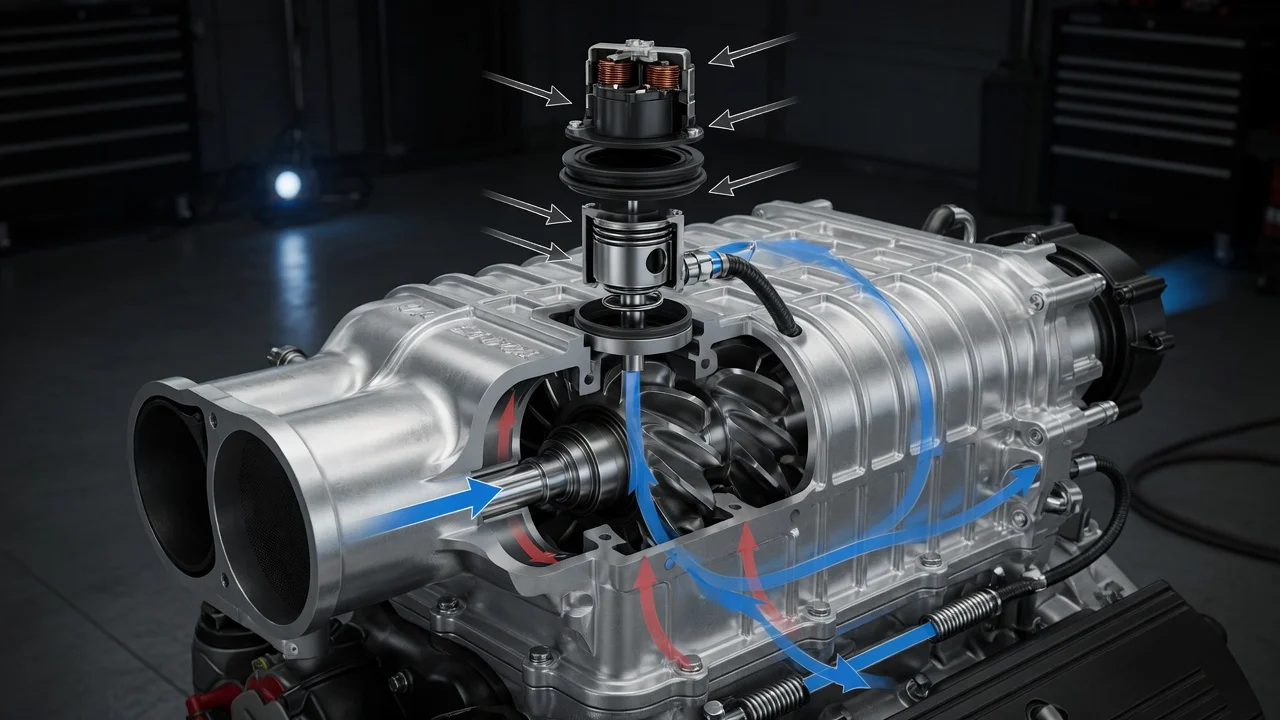
The bypass valve on a Hellcat supercharger is a small part with a big job. It decides when the blower builds boost and when it simply moves air around without loading the engine. Owners usually start asking about it after noticing a power change, an unusual sound or a fault code. This guide explains how to identify the valve, what it does, which factors change its behavior, and when you need vehicle-specific service information instead of a general answer.
What the bypass valve is and what it does
On the supercharged 6.2-liter HEMI engines sold under the Hellcat name, the bypass valve is part of the supercharger assembly on top of the engine. It controls a passage that connects the high-pressure discharge side of the twin-screw rotors back to the inlet side. When the valve is open, air pushed out by the rotors can recirculate instead of being forced into the intake manifold, so the engine sees little or no boost. When the valve closes, that escape path is shut and the supercharger pressurizes the intake charge.
The valve lets the engine behave much like a lightly loaded naturally aspirated engine at idle and light throttle, then switch to full boost when the driver asks for power. It does not create boost itself. It is also not a blow-off valve in the turbocharger sense, although people often confuse the two. Part design, its exact position on the housing and the way it is actuated can differ between model years and engine versions. Confirm identification against the manufacturer specifications for your vehicle.
How the bypass works in daily driving
A positive-displacement supercharger is belt-driven from the crankshaft, so it moves roughly the same volume of air per revolution whether or not the engine needs it. Without a bypass, the blower would keep compressing air during cruising, which wastes crankshaft power and heats the intake charge. The bypass valve prevents this by opening under vacuum conditions such as idle, deceleration and steady cruise. With the valve open, the rotors spin with less resistance.
As the throttle opens and engine load rises, the valve moves toward closed and boost builds in the manifold. The transition is meant to be smooth, which is why a healthy car pulls progressively instead of lurching when boost arrives. Depending on the design, the valve is moved either by an actuator that responds to manifold pressure or by one the powertrain control module commands electronically. The service information for your VIN shows which arrangement your engine uses and how to diagnose it.
Factors that change how the valve behaves
The vehicle configuration matters first. Hellcat-derived engines appear in several Dodge, Jeep and Ram models across multiple years. Calibration, intake layout and supercharger version are not identical between them. A procedure or part number that fits one application may not fit another, so check model, year and engine code before ordering parts or following a guide written for a different vehicle.
Modifications also change the answer. Smaller pulleys, aftermarket tunes, intake changes and altered boost targets can shift when the valve opens and closes, and some tunes deliberately modify bypass behavior. Operating conditions play a part too: intake air temperature, altitude, fuel quality and driving style all influence how much boost the control system allows. On a modified car, a symptom that looks like a bypass fault may actually be a calibration issue, and the reverse is also possible.
Practical checks an owner can make
Start by observing when the problem appears: at idle, during light cruising, under full throttle or only when the engine is hot. Write down any of these signs: • reduced power under load; • boost that arrives late or not at all; • surging at part throttle; • an unusual hiss near the supercharger; • warning lights; If you have a scan tool, read stored codes and live data. A code pointing to the bypass circuit or to boost pressure narrows the search considerably.
With the engine off and cool, a visual inspection can help. Look for disconnected or cracked vacuum lines, damaged electrical connectors, and oil or debris around the supercharger inlet. Do not pry on the valve linkage or run the engine with intake components removed, because debris entering the rotors can cause serious damage. Review the service history as well, since recent intake work, a tune or supercharger service can explain new symptoms. Replace the valve based on diagnosis, not on a generic mileage figure, and follow the maintenance schedule and service information for your vehicle.
Limits of a general answer and when to get help
A general explanation cannot confirm whether a specific bypass valve has failed. Boost complaints can also come from belt slip, intake leaks, sensor faults, throttle body problems, fuel delivery or calibration, and several of these produce similar symptoms. Replacing the valve without confirming the cause risks paying for the wrong part.
Get professional help if codes point to the bypass system, if power loss under load is obvious, or if the car has been modified. The next step is diagnosis by a technician familiar with supercharged Mopar engines, using the factory service information for your exact VIN. Bring your notes on symptoms, operating conditions and recent work. They shorten diagnosis and help separate a genuine valve or actuator fault from a problem elsewhere in the boost system.