How to Choose the Correct Haldex Coupling Oil
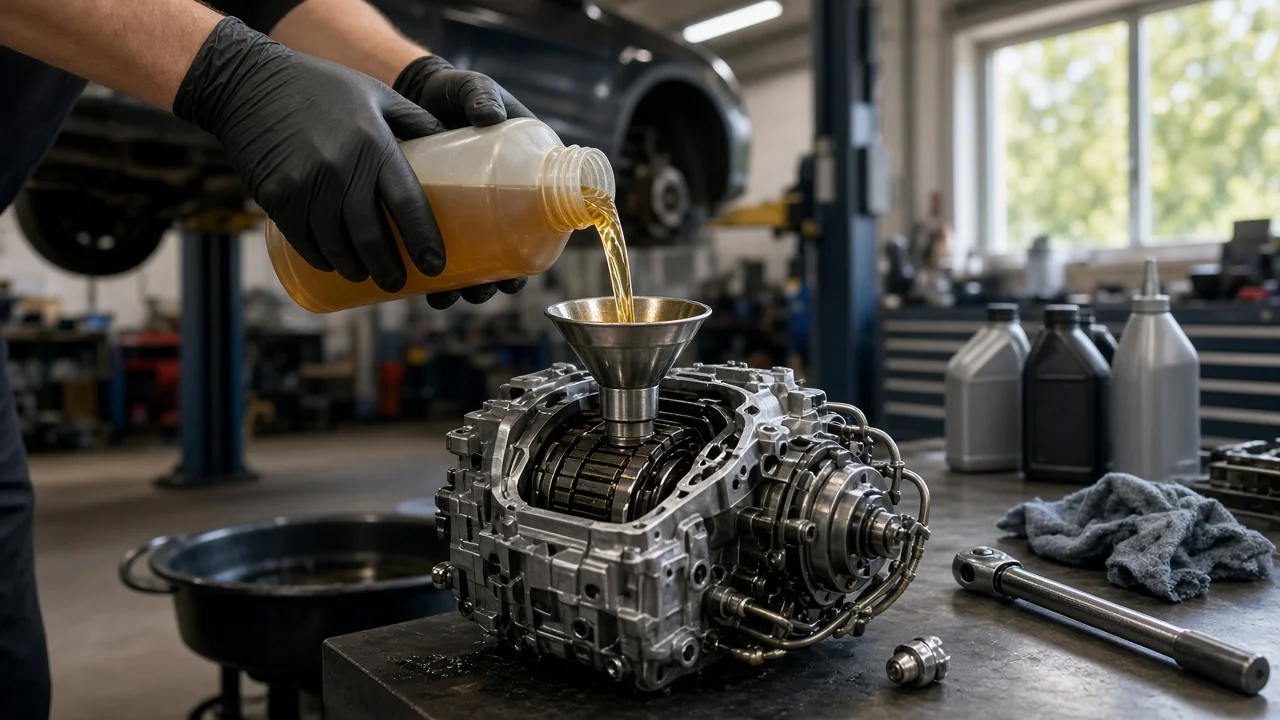
Haldex coupling oil is a small-volume fluid with a big job. It lets the electronically controlled clutch pack in a VW 4Motion drivetrain send torque to the rear axle smoothly and on command. Choosing it is mostly about matching the oil to the coupling generation in your car and to the specification listed for that vehicle, not picking a brand. This guide shows how to narrow the choice and explains what the oil can and cannot fix.
Define the job the oil must do
On VW models with transverse-engine 4Motion all-wheel drive, such as the Golf R, Golf Alltrack, Tiguan, Atlas and Passat 4Motion, the rear-axle coupling is typically a Haldex unit mounted ahead of the rear differential. The coupling is not the gearbox. Whether the car has a manual, a conventional automatic or a DSG, the coupling has its own oil. That oil is separate from the transmission fluid, and it is usually separate from the rear final-drive gear oil, even though both parts sit in the same assembly. Longitudinal-engine models such as the Touareg use a different all-wheel-drive design, so this guide does not apply to them.
Start by clarifying why you are buying oil. A routine service on a car with a known service history calls for the exact specified fluid in the correct quantity. A car with an all-wheel-drive warning, a stored fault, or a feeling that the rear axle no longer engages needs diagnosis first. Fresh oil may be part of that work, but buying it does not confirm what is wrong. Also weigh the practical constraints: whether you can lift the car safely and level, whether you can reach the fill plug, and whether your generation's procedure requires a scan tool.
Check compatibility with your coupling generation
VW has used several Haldex generations, and the oil specification is tied to the generation rather than to the engine or trim. As a broad guide, earlier 4Motion cars from the Mk4 and Mk5 Golf era used Generation 1 to 3 couplings. Mk6-era models such as the Golf R generally use Generation 4. MQB-based models such as the Mk7 Golf R, Alltrack, later Tiguan and Atlas generally use Generation 5. Changeover years overlap and market versions differ, so treat this mapping only as a starting point.
The reliable way to confirm fitment is by VIN. A VW parts catalog or a dealer parts counter can list the coupling oil part number for your exact vehicle. VW part numbers for Haldex oil generally begin with G 055 175 or G 060 175, and newer numbers sometimes supersede older ones. A label on the coupling, visible from under the car, can also help a shop identify the unit. Take the fill quantity, and whether the unit has a serviceable filter, from service information for the same VIN, not from forum posts about similar models.
Do not substitute ATF, DSG fluid, or the 75W-90 class gear oil used in many final drives. Haldex oil is formulated for a wet multi-plate clutch and the coupling's hydraulic pump. Its friction and viscosity characteristics are part of what the control unit's engagement calibration expects. The wrong fluid can change engagement feel and may contribute to faults.
Features that affect the choice
Genuine VW fluid removes guesswork about the fluid specification. An aftermarket oil can be acceptable when its maker states which coupling generation or VW part number it meets. A label that says only 'Haldex compatible', with no generation or reference, is marketing wording, not evidence. Look for a stated equivalence to your car's VW part number, a technical data sheet, and clear batch and packaging information. Be wary of any bottle that claims to suit every generation, unless the VW catalog itself shows that number superseding the older one for your vehicle.
Quantity and packaging matter more than they seem. These couplings hold well under a liter, so one bottle usually covers a change, but check it against the specified capacity and allow a little extra for spillage. Some kits bundle oil with a new pump filter, relevant on generations that have one, such as Generation 4, along with fresh drain and fill plug seals. A kit is only convenient if every part in it matches your VIN.
Limitations and ownership costs
Oil cannot repair a failed pump, a worn clutch pack, a faulty control module or a wiring problem. If the car has diagnostic codes for the coupling, read them before and after service with a scan tool that can access the all-wheel-drive module. A code that names the pump circuit points to an area to test, not proof that the pump has failed. Connectors, power supply and fluid condition belong in the same diagnostic path. Front-drive-only behavior or slow rear engagement can likewise have several causes. A change in shift behavior points to the transmission rather than the coupling and needs its own diagnosis.
The direct cost is the oil, the seals and, where fitted, a filter. The indirect cost is access and procedure. On some installations the plugs are awkward to reach, the vehicle must sit level for an accurate fill, and some service procedures call for a scan tool to run the pump or check the system afterward. Service intervals vary by model, generation and usage, so follow the schedule for your car and record each change in its service history. A shop with VW-specific diagnostics may cost more per job, but it removes the risk of an incorrect fill.
Old coupling oil is often dark from clutch material. Its appearance alone does not show whether the coupling is healthy. Still, metal particles, an unusual smell, or a drained volume well below the specified capacity are worth noting for whoever diagnoses the system.
Build a practical shortlist
Compare each candidate against a short checklist. First, confirm the model year and coupling generation. Second, record the VW part number for the coupling oil and the specified capacity, and note whether your unit has a serviceable filter. Third, check whether each oil's bottle or data sheet names that part number or generation explicitly, and drop any that rely on generic all-wheel-drive wording. Fourth, make sure you are not confusing coupling oil with rear differential oil or transmission fluid, which come in similar bottles on parts shelves. Fifth, add the seals, the filter if applicable, and any tool or scan access the procedure requires.
If the car has symptoms or stored codes, add a diagnostic step before the purchase. Read the codes, check the fluid level and condition, and choose repair options based on what you find. When in doubt, genuine VW oil is the simplest default. An aftermarket fluid earns a place on the shortlist only when its stated specification matches your car exactly.