Choosing a Grease Gun for Serviceable Sway Bar Links
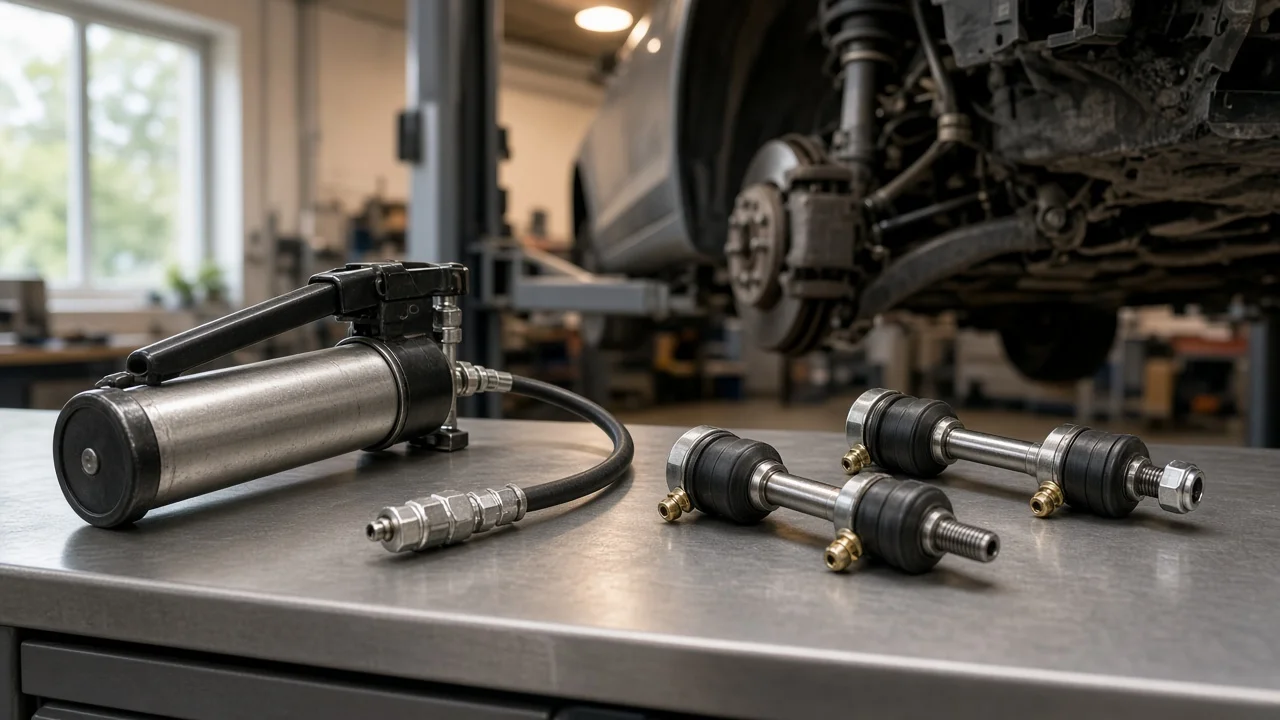
Some sway bar links have grease fittings, and periodic lubrication is part of their upkeep. Choosing a grease gun for these links is less about maximum pressure and more about three things. The gun has to reach a small fitting tucked behind a wheel or control arm, deliver a controlled amount of grease, and work with the lubricant the link maker specifies. This guide covers how to match the tool to that job without overbuying.
Define the job the product must do
Start by confirming that your links are actually serviceable. Many factory sway bar links are sealed units with no fitting. Greasable versions are more common among aftermarket and heavy-duty replacements. Look for a grease fitting, often called a zerk, on the ball stud housing or near the bushing end of each link. If there is no fitting, a grease gun will not help. Do not drill a sealed link to add one, because that can compromise the joint and its boot.
Next, think about your vehicle configuration and how you will work on it. Do you service the car on ramps, jack stands or a lift? Is the wheel on or off? On many trucks and SUVs, the front links sit close to brake hoses, ABS wiring and suspension components, and that limits how a gun body can be positioned. Also think about scope. If you only grease a pair of links and perhaps a few other chassis fittings occasionally, a compact manual gun usually covers the job. If the same tool will serve a vehicle with many fittings or several vehicles, convenience features matter more. Check the service history and the link maker's maintenance schedule for how often greasing is expected. Operating conditions such as off-road use, water crossings or salted roads can influence that guidance, but follow the published recommendation rather than a generic interval.
Check compatibility
Most grease guns sold for automotive use come with a standard hydraulic coupler that snaps onto the common fitting head. The thread size of the fitting itself does not affect the gun choice. Thread size only matters if you need to replace a damaged fitting, and in that case you should match the link maker's specification. What does matter is fitting orientation. Straight, 45-degree and 90-degree fittings each change the angle at which the coupler has to approach, and some links place the fitting where a straight coupler cannot seat squarely.
Cartridge size is the next interface to check. Full-size guns accept the common 14-ounce class of cartridge, while mini guns take small cartridges of around 3 ounces. A mini gun is easier to maneuver in tight wheel wells, but it needs more frequent reloading and may offer fewer grease choices in that format. Use the grease type named in the manufacturer specifications for the link. Many chassis applications call for an NLGI grade 2 grease, but some specify a particular base or thickener. Mixing incompatible greases can degrade lubrication, so confirm that the grease you want is available in the cartridge size your gun accepts, or that the gun supports bulk loading.
Finally, check physical access before buying. With the vehicle in its usual service position, look at the space around each fitting and estimate how much room the coupler and gun body need. A flexible hose lets the gun stay outside the wheel well while the coupler reaches the fitting. A rigid extension with a right-angle coupler can help where a hose would sag or kink.
Features that affect the choice
Operating style is the main trade-off. A lever gun needs two hands but gives good feel for each stroke. A pistol-grip gun can be worked with one hand, which leaves the other hand free to hold the coupler on an awkward fitting. That is a real advantage under a vehicle. Cordless guns remove the hand fatigue but are heavier and bulkier, and their continuous flow can fill a small link boot faster than you expect. Pneumatic guns need a compressor and air line, which makes more sense in a shop than for occasional driveway use. For sway bar links, controllability usually matters more than speed.
Treat pressure ratings with caution. Packaging often advertises peak figures in the thousands of psi. A small link boot does not need that pressure, and excess grease can split it. High pressure mainly helps clear a stubborn or partially blocked fitting. More useful evidence includes a few specific features. A locking coupler grips the fitting and releases cleanly, which reduces spills and lost grease. An air bleeder valve simplifies priming. A clear listing of the included hose length, cartridge size and coupler type tells you more than a label like heavy-duty or professional, which says little about how the gun performs on a small chassis fitting.
Limitations and ownership costs
Setup takes a few minutes the first time. You load the cartridge, release the plunger and prime the gun until grease flows without air pockets. If a gun loses prime, it may pump air instead of grease until you bleed it. Ongoing costs include grease cartridges and replacement couplers, because the coupler jaws wear and start to leak. You may also need hoses, spare fittings and shop rags. Before connecting, wipe each fitting clean so dirt is not pushed into the joint. Afterward, wipe away excess grease, because exposed grease collects grit. Store the gun so its seals and hose are not left under load if the maker advises against it.
A grease gun cannot restore a worn link. During inspection, look for torn boots, play in the ball joint, clunking over bumps or visible damage. Those symptoms usually mean replacement, not more grease. A fitting that will not accept grease may be blocked or damaged and may need to be replaced. When greasing, pump slowly and watch the boot. Stop according to the link maker's instructions, typically when the boot just begins to swell or fresh grease appears, rather than pumping until resistance builds.
Build a practical shortlist
Use a short checklist to narrow the options: 1) Confirm the links are serviceable and note the specified grease. 2) Check fitting orientation and the clearance available with the wheel on or off. 3) Choose an operating style: lever, pistol-grip, cordless or pneumatic. 4) Confirm the cartridge size and grease availability in that format. 5) Check the coupler type, and whether a locking or right-angle coupler is included or can be added. 6) Check hose length and flexibility, or a rigid extension. 7) Check that replacement couplers, hoses and seals are available. A gun that clears every item for your specific links is a sound candidate, whatever its marketing claims.
When comparing two or three guns, rely on stated specifications and included parts rather than rankings or star ratings. Check the warranty terms and whether the manufacturer sells spare seals and couplers. After the first service, record the date, the grease used and the condition of each link in the vehicle's service history. That record makes future inspections easier and helps you notice when a link needs replacing rather than another round of grease.