GDI Fuel System Cleaning: What the Service Cleans
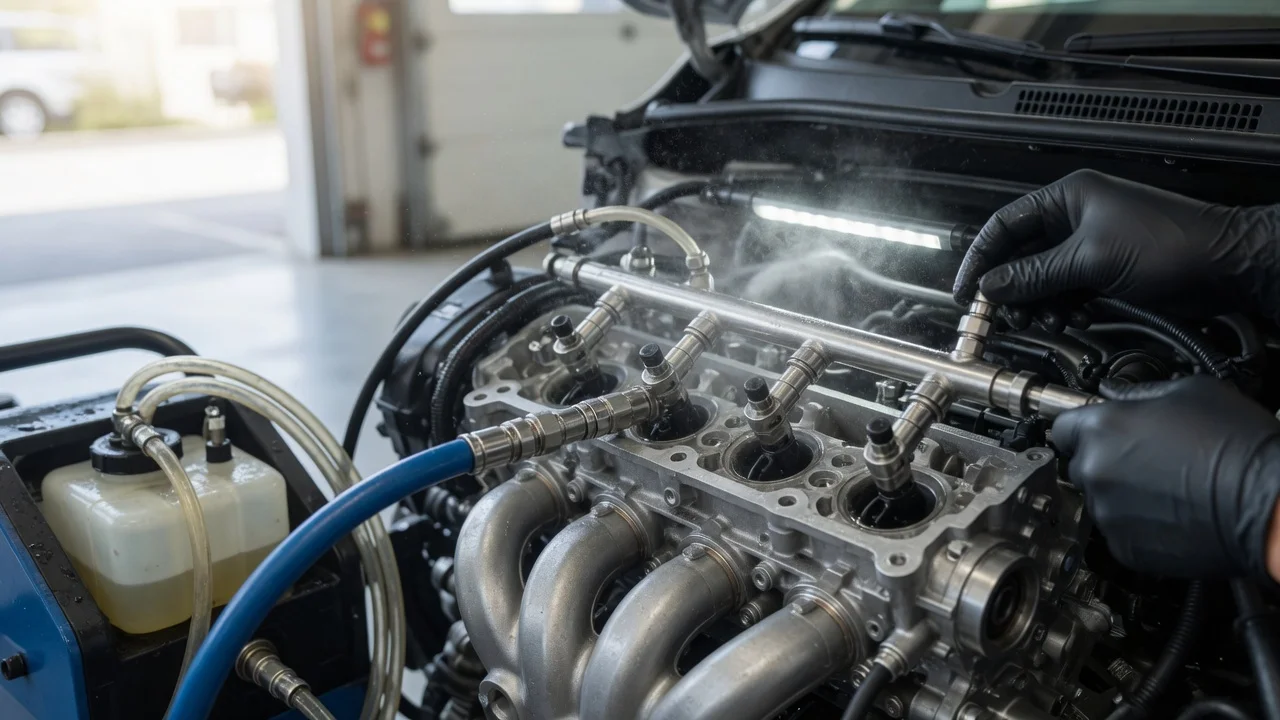
What a GDI fuel system cleaning actually covers
In a gasoline direct injection engine, fuel is sprayed directly into the combustion chamber rather than onto the back of the intake valves. A GDI fuel system cleaning is therefore not one universal procedure. It can mean cleaning the injectors, the combustion chamber, or the intake tract and intake valves, and these are different services with different access points and expected results. The direct answer is that a properly scoped GDI fuel system cleaning targets the components the technician can reach: the high-pressure injector tips and internal injector deposits when an injector cleaning is performed, and the intake valves plus adjacent port surfaces when an intake valve cleaning is performed. Fuel tank additives circulate through the fuel system but do not wash the intake valves on a direct injection engine.
Why direct injection changes where deposits form
Port fuel injection introduces fuel upstream of the intake valves, so the fuel spray and its detergents continually wash the back of each valve. Direct injection moves the injector into the cylinder. Air, oil vapor from the crankcase ventilation system, and combustion byproducts can still pass over the intake valves, but fuel no longer does. That can leave baked-on carbon deposits on the valve stems and tulips over time. The practical effect is that a conventional fuel additive or in-tank cleaner may help keep high-pressure injector nozzles cleaner, but it cannot act as an intake valve wash.
What the service reaches
A professional GDI service is usually divided by the area being treated.
Service|Primary target|Primary cleaning action|May also affect; Injector cleaning|Injector tips and internal passages|Cleaning agent run through injectors or fuel rail|Spray pattern, combustion quality; Intake valve cleaning|Intake valves and port walls|Media blasting or solvent applied through the intake|Airflow, idle quality, misfire tendency; In-tank additive|Fuel system and injector internals|Detergent carried with fuel|Injector deposits, but not intake valves; Combustion chamber cleaning|Piston crowns and chamber surfaces|Foam, solvent, or hydrogen-based carbon removal|Compression, hot-spot tendency
How injector cleaning works
Direct injection injectors operate at high fuel pressure and sit in a hot, tightly packaged environment. Their nozzle orifices are small, and deposits at the tip can disturb the fuel spray pattern. An injector cleaning service typically runs a pressurized cleaning agent through the injectors while the engine operates for a prescribed period, or it may use the vehicle fuel system as the carrier. The cleaning can improve atomization and reduce rich or lean mixture variation caused by uneven delivery, but it will not repair a mechanically worn or electrically faulty injector.
How intake valve cleaning works
Because the injectors no longer wash the intake valves, direct injection engines can require a separate mechanical or chemical intake cleaning. Technicians may use walnut-shell media blasting, which is abrasive enough to remove carbon but soft enough not to harm the metal valve when performed correctly. Some services use solvent and brushes or an induction cleaning apparatus that draws a cleaner through the intake. The goal is to restore airflow and reduce valve-related misfires, rough idle, or hesitation caused by deposit buildup. The exact method and service intervals vary by engine family, mileage, oil-control behavior, and driving conditions.
What a cleaning cannot fix
A GDI fuel system cleaning is not a substitute for diagnosis or parts replacement. It cannot repair a leaking injector, a failed high-pressure fuel pump, worn valve guides, damaged valve seals, or a faulty sensor. It also cannot reverse mechanical damage that has already occurred. If a vehicle has a specific fault code, the code is evidence to investigate, not proof that a cleaning will resolve the problem.
When the service is most relevant
A GDI cleaning is usually considered in response to observable symptoms such as rough idle, light-throttle hesitation, uneven cold running, or elevated misfire counts on engines known for intake valve deposits. It may also be offered preventively at higher mileage or after shortened trips and heavy low-speed operation. The benefit is most relevant when deposits are the probable cause. A diagnosis that confirms deposit buildup, rather than assuming it from mileage alone, makes the service easier to evaluate.
Assessing the service
Strengths
Can restore spray quality and reduce injector-related mixture variation when injector deposits are present. Can remove carbon from intake valves that fuel additives cannot reach on a direct injection engine. May reduce rough idle, hesitation, and misfires when deposit buildup is the actual cause. Is less invasive than disassembly or part replacement when the problem is deposit-related.
Limitations
Does not replace faulty injectors, pumps, sensors, or worn engine parts. In-tank additives cannot clean direct injection intake valves. Effectiveness depends on the particular engine, deposit severity, method used, and whether the correct service is matched to the symptom. Mechanical intake cleaning is more involved and should not be mistaken for a routine fuel additive treatment.
Who it suits
The service suits owners of direct injection vehicles with deposit-related symptoms or a confirmed buildup, and owners who want a targeted preventive treatment within a maintenance plan. It is less suitable as a blind fix for every drivability complaint, or for vehicles where a fault code, fuel pressure test, or mechanical inspection already identifies a failed component.
Steps in a typical professional service
The exact order depends on whether injectors, intake valves, or both are being cleaned. These steps describe the general flow; a shop should follow the applicable equipment and manufacturer directions.
Confirm the symptom or evidence. Check fault codes, misfire data, fuel trims, and, where applicable, intake deposit condition before choosing a service. Select the correct service type. Injector cleaning, intake valve cleaning, or a combination should match the affected area. Prepare the access point. For injector cleaning, isolate the fuel pump or supply as directed. For intake cleaning, remove the components needed to access the intake ports safely. Run the cleaning. Injector cleaning may circulate cleaner through the rail or a dedicated apparatus while the engine runs for the prescribed duration. Intake cleaning may use media blasting or solvent applied to the valves. Remove loosened material safely. Follow equipment guidance so dislodged carbon or cleaning media does not enter the cylinder unintended. Reassemble and verify. Restore all connections and pressure, clear learned adaptives only if required, and start the engine to check for leaks and stable running. Confirm the result. Compare idle quality, misfire counts, or a retest result, and flag any remaining symptom for further diagnosis.
Precautions and boundaries
GDI injector cleaning commonly requires disabling the fuel pump or managing high fuel pressure. Direct injection systems retain pressure even after shutdown, so depressurization and high-pressure line precautions must follow the vehicle-specific procedure. Intake cleaning materials and dislodged debris must be contained correctly. If the vehicle has an active fault for fuel pressure, injection, ignition, or a mechanical concern, the underlying fault should be diagnosed before cleaning is assumed to be the repair. Work involving high-pressure fuel, intake removal, or media removal from the intake should be left to a qualified professional unless the vehicle-specific procedure and tooling are available.
How to choose between cleaning and repair
Deposit-related roughness or mixture drift can make cleaning the appropriate next step. A failed injector, low fuel pressure, a sensor fault, or confirmed internal wear points to repair instead. The practical order is diagnosis first, then the least invasive service that reaches the diagnosed area. A cleaning is only cost-effective when the condition fits the service.
Key takeaway
A GDI fuel system cleaning is most accurately described by what it touches: injector cleaning works on the injectors, intake valve cleaning works on the intake side, and in-tank additives only travel with the fuel. Matching the service to the deposit area, and confirming that deposits are the likely cause, produces a better result than treating the term as one all-purpose fix.