Fuel Injector Repair: When Repair Is Possible
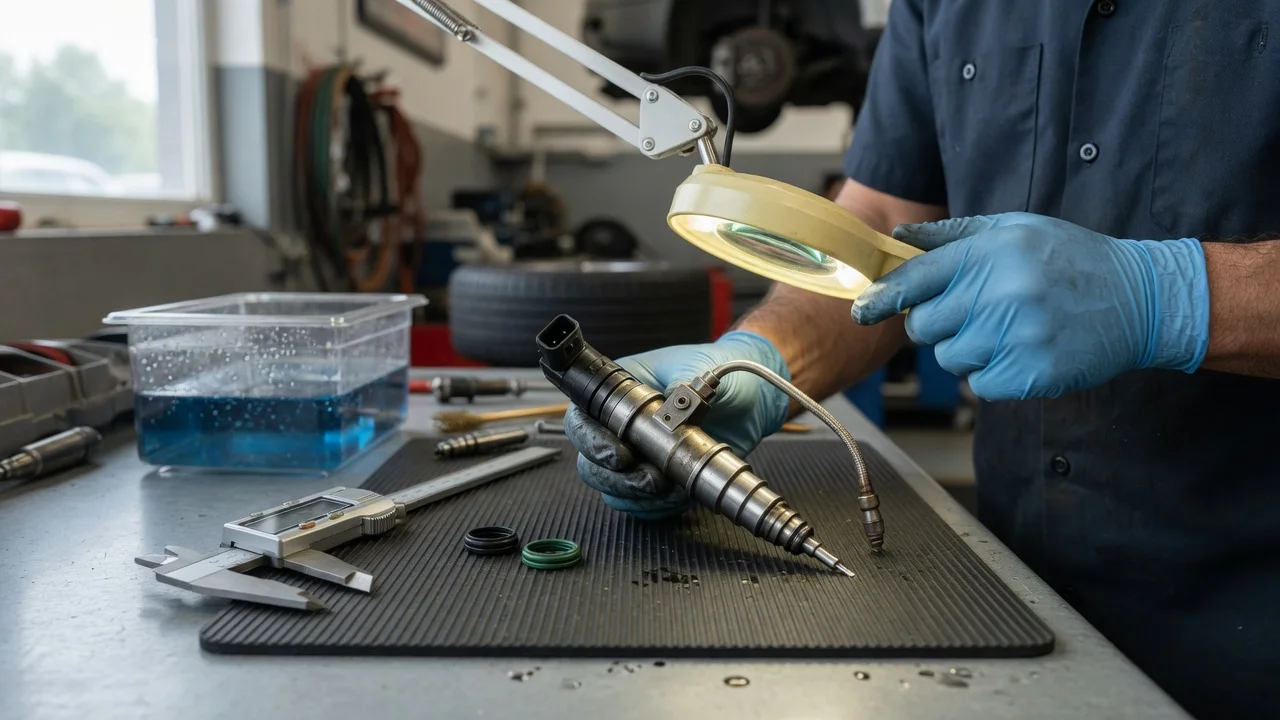
When repair is a realistic option
A fuel injector can be repaired when the fault is restricted spray from deposits, a leaking external seal, a clogged inlet screen, or a rebuildable nozzle and control valve that still meet the manufacturer’s electrical and flow specifications after service. Replacement is the practical path when the solenoid coil or piezo actuator is open, shorted, or out of specification, the injector body is cracked, or internal seats, needles, or high-pressure passages are worn, scored, or contaminated beyond specification. That split depends on injector design—gasoline port, gasoline direct injection (GDI), or diesel common-rail—and on measured condition, not on a misfire or fuel-trim code alone.
What “repair” usually means
In shop practice, injector repair is not a single procedure. The lightest service is cleaning plus new external seals. A fuller rebuild disassembles the injector, ultrasonically cleans internal passages, replaces wear parts that the design allows, then flow-tests and, where the type requires it, electrically tests and recodes or recodes-equivalent matching so the set delivers even volume and spray pattern. Cleaning restores flow only when varnish, carbon, or fuel-borne residue is the restriction. Rebuild restores function only when the remaining metal, coil or piezo stack, and valve geometry are still within the part’s specification. Neither process creates a new injector if those internals are already out of spec.
Faults that often respond to service
Deposit restriction: gasoline and diesel injectors can lose spray quality when gums, carbon, or fuel residue build on the pintle, nozzle holes, or valve seat. Ultrasonic cleaning and flow testing commonly restore pattern and volume when the nozzle is otherwise intact. Inlet-screen blockage: many port injectors use a small filter basket at the fuel inlet. A clogged screen starves that cylinder and is often replaceable with the injector off the rail. External leakage at O-rings or pintle caps: the rubber seals between the injector, fuel rail, and intake port (or the lower seal on a port injector) harden, swell, or tear. Seal kits are a standard repair and do not address internal metering faults. Diesel nozzle and control-valve wear within rebuild limits: common-rail and unit injectors are frequently rebuilt by specialists because the complete assembly is expensive. Repair is viable when nozzle, control valve, and remaining hydraulic parts can be brought back inside the maker’s flow, return, and response limits. Balancing a set after cleaning: a bank of injectors that are all somewhat restricted may be serviceable if, after cleaning, flow variation across the set is within the specification used for that part number.
Faults that usually require replacement
Failed solenoid coil: an open, shorted, or out-of-range coil will not open the injector on command. Coil windings are not a routine field repair on passenger-car gasoline injectors. Failed piezo stack: many GDI and modern diesel injectors use a piezo actuator instead of a solenoid. A failed stack is treated as a replace or specialist-rebuild item, not a parts-counter repair. Cracked or corroded body: a fractured housing, damaged connector boss, or corroded electrical terminal that cannot be restored to a sealed, specified condition ends repair. Scored needle, seat, or nozzle: water, rust, or debris in fuel can cut sealing surfaces. Once the seat leaks or the spray holes are eroded, cleaning will not restore atomization. Internal leakage beyond spec: diesel return-flow that stays high after rebuild, or a gasoline injector that dribbles with key on and engine off, points to a valve that no longer seals. That is a replace or full specialist rebuild decision, not a seal-kit job. Physical damage from handling or a failed installation: bent connectors, crushed inlet tubes, and damaged high-pressure fittings on GDI or common-rail injectors are not repaired in ordinary service.
How injector type changes the decision
Gasoline port injectors sit in the intake tract, run at relatively modest rail pressure, and are the most commonly cleaned and resealed units. Many independent shops can test resistance, leak-down, and flow on a bench and decide clean-and-seal versus replace for that part number.
GDI injectors spray directly into the cylinder at much higher pressure, often with a piezo or high-speed solenoid actuator, and they see combustion-side carbon on the nozzle. Cleaning can help a coked tip. Internal hydraulic or actuator faults, and many coding or calibration requirements after install, push failed GDI injectors toward replacement or a specialist rebuild. Exact pressure, coding, and service steps are model-year, engine, and part-number specific.
Diesel common-rail injectors operate at still higher pressure, meter tiny quantities, and are priced such that rebuild is a normal trade path when internals are within limits. Water in diesel, poor filtration, and metal debris from a failed pump commonly score nozzles and control valves beyond repair. A single contaminated injector is a reason to inspect the rest of the high-pressure system before deciding to rebuild or replace the set.
Hybrid arrangements exist—for example port plus GDI on the same engine—so a repair that is sound for one injector family on that vehicle can be the wrong choice for the other. Identify the injector by engine code and part number before assuming a cleaning kit or a used unit will fit and function.
Repair versus replace by typical fault
Observed condition Usual path Qualification; Restricted spray, deposits, clogged inlet screen Clean, replace screen and seals, flow-test Viable if volume and pattern meet spec after service; Wet well, fuel odor, rail or port seepage Replace O-rings and related external seals Confirms only an external leak; does not fix a dribbling nozzle; Open, shorted, or out-of-range coil or piezo Replace the injector Electrical failure is not corrected by cleaning; Cracked body, damaged high-pressure fitting, bent connector Replace the injector Housing integrity cannot be restored in ordinary service; Diesel high return flow or scored nozzle after contamination Specialist rebuild or replace; inspect pump and fuel One damaged injector often means the fuel system shared the debris; Misfire, rough idle, or fuel-trim code with no injector test Diagnose first A stored code is a reason to test, not proof the injector is failed
Checks that decide repair or replacement
A repair decision is supported only after the injector is shown to be the fault and after its remaining condition is measured. Resistance or piezo insulation tests, commanded injector contribution or power-balance tests, leak-down or return-flow measurement, and a bench flow and spray-pattern test are the usual evidence. Specifications for ohms, flow volume, pulse response, and allowable variation are those published for that injector part number or engine; they are not interchangeable across gasoline port, GDI, and diesel designs, and they are not inferred from a generic scan-tool label.
Stop using the engine and seek professional diagnosis if there is a strong fuel smell in the cabin or engine bay, visible fuel leakage, a fire risk around a hot exhaust, a no-start after fuel-system work, or diesel contamination suspected after water or pump debris. Continued running with a leaking high-pressure injector can wash a cylinder, dilute engine oil, or damage a catalytic converter or diesel particulate filter. Those are safety and secondary-damage limits, not cleaning opportunities.
What to do next
Confirm the injector type and part number for the engine, then have the suspected injector electrically tested and flow-tested rather than replacing on a code. If tests show deposit restriction or seal leakage and the internals still meet spec, cleaning and a seal kit—or a documented specialist rebuild on diesel and some GDI units—are the repair path. If tests show an open actuator, a cracked body, or flow and leak values that stay out of spec after service, replace with a unit specified for that engine and complete any required coding, rail-pressure checks, and fuel-quality or filtration repairs so the new or rebuilt injector is not failed by the original cause.
Limits of this guidance
This article does not list ohm, flow, or pressure figures because those values are part-number and model-year specific and were not supplied here. It also does not treat a misfire, lean or rich fuel-trim, smoke, or hard-start complaint as proof of a failed injector; those symptoms have other common causes in ignition, air metering, low fuel pressure, and mechanical compression. Without the vehicle’s engine code, injector design, and bench or return-flow results, repair versus replace cannot be closed from description alone.