Fuel Filter Funnels and Transfer Tank Filters: Keeping Water and Debris Out
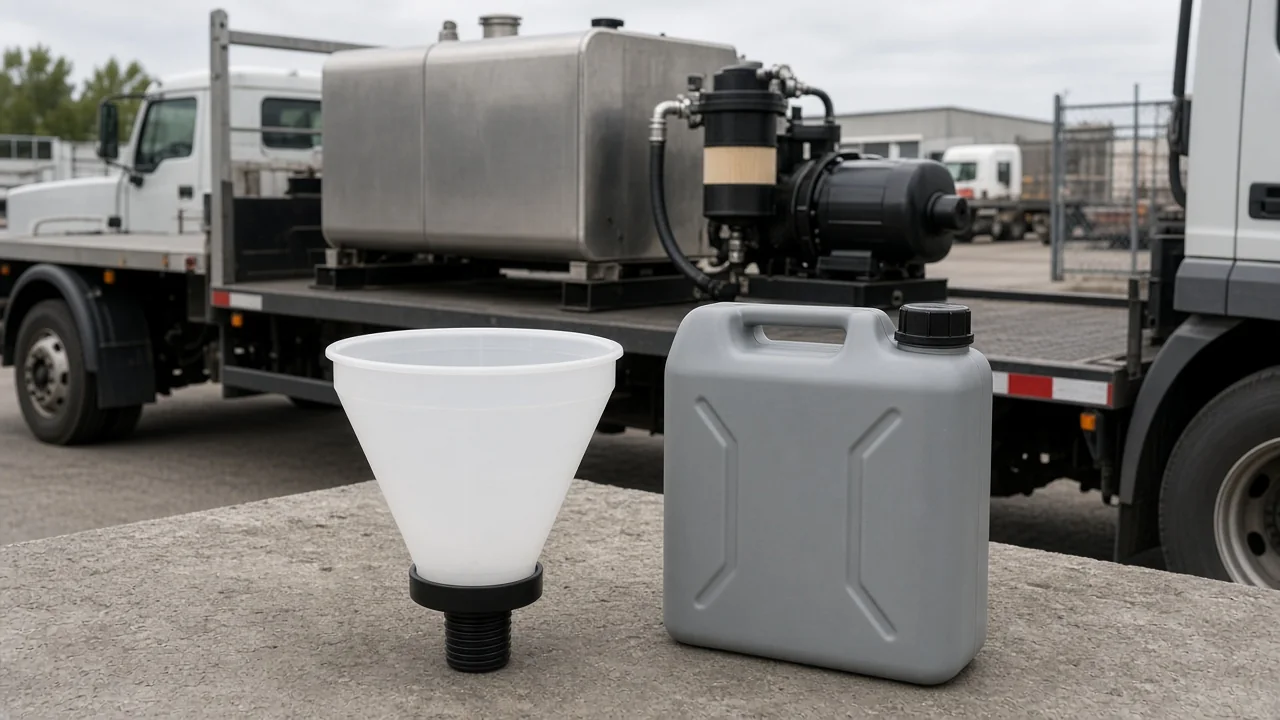
Truck and fleet owners fueling from cans or transfer tanks often add a fuel filter funnel, a fuel filter for a gas pump, or a transfer tank fuel filter to limit water and debris. These devices can reduce fuel contamination when they match the fuel, rated flow, and intended use, but they cannot certify unknown fuel as safe or replace filling from an approved fuel container.
How Fuel Filter Funnels Handle Debris and Free Water
A fuel filter funnel, also called a fuel funnel filter or fuel funnel with filter, is used during gravity-fed filling. Fuel poured into the funnel passes through a filter medium that retains particles within its stated particulate filtration capability. Fuel filter funnels differ: a debris screen alone does not establish water-removal capability. Confirm whether the specific funnel fuel filter is documented only for debris or also for water separation before treating it as a barrier against free water.
Free water is liquid water that has settled or remains as a separate phase in fuel, distinct from water dissolved in the fuel itself. A water-separating funnel may help keep free water from entering the tank if that function is documented, but it should not be assumed to remove dissolved water or restore degraded fuel. These funnels are useful when fueling from an approved fuel container that already has a known identity, because they add a last-chance check for debris and, where designed, free water. Filtration still cannot certify unknown fuel as safe.
What to Check on a Mr. Funnel Fuel Filter
A Mr. Funnel fuel filter, Mr filter fuel funnel, or Mr Funnel fuel filter funnel is a branded family of products rather than a single specification. Confirm the exact model and its documented filtering and water-separation capabilities before relying on it. Fuel compatibility matters: the specified fuel types, permitted blend content, and rated flow must suit the intended use, because a funnel rated for one fuel may not be appropriate for another, and a flow rating that is too low will slow filling or encourage overflow at the rim.
Practical fit is separate from filtration performance. Check funnel capacity, outlet dimensions, and whether the spout seats in the receiving fill opening without assuming vehicle compatibility from a catalog photo. A funnel that sits loosely can splash, while one that is too large may not enter the filler at all. Use the product instructions for retained liquid, inspection, cleaning, and storage. Those directions define how to handle fuel left in the medium and how to inspect the funnel after use, rather than a generic cleaning method or assumed service interval.
Choosing a Filter for a Fuel Transfer Pump
A fuel filter for a gas pump, also called a gas pump fuel filter, refers here to owner-operated dispensing and transfer equipment rather than a retail station dispenser. Commercial dispenser servicing belongs with qualified personnel. A fuel filter for a transfer pump is only useful if the pump, filter head, element, seals, and filter housing have documented suitability for the fuel and operating conditions. Fuel compatibility and the housing's pressure and seal materials must match the liquid being pumped, whether the part is sold as a fuel transfer pump filter or a transfer pump fuel filter.
Before purchase, verify rated flow, working pressure, connection specifications, and the manufacturer-approved filter location on the suction or discharge side. Installing an element where the pump maker does not approve it can starve the pump, leak at the filter housing, or bypass the medium. A fuel transfer pump with filter still requires confirmation of the included element's particle and water-handling functions. Some kits include only particulate filtration; others use water-absorbing filter media or a water-separating design. The listing name alone does not establish which of those functions is present.
Planning Filtration for a Truck or Fleet Transfer Tank
A fuel filter for a transfer tank sits in the dispensing path between stored fuel and the vehicle being filled. A transfer tank fuel filter can intercept debris and, if designed for it, free water as fuel leaves the tank, but it does not clean fuel already in the tank. Filling practices, storage conditions, and damaged closures can allow rain, condensation, rust, or dirt into stored fuel. Caps left loose, vents that ingest moisture, and dirty fill hardware all create a path for water and particles.
Filter selection should follow the tank's approved fuel use, the pump specifications, and the fleet's documented dispensing needs, including rated flow and fuel compatibility. A gasoline-approved tank and pump combination is not automatically suitable for diesel, and the reverse is also true. When filters load repeatedly with water or debris, continued dispensing through replacement elements only treats the outlet. That pattern is a reason to stop and seek professional tank and fuel assessment rather than keep changing filters while the source of contamination remains in the vessel.
Reading Goldenrod and Fill-Rite Filter Specifications
A Goldenrod fuel filter or Fill-Rite fuel filter identifies a brand rather than a complete specification, including Fill Rite fuel filter names under a different spelling. Identify the exact model or element number and read the applicable product documentation. That documentation shows whether the element is for particulate filtration, uses water-absorbing filter media, or is intended for water separation. Appearance of the filter housing is not a reliable guide, because similar housings can contain elements with different functions. Printed labels on the element should be matched to that documentation rather than assumed from color or can size.
Confirm fuel and blend compatibility, filter-head fit, seals, pressure limits, and flow specifications for that exact part. Interchangeability should not be inferred from appearance or thread size alone, because a mismatch can leak, restrict flow, or allow unfiltered fuel around the element. A micron rating describes particle capture only when it is paired with its stated efficiency or rating basis. That number does not establish water-removal performance. Water-absorbing and water-separating products must be identified from their documented function, not from a micron figure printed on the can.
Recognizing Filter Problems and Knowing When to Stop
Reduced dispensing flow can mean the element is restricted by particles or that water-absorbing filter media has reached its limit, but the same symptom can come from a weak pump, a blocked vent, a kinked hose, or a clogged nozzle. Treat slow flow as a reason to inspect the whole dispensing path, not as proof that the filter has failed. Limit owner observations to external condition, visible leaks, and manufacturer-provided indicators. Opening pressurized equipment or handling fuel for improvised tests is outside safe owner practice.
Stop dispensing if there is leakage, visible contamination, or uncertainty about the fuel's identity, and seek qualified assessment before putting suspect fuel into a vehicle. Inspection and element replacement should follow the specific equipment instructions and the observed condition of the housing and element. There is no universal service interval for a transfer pump fuel filter or funnel medium, and bypassing a restricted filter to keep pumping is not a substitute for correcting the cause. If the fuel itself is in doubt, filtration at the nozzle does not make it suitable to use.