Fuel Filter Flow Direction: Which Way Does an Inline Filter Go?
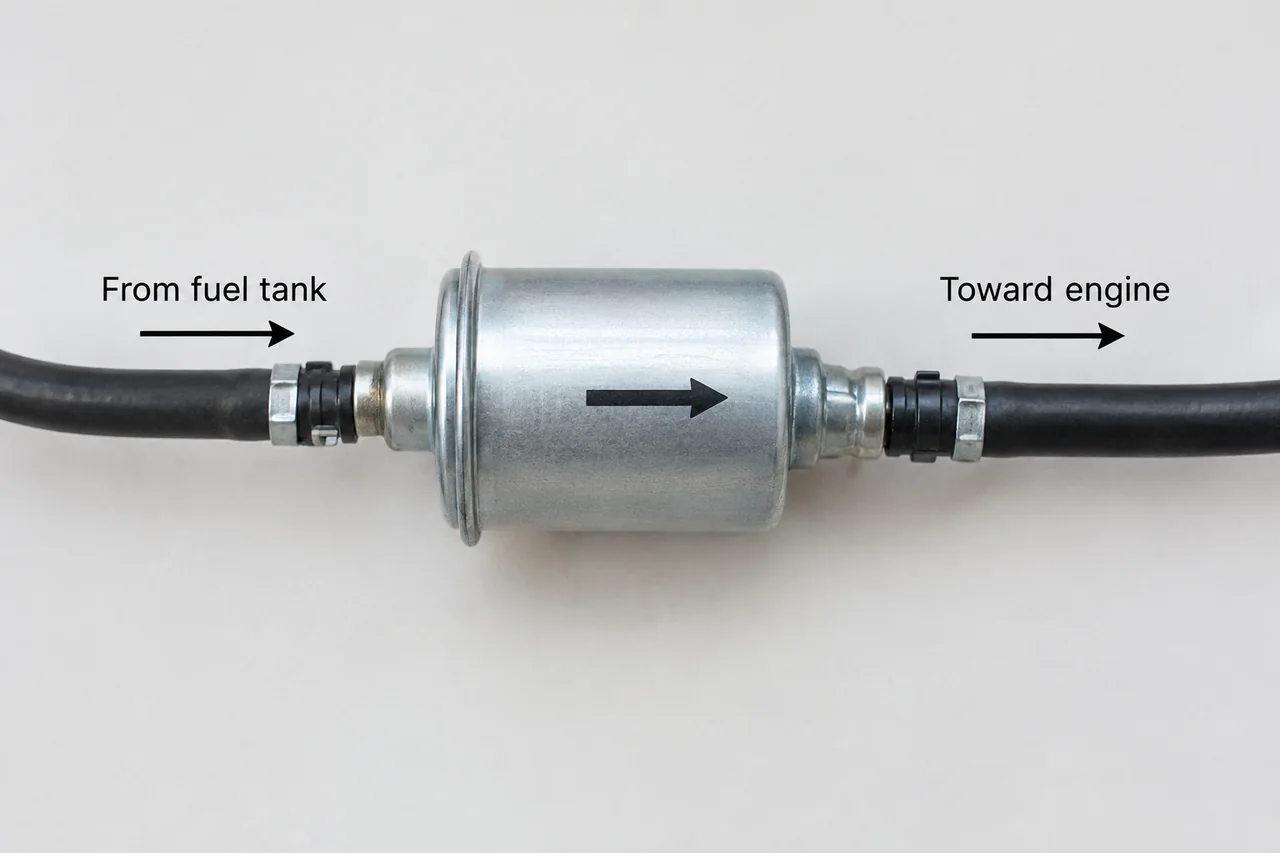
Choosing the direction of a fuel filter starts with matching an inline housing to the intended fuel filter direction of flow in the fuel supply line. Which direction that filter faces is not a guess based on vehicle front or rear. For a directional filter, the correct inline fuel filter direction follows fuel from the tank toward the engine. Confirm the part number and flow arrow before treating the housing itself as a guide.
Fuel Filter Direction Follows the Fuel Supply Path
The flow arrow on an inline filter shows the intended fuel filter flow direction through the media, from filter inlet to filter outlet. When that housing is in the engine's fuel supply line, the arrow should follow fuel from the tank toward the engine. Direction of an inline fuel filter is therefore a routing question, not a styling choice. If the line snakes around a frame rail, the arrow still follows the fuel, even when the hose itself turns.
Vehicle front, rear, up, and down do not independently set in-line fuel filter direction, because a fuel supply line can reverse, rise, or loop. An arrow pointing toward the firewall is correct only if that is actually the downstream path on that vehicle. Keep this guidance to inline supply-line filters. Return lines, vapor lines, and pump-module screens follow different layouts. When routing is hidden, clipped, or shared with other hoses, use the vehicle's service information rather than assuming the filter faces the same way as a neighbor's similar model.
Read the Arrow and IN/OUT Markings Correctly
On a directional filter, the arrowhead identifies the downstream fuel filter direction of flow, so the pointed end faces toward the engine side of a supply-line installation. Stamped IN and OUT labels identify the filter inlet and filter outlet even when the housing sits at an odd angle. Do not treat a brand logo, a raised rib, a date code, or a molding parting line as a flow arrow. Those features exist for manufacturing and branding. Only a dedicated flow marking, or paired IN and OUT text, shows which direction the fuel filter should face.
Installation markings still need a check against the instructions for that exact part number, because aftermarket housings reuse similar bodies with different internals. A filter sold for low-pressure suction use is not oriented by the same rules as a high-pressure line unit even if both are described as inline. Position relative to the fuel pump is also not a universal orientation rule. Some layouts place the filter before the pump, others after it, and a few use more than one filter. Pump location tells you system layout, not which port is the inlet.
Confirm Orientation When an Inline Filter Has No Clear Arrow
If the housing has no readable flow arrow, start with the filter part number, the carton, and the manufacturer's installation sheet rather than guessing the direction of an in line fuel filter from the hose run alone. Paint, road film, and heat can hide stamped text that is still documented on the package. A catalog listing for that part number may show which port is the inlet even when the metal is blank. Photograph any remaining markings on the existing filter before a shop removes it so those clues can be compared later.
Housing taper, a larger connector on one end, and a glimpse of media through a clear bowl do not reliably establish filter inlet and filter outlet. Those details can be packaging convenience or a bypass feature, not a flow map. Use in either direction is acceptable only when the exact filter's documentation says so. If the part is unmarked, the paperwork is missing, and application suitability is still unclear, stop short of installing or running the vehicle. Have the filter identified professionally so the direction of fuel filter flow is confirmed for that system.
What Can Happen If an Inline Filter Is Backward?
A reversed inline fuel filter does not produce one standard failure. Internal design decides whether backward installation mainly changes how fuel restriction builds, how particles are trapped, or how a bypass or check feature behaves. Some directional filters use a one-way support for the media; others rely on an inlet geometry that is not mirrored at the outlet. Because those internals vary by part number, do not assume every reversed housing will starve the engine, dump debris, or look identical on inspection. The fuel filter direction of flow must be judged from that filter's construction.
Hard starting, hesitation, loss of power, or stalling can appear when fuel delivery is limited, and a reversed filter is one possible contributor among clogged media, a weak pump, or a leaking line. Those symptoms are not proof of reversed installation. An engine that starts and idles normally also does not prove correct orientation or that the filter suits the vehicle. Seeing a flow arrow facing the tank confirms a reversed marking. Proving that reversal caused a running problem still requires comparing delivery, restriction, and the rest of the fuel path.
Safe Observations Before Any Further Work
Owner checks should stay at visible installation markings, the filter part number, and printed documentation, with the engine off and cool. Look at the flow arrow and IN or OUT text without moving the housing. Note how the fuel supply line approaches each port so you can compare that path to the markings. Do not crawl under a hot exhaust or rest on a warm catalytic converter to read a stamp. If the filter is not safely reachable from the ground with the vehicle parked and supported as it sits, stop at documentation.
Fuel systems can hold pressure after shutdown, so do not disconnect lines, crack fittings, open the filter, or try to test flow with exposed fuel. Those steps belong to a shop with the right relief method and fire precautions. Fuel odor, visible wetness, or dripping at the housing or nearby hoses is a reason to stop work and avoid starting or driving. Wipe nothing that is actively leaking. When reading the in-line fuel filter direction would require lifting the vehicle or disturbing fuel connections, leave the job to a technician.
Resolve Uncertain Orientation and Persistent Symptoms
A technician can work faster when you bring vehicle identification, the filter part number, photos of any readable markings, and a timeline of when symptoms began. Include whether the housing was just replaced and whether the flow arrow was copied from the old unit or from memory. Note fuel type if the vehicle can run more than one. That package lets the shop confirm inline fuel filter direction against the supply path without repeating guesswork. It also separates a marking question from a longer fuel-delivery complaint that started on a different date.
Physical fit does not prove the filter matches the vehicle's fuel type, pressure needs, or connection style. A housing that threads on can still be the wrong rating or the wrong media. After identifying the part, a technician should decide whether a backward filter can be reoriented or must be replaced, using its condition and manufacturer guidance. Crushed media, debris in the outlet, or damaged seals argue for replacement. Once orientation is corrected, professional leak checks and fuel-delivery testing are the right next steps if running symptoms persist.