Ford Super Duty Transfer Case Shift Motor Identification
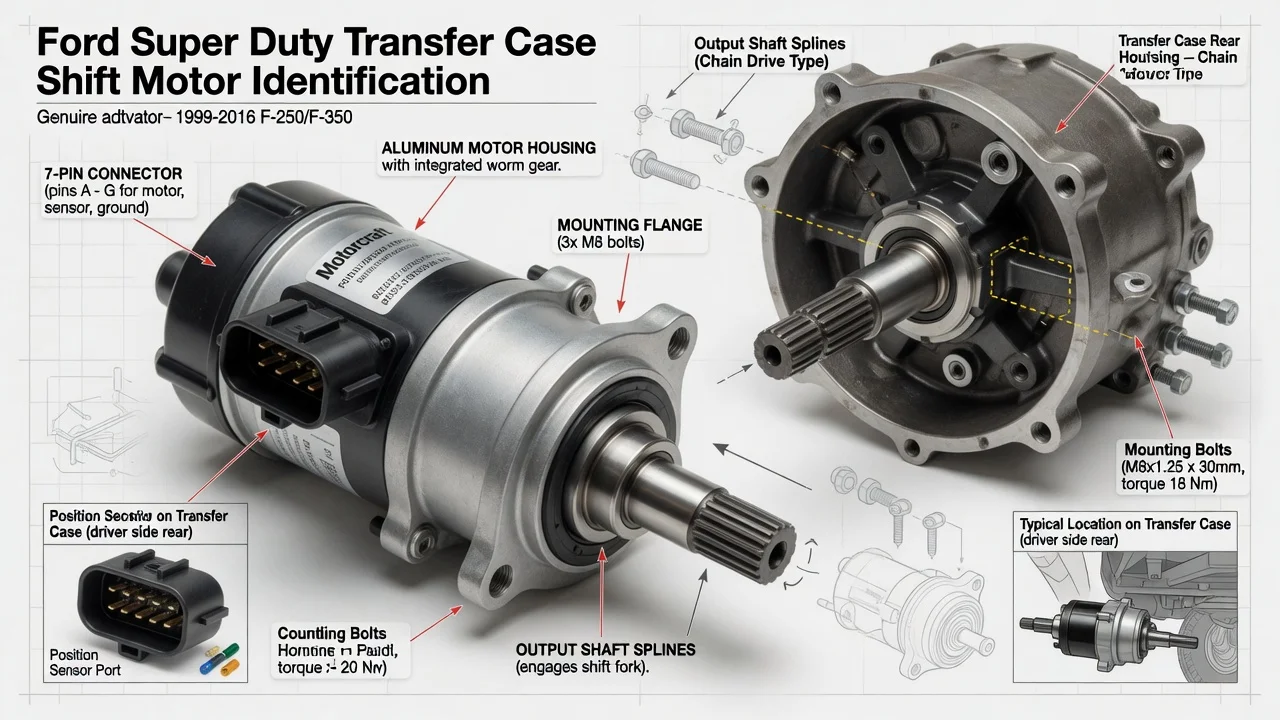
On a four-wheel-drive Ford Super Duty with a dash-mounted 4x4 selector, an electric shift motor on the transfer case moves it between drive ranges. When 4WD stops engaging, the motor is often suspected, but many Super Duty configurations exist across model years. Ordering the wrong unit wastes time and money. This guide explains how to identify the shift motor your truck actually uses, what changes the answer, and when to rely on dealer or service information.
The short answer
First confirm that your truck has a shift motor. Super Duty 4x4 trucks with a floor-mounted transfer case lever are mechanically shifted and do not use one. Trucks with a rotary knob or push buttons on the dash use electronic shift-on-the-fly, and those transfer cases carry an electric shift motor.
If your truck is electronically shifted, the most reliable identifier is the VIN. A Ford dealer parts counter or a parts catalog that decodes the VIN can match the motor to your exact build. The second identifier is the hardware. The transfer case has an identification tag with its model and serial information, and the motor housing usually carries a stamped or labeled part number. Matching both the VIN lookup and the physical numbers is the safest way to get a motor that fits and communicates correctly with the truck.
How the shift motor works
The shift motor is a small electric gear motor bolted to the outside of the transfer case. Its output engages the transfer case shift shaft. When you turn the 4x4 selector, a control module checks the conditions for the request and powers the motor. The motor rotates the shift shaft, which moves the internal shift fork and selects two-wheel drive, four-high or four-low.
Most of these motors also contain a position sensor, often called an encoder, that reports the shaft position back to the control module. The module uses that signal to stop the motor in the right place and to set the dash indicator. A fault therefore does not always mean the motor windings have failed. A worn encoder, a corroded connector, a damaged wire or a control module problem can produce similar symptoms. Typical complaints include a flashing 4x4 indicator, no engagement, engagement that will not release, or a motor that runs without completing the shift.
What changes the correct part
Model year is the biggest variable. Ford has used different transfer cases, shift motors, connectors and control strategies across Super Duty generations. A motor that looks similar from one generation may have a different mounting pattern, shaft engagement, connector or electrical behavior. Changes can also occur within a model year, so the build date can matter as much as the year on the registration.
Vehicle configuration also matters. Engine, chassis type such as pickup versus chassis cab, and installed options can affect which transfer case was fitted and how 4WD is controlled. Front hub type can change the overall 4WD system, even when it does not change the shift motor itself. A replaced transfer case, a previous repair with a used part, or an aftermarket conversion can also mean the truck no longer matches its original build. That is why the numbers on the installed parts should be checked against the VIN result instead of trusting either one alone.
What you can do as an owner
Start with the paperwork. Record the full VIN, the model year and build date from the door jamb label, and any service history involving the transfer case or 4WD system. Ask whether the transfer case or motor has been replaced before. A prior swap changes how much the original build data can be trusted.
Next, do a careful visual inspection with the truck parked safely on level ground and the engine off. Locate the motor on the transfer case and clean around it before reading any labels. Photograph the transfer case tag, the number on the motor housing, the electrical connector and the mounting bolt layout. Check the connector and harness for corrosion, broken locks, chafed insulation and mud packed into the terminals, since these problems are common on underbody components.
If you remove the motor, mark its orientation and note the position of the shift shaft before you take it off. The replacement motor needs to align with the shaft, and the correct preparation and installation steps depend on the specific transfer case. Follow the service procedure for your truck instead of forcing the motor into place. When ordering, give the parts supplier the VIN and the numbers from the installed motor, and compare the new part's connector and mounting to your photos before installing it.
Limits and when to get professional help
Identifying the correct motor does not confirm that the motor is the cause of the fault. Proper diagnosis usually means reading stored codes, checking power and ground at the motor, and reviewing the encoder signal with a scan tool or wiring diagram for your exact truck. Replacing a motor without those checks can leave the real problem in place, especially if a fuse, relay, wiring fault or control module is involved.
Some trucks also need a module procedure or calibration after the motor is replaced, while others do not. That requirement depends on the specific configuration and should come from manufacturer service information, not general advice. If the numbers on your hardware do not match the VIN lookup, if labels are missing or unreadable, or if the 4WD fault comes with grinding, binding or noise from the transfer case, have a qualified technician inspect the truck. Internal transfer case problems can look like a shift motor failure, and a new motor will not fix them.