Ford Ranger Fuel Pump Relay: Identification and Location
Introduction
The fuel pump relay on a Ford Ranger is an electrically controlled switch that allows the powertrain control module to operate the fuel pump. When the relay closes, battery voltage reaches the fuel pump and pressurizes the fuel system. Readers commonly search for the relay when the engine cranks but will not start, or when they are preparing to test the fuel pump circuit. Because Ford used different power distribution boxes across model years and engines, the relay is not always in the same physical position. The identification process therefore starts with confirming the applicable model year and engine before using a relay box diagram or checking the under-hood fuse panel.
What the Fuel Pump Relay Does
The fuel pump relay is a control-circuit component, not the fuel pump itself. In most Ford Ranger applications, the powertrain control module grounds the relay coil for a short prime cycle when the ignition is switched on. The energized coil closes a set of contacts that connect the fuel pump power circuit. Once the engine starts, the relay normally remains energized while the engine is running. If the relay fails to close, the pump receives no power and the engine can crank without fuel pressure.
The exact control logic can differ by market and powertrain configuration. Some systems also route fuel pump power through an inertia fuel shutoff switch, which is a separate safety device that can interrupt the same circuit after an impact. When diagnosing a no-start condition, the relay is only one possible cause. A blown fuse, a tripped inertia switch, a faulty pump, a wiring problem, or a missing powertrain control module signal can produce similar symptoms.
Where the Relay Is Normally Located
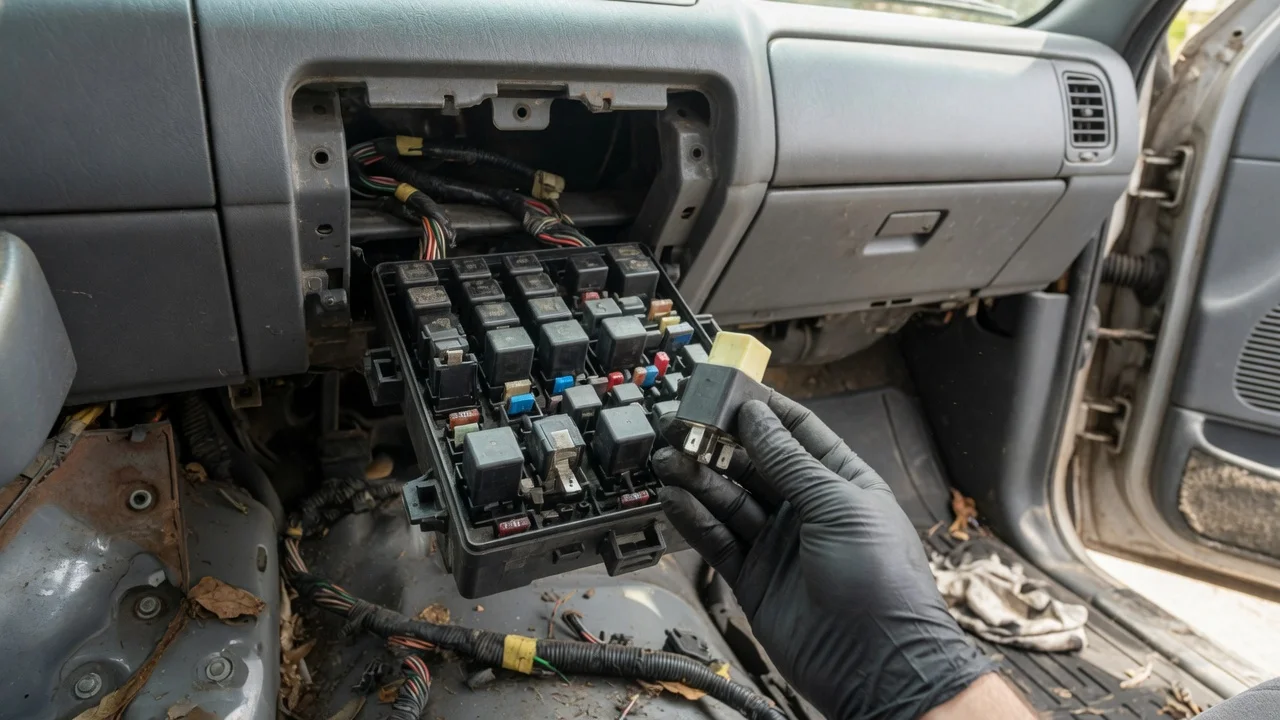
On many Ranger model years, the fuel pump relay is mounted in the power distribution box under the hood. This box is usually located in the engine compartment near the battery or the fender. It contains blade-type fuses and several plug-in relays, and its cover may include a diagram identifying each position. The fuel pump relay is often one of several relays of similar size and color, so the printed diagram is the most reliable way to identify the correct position for the specific vehicle.
Older Rangers can have a separate relay location, while some configurations may place the relay in the battery junction box or another under-hood electrical center. The passenger compartment fuse panel is not the primary fuel pump relay location in typical gasoline applications, although it may contain fuses for related circuits. A relay box diagram based on model year, engine, and sometimes market or trim is needed when the under-hood layout is not clearly marked.
How to Recognize the Correct Relay
Most fuel pump relays in these vehicles are small rectangular or cube-shaped plug-in relays with four or five blade terminals. The correct relay may look identical to relays for the horn, cooling fan, air conditioning, or other systems. Color alone is not a reliable identifier because the same relay body color can be used for different circuits. The key identifying information is the position shown in the power distribution box diagram and the circuit function printed or embossed on the box cover.
A typical relay includes two control-coil terminals and two switched-contact terminals. On a five-terminal relay, the extra terminal is usually a normally closed contact or a second output path. Before removing a relay, it is useful to note its orientation and compare the terminal pattern with the socket. If the relay fits but the vehicle application chart does not list that position as the fuel pump relay, it should not be assumed to be the correct part.
Accessing and Inspecting the Relay
Begin by parking the vehicle, switching off the ignition, and opening the hood. The power distribution box cover normally releases with simple tabs or clips. Inspect the diagram on the inside or outside of the cover and locate the position labeled for the fuel pump. If the label is missing or illegible, the relay should not be removed arbitrarily. The correct position should be confirmed with documentation for the applicable model year, engine, and market before any electrical testing or replacement.
A relay that is being tested can be removed carefully by pulling it upward from its socket. The socket terminals should be checked for corrosion, looseness, or heat damage. A relay that clicks does not prove that its contacts are passing current. A relay that does not click may have a failed coil or may not be receiving the expected control signal. In that situation, the fault can also be in the control side of the circuit rather than the relay itself.
Basic Circuit Checks Without Guessing
A practical approach is to first verify the related fuel pump fuse and the power distribution box feed. If the relay is suspected, it can be temporarily swapped only with a relay known to be the same part number and circuit type. Swapping with a different circuit relay may be misleading if the replacement relay is not electrically equivalent. Listening for the fuel pump during the ignition-on prime cycle can help, but a quiet pump does not by itself identify the failed component.
Relay terminal identification should come from the official wiring diagram for the exact Ranger configuration. The material available here does not reproduce a confirmed year-by-year pinout or power distribution box position chart, and such details should not be guessed. If testing the relay coil or contacts with a multimeter, check continuity and voltage according to the vehicle-specific diagram rather than treating all similar relays as interchangeable.
Replacement and Final Identification
Before installing a replacement, compare the part number, terminal arrangement, and electrical rating with the original relay and the application information for the vehicle. Insert the relay squarely into the correct socket and make sure it is fully seated. After replacement, the key check is not simply that the engine starts once, but that the fuel pump circuit operates correctly during the priming function and while running.
Because the fuel pump relay can be confused with other relays in the same power distribution box, the deciding reference remains the diagram for the specific Ford Ranger configuration. If no legible diagram is present, obtain the correct power distribution box chart for the model year and engine before removing or replacing a relay. This avoids disturbing an unrelated circuit and gives the best chance of resolving the no-fuel-pressure condition accurately.