Ford Locking Hubs Explained
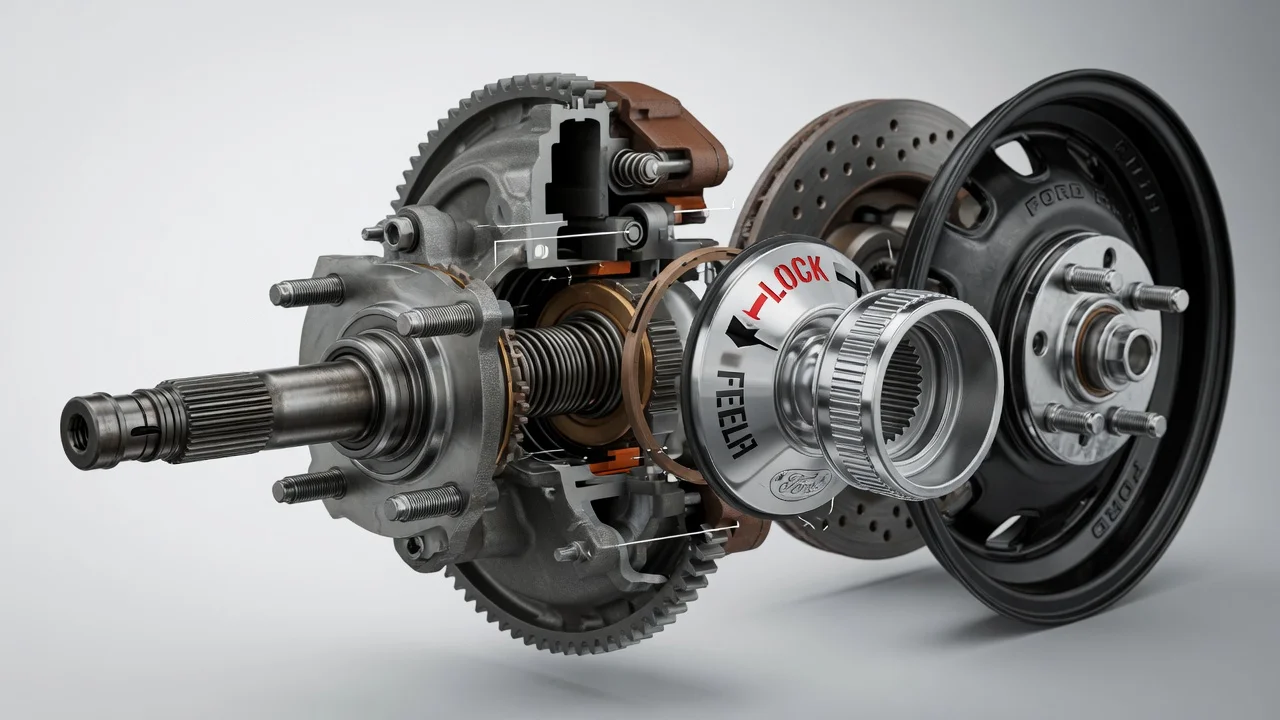
Locking hubs decide whether a Ford's front wheels are connected to the front axle shafts. They explain why some trucks need a hand-turned dial before four-wheel drive works, why others engage on their own, and why a front-end grind in two-wheel drive often points to the hubs. This guide covers how Ford locking hubs operate, which designs appear on part-time four-wheel-drive models, and what an owner can check before calling a shop.
The short answer
Ford locking hubs are couplers at the front wheels of part-time four-wheel-drive trucks and SUVs. When they are locked, they join each front wheel hub to its axle shaft so the front differential can drive the wheels. When they are unlocked, the wheels spin freely on their bearings. The front axle shafts, differential and driveshaft then stay mostly still, which reduces drag and wear during normal two-wheel-drive driving. Hubs alone do not create four-wheel drive. The transfer case must also be shifted into a four-wheel-drive range, and on most systems both hubs must be engaged for the front axle to deliver power. Depending on the vehicle configuration, a Ford may use manual hubs turned by hand, automatic hubs that lock mechanically when torque is applied, or vacuum-actuated hubs controlled by the truck. Full-time four-wheel-drive and all-wheel-drive Fords typically do not use locking hubs at all.
How locking hubs work
The outer end of each front axle shaft carries splines. A sliding clutch ring or gear sits between those splines and the wheel hub. In the locked position, a spring or actuator pushes the ring into engagement with both parts, so the shaft and the wheel turn as one. In the free position, the ring retracts and the axle shaft is no longer tied to the wheel.
Manual hubs use a dial in the center of each front wheel, marked with positions such as lock and free. Turning the dial moves a cam that sets the clutch ring. The driver has to get out and turn both dials, usually with the vehicle stopped. Automatic mechanical hubs replace the dial with a mechanism that locks once the front driveshaft starts delivering torque after the transfer case is shifted. Many of these release only after the transfer case returns to two-wheel drive and the vehicle is driven a short distance in the opposite direction. The owner's manual gives the exact procedure. Vacuum-actuated designs, often called integrated wheel ends on F-150 models, route engine vacuum through a solenoid and hoses to a sealed chamber at each hub. On many of these systems, vacuum holds the hub disengaged. A loss of vacuum can therefore let a hub engage when it should be free.
What changes the answer for your Ford
The right explanation depends on model, year, drivetrain package and any aftermarket changes. Many Super Duty trucks combine automatic engagement with a manual override dial marked auto and lock, and the override can be used if the automatic function fails. Older F-Series, Bronco and Ranger models commonly have manual or automatic mechanical hubs. Many later F-150 trucks have no visible dial because their hubs are vacuum controlled. A previous owner may also have converted automatic hubs to manual units, which changes both operation and the correct service procedure. For that reason, the service history matters as much as the original build.
Operating conditions also matter. Mud, deep water and freezing temperatures can contaminate or stiffen hub internals. Water that enters a vacuum chamber or a manual hub housing can cause corrosion, which makes engagement unreliable. Lubricant that has thickened from age or cold can slow an automatic hub. Larger tires and lift kits do not change how hubs lock, but they increase the load on hub and bearing components. Running four-wheel drive on dry pavement is mainly a transfer case and driveline concern, yet it can stress hub parts too. Follow the manufacturer specifications for when four-wheel drive should be used.
What the owner can do
Start by identifying the hub type. A dial or knob at the center of each front wheel means manual hubs or hubs with a manual override. A plain cap with no control usually indicates automatic mechanical hubs or a vacuum-actuated system, and the owner's manual and four-wheel-drive controls will confirm which. With manual hubs, set both dials to the same position and turn each one fully until it seats. A dial left between positions can leave the clutch ring partly engaged. Shift the transfer case into four-wheel drive only when the hubs are locked, and unlock them after returning to two-wheel drive.
Several symptoms point to the hubs. A grinding, ratcheting or clicking noise from one front wheel in two-wheel drive, especially at low speed or under acceleration, often means a hub is partly engaged. On vacuum systems, a leaking hose, cracked fitting or failed seal is a common cause. If the four-wheel-drive indicator comes on but the front wheels do not pull, the hubs may not be locking, although the transfer case, shift motor or front axle can produce similar symptoms. A manual dial that will not turn, turns without clicking into position, or feels gritty needs inspection rather than force.
During routine inspection, look for cracked or loose hub caps, missing O-rings, rust streaks around the hub, and damaged vacuum lines near the steering knuckles. Many owner's manuals recommend engaging four-wheel drive briefly at regular intervals to keep front driveline parts lubricated. Whether and how often to do this depends on your vehicle's maintenance schedule rather than a universal rule. Record any hub service, seal replacement or conversion in the service history, so the next diagnosis starts from known facts.
Limitations and when to get help
This overview describes common designs and cannot confirm how a specific Ford is built. Hub type, vacuum logic, override procedures, lubricant type and torque values vary by model and year. Before ordering parts or disassembling a hub, check the owner's manual, factory service information or a dealer lookup based on the VIN. Do not assume a vacuum hub behaves like a manual hub. Do not reroute or plug vacuum lines as a quick fix unless the service procedure for your truck allows it.
Professional help is the safer path in several cases: a hub grinds continuously, a wheel bearing feels loose, or four-wheel drive will not engage even though the hubs are confirmed locked. The same applies when diagnosis requires vacuum testing, scan tool checks of the four-wheel-drive module, or removal of axle components. Front hubs share space with wheel bearings and brake parts, and incorrect reassembly can affect steering and braking. A qualified technician can test the system, confirm the correct parts for the vehicle configuration, and explain whether repair, replacement or conversion makes sense.