Ford Fuel Pump Driver Module Codes P1233, P1235, P1237 and P1238 Explained
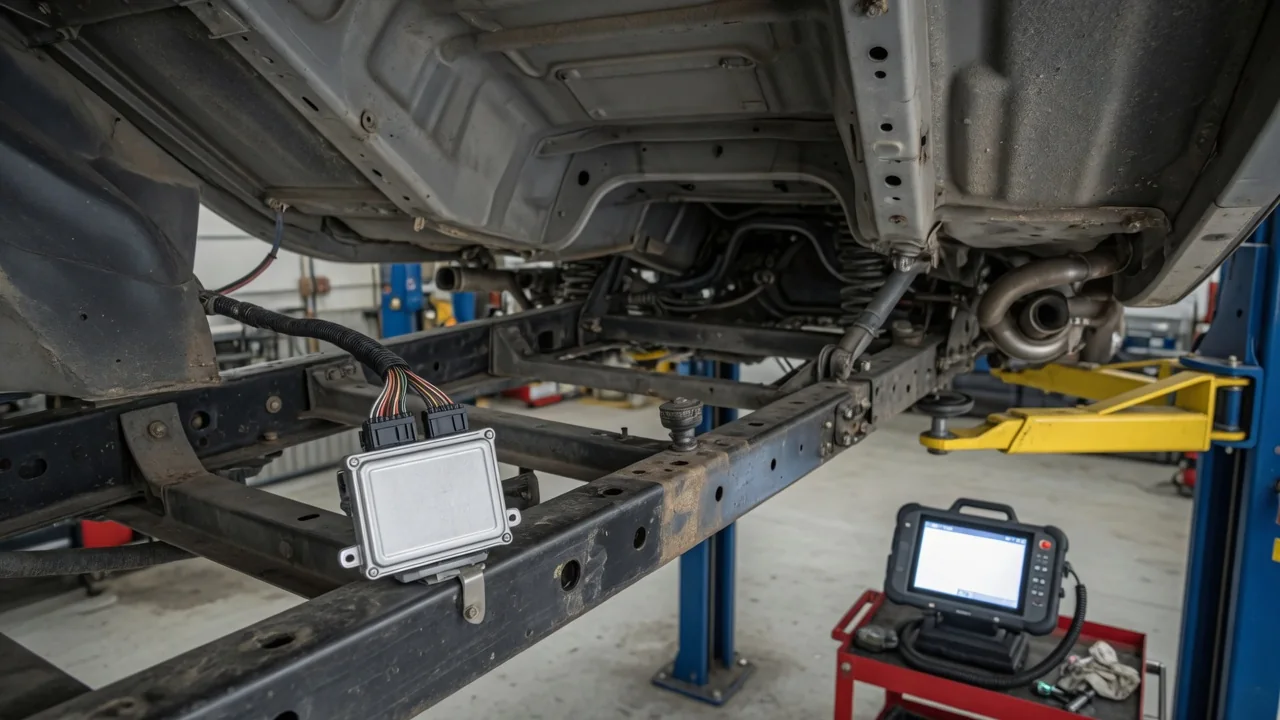
When a Ford suddenly cranks but won't start, loses power, or stalls, trouble codes like P1233, P1235, P1237, and P1238 often point to the fuel pump driver module (FPDM) and its control circuit. These manufacturer-specific codes can be confusing because they overlap in symptoms and causes. Understanding how the powertrain control module (PCM) commands the FPDM and how the module responds is key to diagnosing the fault—before spending money on parts that may not be the problem.
How the Ford Fuel Pump Driver Module and PCM Control the Fuel Pump
On many Ford models, the PCM does not power the fuel pump directly. Instead, it sends a low-current command signal to a separate FPDM, which then varies the voltage or duty cycle to the pump. This lets the PCM control fuel delivery pressure precisely in returnless fuel systems, where the pump speed alone sets pressure. The PCM also receives feedback from the FPDM to confirm the pump is operating as commanded, completing a monitoring loop that is central to these four codes.
Because the PCM and FPDM share both control and diagnostic responsibilities, a fault anywhere in that chain can set related codes. The module's physical location and the harness routing vary by model and year—some FPDMs are mounted under the spare tire area, others along the frame rail or near the fuel tank. Before interpreting any specific code, check your exact vehicle's service information to confirm where the module lives, how it is wired, and what the code definition truly means for that application.
P1233 Code: Fuel Pump Driver Module Disabled or Offline
Ford's typical description for P1233 is 'Fuel Pump Driver Module Disabled or Offline.' In practice, 'offline' means the PCM no longer sees the expected feedback or handshake from the FPDM. The module may have lost power, lost ground, suffered an internal failure, or simply stopped communicating over the control circuit. The code does not prove the module itself has failed—it only says the PCM has lost contact.
When P1233 sets, the fuel pump may not run at all if the module truly lost its enable signal, leading to a crank-no-start. If the fault is intermittent, the engine may start and then stall or hesitate as the module drops offline. Because a bad ground, corroded connector, chafed wire, or blown fuse can mimic a dead module, replacing the FPDM without first checking power, ground, and circuit continuity often fails to cure the problem.
P1235 Code: Fuel Pump Control Out of Range
P1235 is commonly listed as 'Fuel Pump Control Out of Range.' This means the PCM expected a certain fuel pump duty cycle or feedback signal, but the reported value fell outside acceptable limits. The mismatch can come from a driver module that cannot regulate output correctly, a pump circuit drawing an abnormal current, a voltage supply issue, or even a software calibration problem in some modules.
Drivers may notice hesitation when accelerating, low power under load, or intermittent stalling. In other cases, the check engine light appears with no obvious drivability change. Freeze frame data is valuable here: the coolant temperature, engine load, and whether the engine was cranking or running when the fault set can reveal whether the problem is temperature-dependent, load-related, or triggered only during a start attempt—clues that narrow the diagnostic path.
P1237 and P1238 Codes: Fuel Pump Secondary Circuit Faults
P1237 and P1238 are generally described as fuel pump secondary circuit faults, but the exact wording and the specific circuit each code monitors can differ by vehicle and model year. The 'secondary' circuit usually means the high-current output side from the FPDM to the fuel pump—the wiring, connectors, and pump motor itself—rather than the low-current control side between the PCM and FPDM. Always verify this in your vehicle's wiring diagrams.
A damaged harness, poor connection at the pump or module, a pump drawing excessive or insufficient current, or a faulty driver output transistor can all trigger P1237 or P1238. These codes often appear alongside P1233 or P1235, because a failing module may set an offline code while the secondary circuit monitor catches a problem. When multiple codes are present, a technician can compare freeze frame timestamps and circuit conditions to identify a common root cause rather than chasing each code independently.
Shared Symptoms and Safe Observations Before Diagnosis
These fuel pump control codes share several symptoms: a no-start or an extended crank before the engine fires, stalling at idle or while driving, surging at steady speed, hesitation under load, and an illuminated check engine light. Some owners also notice a loss of power on hills or during hard acceleration. Because the symptoms overlap heavily, the code alone rarely pinpoints the failed component.
Before taking the vehicle to a shop, make safe observations. Note whether the problem occurs only when cold, after driving through rain or standing water, or on rough roads—conditions that point toward connector corrosion, water intrusion, or harness chafing. Look only at any visible wiring near the suspected module location; do not touch or disturb connectors. Record all stored and pending codes plus freeze frame data before clearing anything, because clearing erases the snapshot of conditions that triggered each fault.
Common Causes and What Professional Testing Involves
Common causes include corroded or loose connectors, damaged wiring, poor power or ground supplies to the FPDM, a fuel pump drawing abnormal current, an internally failed FPDM, or less often a PCM fault. A professional test usually begins with circuit integrity and voltage drop checks, then moves to scan-tool monitoring of module status, command duty cycle, and feedback. Actual fuel delivery pressure or volume may be tested to confirm the pump itself can meet demand.
Guessing and replacing parts without diagnosis often costs money without fixing the fault. A no-start, stalling in traffic, any fuel odor, or a visible fuel leak warrants immediate professional attention. Fuel systems retain pressurized, flammable fuel, so do not disconnect lines, open the tank, or bypass electrical components. When taking the vehicle in, ask the shop to confirm the exact vehicle-specific code definition and show test results before approving parts—do not promise repair costs or part availability.
What P1233, P1235, P1237 and P1238 Mean on Non-Ford Vehicles
P1xxx codes are manufacturer-specific. A code like P1233 on a Ford may mean something completely different on a GM, Chrysler, Toyota, or even another Ford platform with different module naming. The 'P' means powertrain, the first '1' indicates manufacturer control, and the remaining digits are assigned by that manufacturer. Applying Ford's fuel pump descriptions to another brand can mislead a repair entirely.
For any make, confirm the code definition using a scan tool with manufacturer-specific coverage or official service information for the exact make, model, year, and engine. The diagnostic approach is identical across brands: confirm the definition, record all data and freeze frame information, make safe observations about symptoms and conditions, and obtain professional circuit and component testing before replacing parts. Leave unsupported exact details to the service information rather than guessing.