Ford F-250 Transfer Case Shift Motor: Identification by Model Year
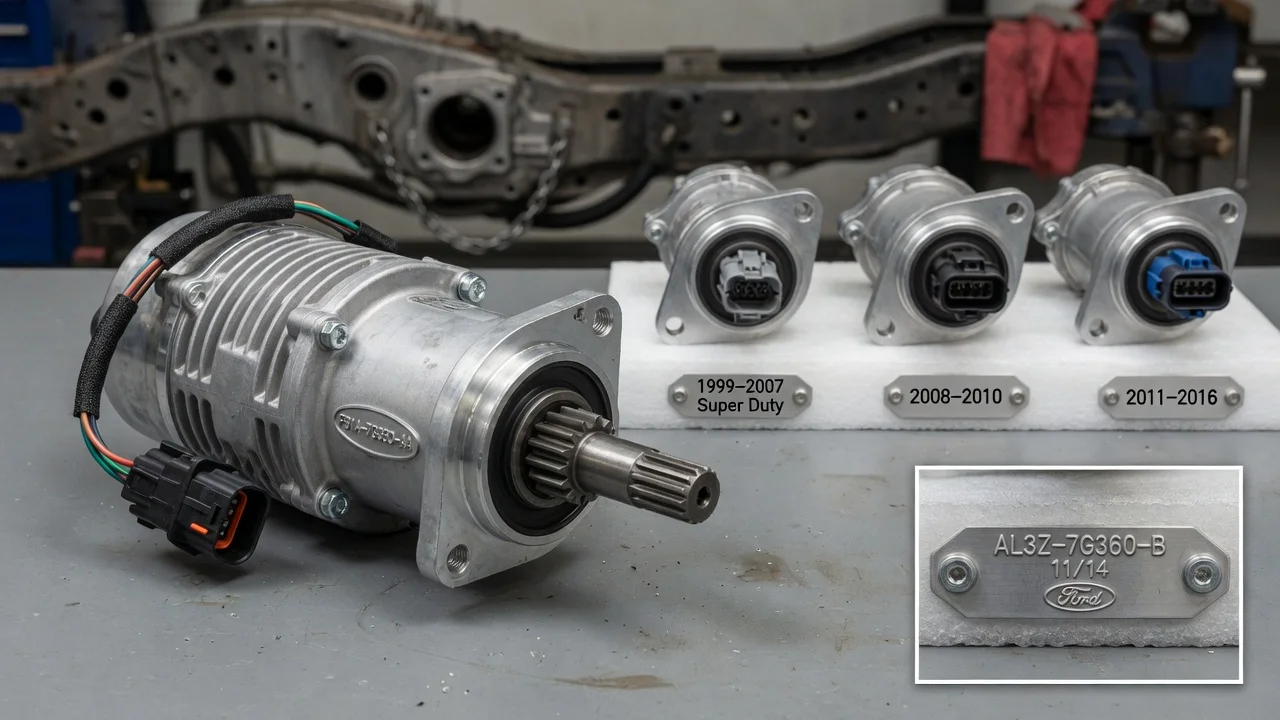
A transfer case shift motor is the electric actuator that moves an F-250 transfer case between two-wheel drive, 4-high and 4-low on trucks with a dashboard switch or buttons for four-wheel drive. To find the right one, first confirm that your truck actually has electronic shift. Then match the exact model year, build details and part number instead of relying on the year alone. The same approach applies to a 2000, 2002, 2005 or 2006 truck.
The short answer
Identify a Ford F-250 transfer case shift motor by three things together: the model year, the type of four-wheel-drive control, and the part number on the motor or in Ford parts data for your VIN. If the truck shifts with a floor lever, there is no shift motor to replace and the problem lies elsewhere. If it uses a dashboard switch or buttons, the motor is bolted to the transfer case and matched to that transfer case and its control system. Since the 1999 model year the F-250 has been built as a Super Duty. Parts for earlier F-250s, including the light-duty version sold in the late 1990s, do not interchange with it. Applications also change within the Super Duty years, so confirm any motor listed for a span of years against your exact truck before you buy it.
How the shift motor works
When you select a range on the dash, the four-wheel-drive control logic checks conditions such as vehicle speed and gear selection, then powers the shift motor. The motor turns a shaft on the transfer case, which moves the internal shift mechanism into the requested range. Most electronic-shift units also contain a position sensor that reports the motor position back to the control module. That feedback is how the system knows the shift has finished and whether to light or flash the 4x4 indicator.
Driving the front axle also depends on the front hubs. Depending on the truck, the hubs may be manual or they may lock automatically, for example by vacuum. A truck with a perfectly good shift motor can still fail to drive the front wheels if the hubs or their controls are not working. The motor is one link in a chain, not the whole system.
What changes the answer
Model year sets the starting point, not the final answer. If you need a part for a 2000 or 2002 F-250, first check how the truck shifts. Lever-shift transfer cases were common in that period, and only electronic-shift trucks use a motor. A 2005 or 2006 F-250 belongs to the same first Super Duty generation but received updates for the 2005 model year, so confirm the part number before assuming a motor listed for an earlier truck will fit. Later generations brought further changes to the transfer case, wiring and control modules.
Vehicle configuration also matters. Cab and bed choices rarely affect the motor, but transfer case type, transmission and the way the front hubs lock can. A truck may also differ from its original build if the transfer case, motor or wiring was replaced in the past, so service history can matter as much as the factory record. Operating conditions affect how these motors fail. The motor sits under the truck, where road spray, salt and mud reach its connector. A truck that rarely uses four-wheel drive can also develop sticking or corrosion from disuse.
Checks you can make before buying a motor
Start with what you can see. Note whether the truck has a shift lever or a switch, then get under the truck and inspect the motor on the transfer case. Check the connector and harness for corrosion, broken locking tabs, chafing against the frame and damage from debris. Write down any part number stamped or printed on the motor housing, together with your VIN. If the motor has been replaced before, the number may belong to an aftermarket supplier rather than Ford, so compare it with the Ford listing for your VIN.
Pay attention to how the fault behaves. A flashing 4x4 indicator, no change in range, clicking or humming without engagement, or a truck stuck in four-wheel drive can all point to the shift system. The same symptoms can also come from a blown fuse, a failed relay, a damaged wire, a faulty switch, a hub problem or the control module. If the motor runs but the front wheels do not drive, check the hubs. If nothing happens at all, check power and ground at the motor first.
Follow the shifting procedure in the owner's manual. Many systems will not shift into 4-low unless the truck is stopped or nearly stopped and the transmission is in neutral, so a failed attempt at the wrong speed or in the wrong gear does not prove the motor is bad. If you have a scan tool that reads four-wheel-drive or body module codes, stored codes are far more useful than guessing.
Ordering the right replacement
Give the parts supplier your VIN, model year and the number from your existing motor, and confirm that the listing specifies electronic shift and the correct transfer case. Before installing, compare the connector shape and mounting pattern with the old unit. Some motors come with a new seal or gasket and some do not, so check what is included. After installation, test every range in a safe place and confirm the indicator stops flashing. Transfer case fluid type and service are covered by your maintenance schedule and the manufacturer specifications. A motor replacement is a good time to check the fluid level, but do not use a service interval taken from another truck.
Limits and when to get professional help
This guide explains how to identify the motor, but it cannot confirm which part fits a specific truck. That depends on build data, previous repairs and the exact transfer case fitted. Ford parts data matched to the VIN, or a dealer parts counter, is the reliable way to settle compatibility. Wiring diagrams, connector pin data and module test procedures for your model year are in the factory service information.
Get a professional inspection if the truck is stuck in four-wheel drive, the transfer case grinds, codes point to the module or wiring, or a new motor does not fix the problem. Driving on dry pavement in four-wheel drive can strain the driveline. If the truck will not return to two-wheel drive, have it diagnosed promptly instead of continuing to drive it that way.