Ford F-150 Transmission Speed Sensor Identification
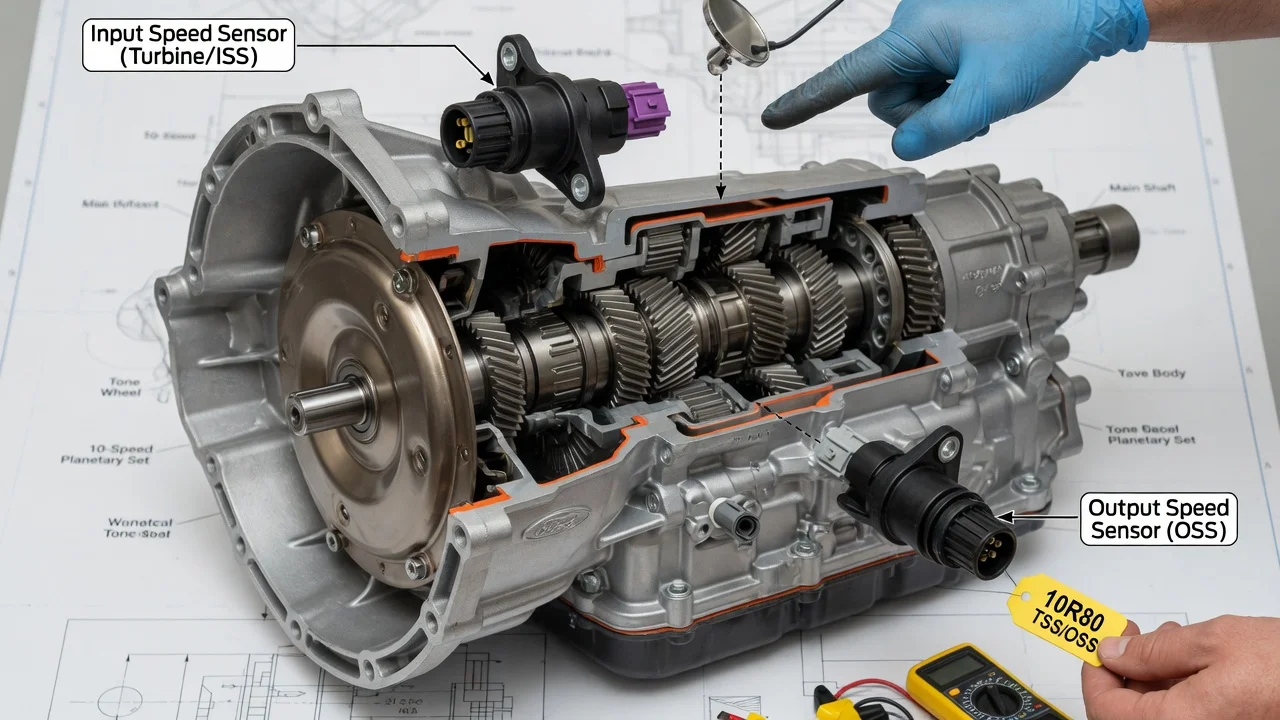
Finding the right transmission speed sensor on a Ford F-150 starts with knowing which transmission the truck has. Sensor count, location and the way the part is serviced differ between generations. This guide explains how to identify the sensors on your truck, including the 2013 F-150. It also covers what the related diagnostic codes do and do not prove, and how to choose a repair without replacing parts on guesswork.
Which speed sensor your F-150 uses
No single transmission speed sensor fits every F-150. Most automatic F-150s monitor at least two shaft speeds. An input or turbine shaft speed sensor reports how fast the torque converter output is turning. An output shaft speed sensor reports how fast the transmission output is turning. Many six- and ten-speed units also monitor an intermediate shaft. The transmission control module compares these signals with engine speed to calculate gear ratio, converter slip and shift timing.
For a 2013 F-150, the answer is narrower because that model year paired every engine with the 6R80 six-speed automatic. On the 6R80, the shaft speed sensors sit inside the transmission rather than bolting to the outside of the case. On many applications they are serviced together with an internal assembly instead of as a separate plug-in part. Confirm the exact service part for your VIN before buying anything. Listings labelled simply as an F-150 speed sensor may be meant for a different transmission or for the ABS system.
How the sensors report shaft speed
Each sensor reads a toothed surface on a rotating shaft or drum. As the teeth pass, the sensor produces a pulsing signal whose frequency rises with speed, and the control module converts that frequency into revolutions per minute. Some sensors are magnetic pickups that generate their own alternating signal. Others are Hall-effect types that need a supply voltage and return a switched signal. The sensor type determines how it is tested.
The module calculates gear ratio from input and output speeds, so a missing or erratic signal can make it believe the transmission is slipping or in the wrong gear. It usually responds by setting a code and limiting shifting to protect the clutches. That is why a sensor or circuit fault can feel like a mechanical transmission failure. On some F-150s, the speedometer and other systems take vehicle speed from the wheel speed sensors rather than the transmission output. A speedometer problem alone therefore does not point to the transmission.
What changes the answer for your truck
Transmission type is the biggest variable. Earlier F-150s used four-speed automatics from the 4R70 family, and the 2009 through 2017 generation largely used the 6R80. The 10R80 ten-speed began appearing in 2017 and became the common unit in later trucks, although some base engines kept the six-speed for a few more years. Hybrid versions use a modified ten-speed with an integrated electric motor. These units differ in sensor layout, connector design and whether a sensor can be reached from outside the case.
To identify your transmission, check the transmission code on the safety certification label in the driver door jamb, the original window sticker, or a parts or dealer lookup by VIN. Drivetrain also matters, because two-wheel-drive and four-wheel-drive trucks can differ in output components, which affects fitment. Fluid specification follows the transmission: older four-speeds generally use Mercon V, the 6R80 uses Mercon LV and the 10R80 uses Mercon ULV. If the repair requires removing the pan or valve body, the correct fluid and fill procedure are part of the job.
Reading the codes and symptoms
Diagnostic codes narrow the search but do not name a failed part. Several generic codes apply here: • P0715 and P0717 relate to the input or turbine speed sensor circuit. • P0720 and P0722 relate to the output speed sensor circuit. • P0791 relates to an intermediate shaft speed sensor circuit. A circuit code can come from the sensor, its wiring or connector, the internal harness, or the control module. Ford-specific codes and freeze-frame data add detail. Read the full code list with a scan tool that supports transmission data rather than a basic code reader.
Speed sensor faults are commonly associated with harsh or delayed shifts, unexpected downshifts, being held in one gear, erratic torque converter lockup and a warning light. The same shift behavior can also come from low or degraded fluid, solenoid faults, internal wear or software issues. Treat symptoms as clues to confirm with data.
What the owner can do
Start with the inexpensive checks. Record all stored codes and note when the problem happens, such as when cold or hot, during particular shifts or over bumps. Check the fluid level and condition using the method for your transmission, since some units have no conventional dipstick and require a temperature-specific check. Inspect the visible transmission harness and connectors for damage, oil intrusion or loose pins, especially where the main connector enters the case.
Use a scan tool that displays live transmission data to compare turbine, intermediate and output shaft speeds, either while driving safely or with the truck on a lift. If one signal drops to zero, spikes or disagrees with the others while the rest look normal, that supports a sensor or circuit problem. Review the service history as well. Recent fluid service, valve body work or software updates can be relevant, and some issues may be covered by dealer bulletins or module reprogramming for your VIN.
Repair options depend on the design. Where a sensor is external and serviced individually, replacement can be straightforward. Where sensors are internal or integrated, the job usually means draining fluid, removing the pan and working inside the transmission. Module programming or an adaptive relearn may follow, which makes this work better suited to a shop with the right equipment.
Limitations and next step
This guide describes general patterns, not the procedure for a specific truck. Sensor locations, part numbers, test values and the need for programming depend on model year, engine, transmission and drivetrain. Confirm them in factory service information for your VIN. A transmission specialist or dealer can run pinpoint tests to confirm the cause before parts are replaced. That is the right step if codes return after basic checks, if live data is inconclusive, or if the fix requires opening the transmission. Bring your codes, a note of when the problem appears and any service records. That information shortens diagnosis and helps you avoid paying for parts that were never the problem.