Ford F-150 TCC Solenoid Location: Where It Is and How to Reach It
If your F-150 shows a converter clutch code or the engine speed never drops on the highway, the TCC solenoid is a likely suspect. Before you buy parts or put the truck on stands, find out where the solenoid sits on your transmission and whether it can be replaced separately. The answer depends on which automatic your truck has, so identify that first.
Where the TCC Solenoid Is on an F-150
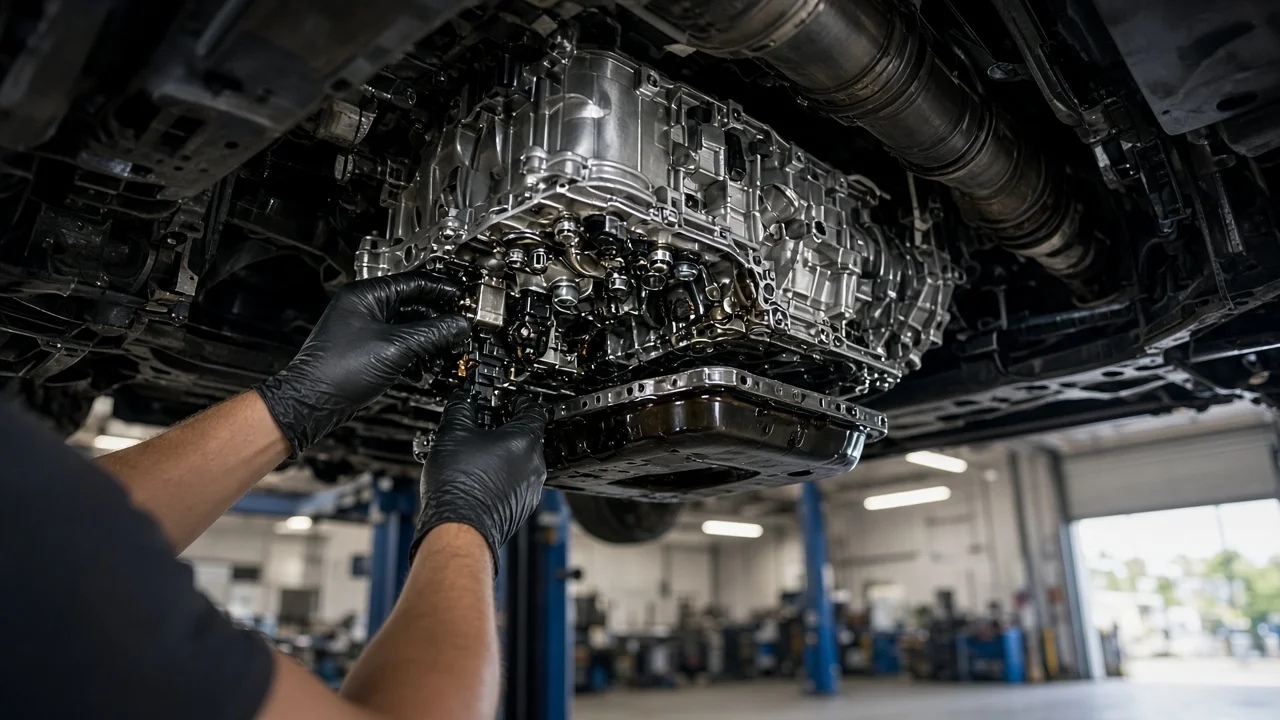
On every electronically controlled automatic used in the F-150, the torque converter clutch solenoid is inside the transmission, not on the outside of the case. It mounts on or in the valve body, the hydraulic control assembly bolted to the underside of the transmission behind the oil pan. You cannot see or test it with the pan installed. The only external part of the circuit is the wiring harness, which connects to the transmission case through a multi-pin connector.
Getting to the solenoid means draining the fluid, removing the pan, and often removing the filter. On many units the TCC solenoid is one part of a solenoid body or solenoid pack that also holds the shift solenoids and the pressure control solenoid. In that case you replace the whole assembly rather than one valve. On some designs, the valve body must be partly or fully removed before the solenoid can come out.
How the Converter Clutch Solenoid Works
The torque converter couples the engine to the transmission through fluid, and some slip is normal. Once the truck reaches cruising conditions, the converter clutch locks the engine and transmission together mechanically. That cuts slip, lowers heat, and improves fuel economy. The powertrain computer decides when lockup should happen based on speed, throttle position, gear, fluid temperature, and load.
The solenoid carries out that decision. When the computer energizes it, often with a pulsed signal for smooth, partial engagement, the solenoid moves a valve that sends hydraulic pressure to apply the clutch. When the signal stops, the clutch releases. Because the circuit includes wiring, the solenoid, hydraulic passages, valve bores, and the clutch inside the converter, a lockup problem can begin at any of these points.
What Changes the Answer: Transmission Type and Year
Ford has used several automatics in the F-150, and the right one depends on model year and engine. Older trucks with four-speed units such as the AODE, 4R70W, and 4R75 family use a solenoid body on the valve body inside the pan. Very early trucks with the original mechanical AOD have no electronic TCC solenoid. From roughly 2009 into the late 2010s, many trucks used the 6R80 six-speed. Its TCC solenoid is part of a solenoid body attached to the valve body, and a replacement unit may need its calibration data programmed with a scan tool before the transmission shifts correctly. The 10R80 ten-speed, which began appearing in 2017 depending on engine, also keeps its solenoids inside the case on the main control assembly, and its service procedures differ from earlier units.
Check the transmission code on the vehicle certification label in the driver door jamb, or decode your VIN with a dealer or reliable parts source. The fluid specification differs too. Older units generally take Mercon or Mercon V, the six-speed uses a low-viscosity Mercon fluid, and the ten-speed uses an ultra-low-viscosity version. Using the wrong fluid can cause shift and lockup problems that look like a failed solenoid. Many later trucks also have no conventional under-hood dipstick and require a level check at a specific fluid temperature.
What the Owner Can Do Before Replacing Anything
Start with the diagnostic codes. Converter clutch faults usually fall in the P0740 to P0744 range. These cover a general circuit fault, a performance or stuck-off condition, a stuck-on condition, an electrical fault, and an intermittent fault. A stuck-off code points toward slip or poor hydraulic apply. A stuck-on code may come with stalling or bucking when you stop. Electrical codes point first to wiring, connectors, or the solenoid coil. Record any shift solenoid or pressure control codes that appear alongside, because several codes together often mean a shared harness, connector, or fluid problem rather than one bad part.
Next, watch the shift behavior on a road test. Note whether rpm drops slightly at steady highway speed once lockup should engage, whether shudder appears at light throttle in the 40 to 55 mph range, and whether the problem changes as the transmission warms up. Check fluid level and condition using the correct procedure for your unit. Look over the harness and case connector for damage, oil intrusion, or corrosion. Review the service history for recent fluid changes, flushes, or software updates, since a wrong fluid or skipped relearn can produce similar complaints.
If testing confirms the solenoid circuit has failed, your repair options include replacing the solenoid or solenoid body, servicing or replacing the valve body, or addressing the converter itself. Check fitment carefully: solenoid bodies are often specific to transmission version and model year, and some must be paired with matching calibration data.
Limitations and When to Get Professional Help
A converter clutch code or a shudder does not prove the solenoid has failed. The same symptoms can come from a worn converter clutch, a worn valve bore, degraded fluid, a chafed wire, a poor connector pin, or a software issue. Replacing the solenoid without testing can cost money and leave the real fault in place. Resistance checks through the case connector, live data showing commanded versus actual converter slip, and pressure testing give a much clearer picture than codes alone.
Use the factory service information for your exact model year and transmission for torque specifications, fill and check procedures, and any required programming. If your truck has a six-speed or ten-speed, or if diagnosis points beyond the solenoid toward the converter or internal hydraulics, a transmission specialist with a capable scan tool is usually the right next step. They can confirm the cause, perform the relearn or calibration, and verify lockup on a road test after the repair.