Choosing a Ford F-150 Shift Interlock Solenoid by Model Year
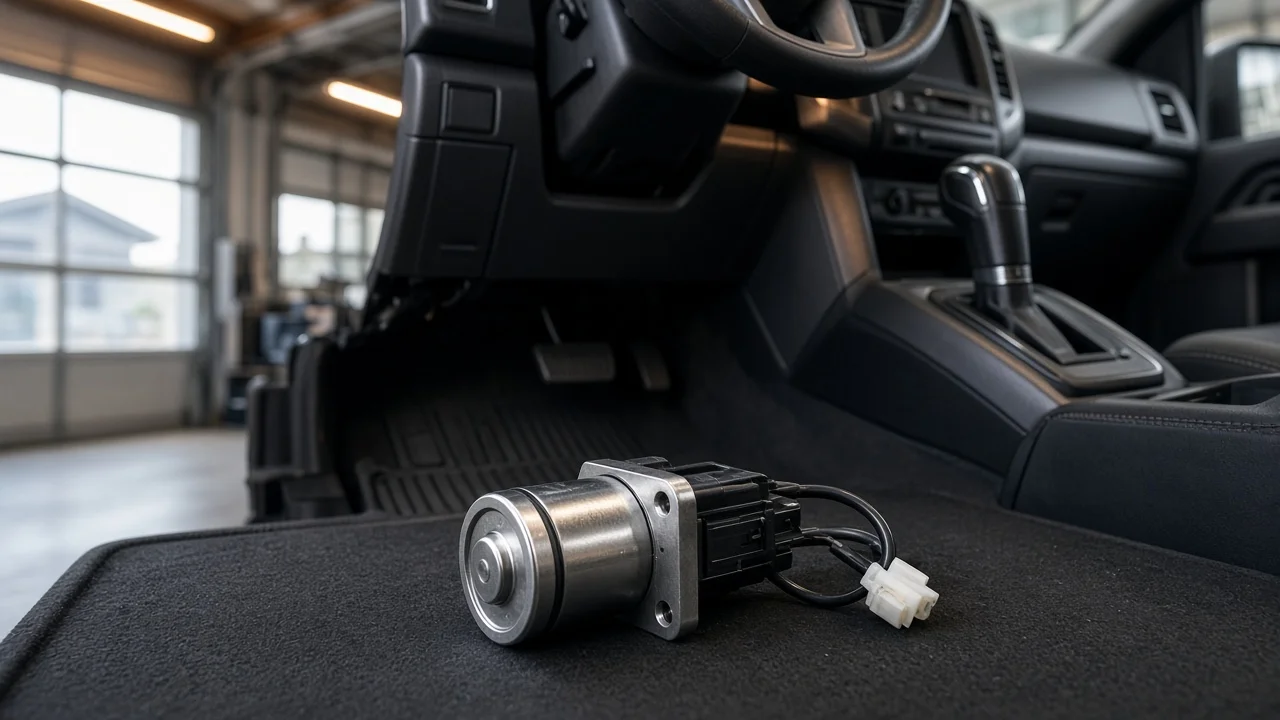
When an F-150 refuses to leave Park even with the brake pedal pressed, the shift interlock solenoid is one likely suspect, but not the only one. Choosing the right replacement starts with knowing exactly which truck you have: model year, body generation, column or floor shifter, and transmission type. This guide explains how to match an interlock solenoid to 2004 through 2010 trucks, how to judge a parts listing, and what the part cannot fix.
Define the job the product must do
The brake shift interlock keeps an automatic transmission shifter locked in Park until the truck sees the brake pedal applied with the ignition on. The solenoid is the electrical actuator that releases that lock. When it stops working, the usual shift behavior is a lever that stays stuck in Park no matter how hard you press the brake. Less often, a failed interlock lets the lever move out of Park without the brake applied, which is a safety problem worth fixing promptly even though the truck still drives.
Before ordering anything, make sure the symptom actually points to the solenoid. Check whether the brake lights come on when you press the pedal. If they don't, a blown fuse, a faulty brake pedal switch or a wiring fault can keep the interlock from releasing while the solenoid itself is fine. Try the manual shift lock release described in your owner's manual; if the lever still won't move with the override, look at the shift cable, linkage or a parking pawl loaded on a slope instead. Scanning for diagnostic codes is worthwhile, but an interlock fault may not set any code, so a clean scan does not clear the part. A click near the shifter when you press the brake is a useful clue, not proof either way.
Check compatibility by year, body and shifter
Model year alone is not enough to guarantee fitment. The 2004 model year is the clearest trap: Ford sold the redesigned F-150 alongside the carryover previous-generation truck marketed as the F-150 Heritage, and their steering columns and shifter parts are not the same. Trucks from 2004 through 2008 share the newer body, while 2009 started a new generation, so a part listed for a 2008 F-150 should not be assumed to fit a 2009 or 2010 truck, or the reverse. If you own a 2005, 2006 or 2007 model, confirm the listing names your year rather than a broad range with no further detail.
Shifter location matters as much as year. On a column-shift truck, the interlock mechanism sits inside the steering column; on trucks with bucket seats and a center console, some trims use a floor-mounted shifter with its own interlock in the shifter assembly. The two are not interchangeable, so look at your truck rather than relying on trim names. Transmission type helps the parts catalog narrow results: the 2004–2008 automatics are four-speed units, while 2009 and 2010 trucks used either a four-speed or a six-speed automatic depending on the engine. Trucks with a manual transmission don't use this part at all. Your VIN is the most reliable way to confirm the configuration.
Finally, compare the physical interfaces. Connector shape, pin count, wire length and mounting tabs should match your original part or clear photos of the correct one. If you can read a part number on the old solenoid once it is exposed, use it to cross-check the replacement.
Features that affect the choice
The biggest decision is how much of the mechanism to replace. A solenoid-only part is the cheapest option, but it assumes the surrounding lock components are in good shape and usually means more careful disassembly. An actuator sold with its bracket, or a complete shifter or lever assembly, costs more but also replaces worn plastic and pivots nearby, which can make sense on a high-mileage truck whose shifter already feels loose or binds.
Original-equipment and aftermarket parts can both work; what matters is the evidence behind the listing. Useful signs include a fitment table that names model year, shifter location and engine or transmission, clear photos of the connector and plunger, a cross-reference to the original part number, and a stated return policy and warranty. Labels such as heavy duty, OE quality or fits all F-150 trucks are marketing language, not proof of fitment. A listing that covers 2004 through 2014 with no mention of column versus floor shift deserves extra scrutiny.
Check whether a connector pigtail is included or available. If the original connector is cracked, corroded or has loose terminals, a new solenoid plugged into a damaged connector may behave just like the old one.
Limitations and ownership costs
Labor is often the larger cost. On a column-shift truck, the job means removing the column shrouds and working close to the steering wheel airbag and related wiring, so disconnect the battery and follow the airbag precautions in the service information for your year. Floor-shift trucks require removing console trim to reach the shifter assembly. Plastic clips and trim can break during removal, so budget for a few replacements.
A new solenoid cannot fix a bad brake pedal switch, a blown fuse, damaged wiring, a misadjusted or stretched shift cable, or worn linkage, and it has nothing to do with transmission internals. No fluid is involved in this repair, so fluid specification does not enter into it. If you also notice slipping, harsh shifts or delayed engagement, treat those as a separate transmission concern and check the fluid level and condition against the specification for your transmission.
Once installed, the part needs no routine maintenance. The manual override is only a way to move the truck temporarily, not a long-term repair. Your repair options range from doing the job yourself to an independent shop or a dealer. Reviewing the truck's service history and checking by VIN for any open recalls or service bulletins before you buy can save you from paying for work that may already be covered.
Build a practical shortlist
Start by writing down what you know about the truck: model year, whether a 2004 is the redesigned model or the Heritage, column or floor shifter, engine, transmission and VIN. Then confirm the diagnosis: brake lights working, fuses checked, override behavior noted and any diagnostic codes recorded. Only a truck that passes those basic checks is a strong candidate for a new solenoid.
For each part you consider, check that the listing names your exact year and shifter location, the connector and mounting match your original, the scope is clear (solenoid only, actuator with bracket or full assembly), and the warranty and return terms are stated. Drop any listing that relies on broad claims without fitment detail. Between the remaining options, choose the scope that fits the condition of your shifter, and weigh the part price against the labor needed to install it.